
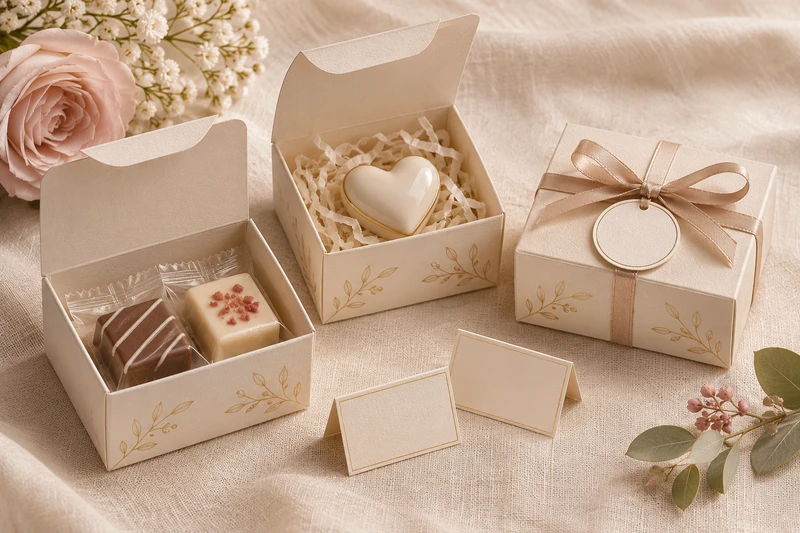
Wedding favour boxes turn a small guest gift into part of the table setting and the wider celebration. The best choice is not simply the prettiest box: it must fit the actual favour, protect its presentation during set-up and make the gift easy for each guest to take away.
For couples, event planners and gifting buyers in South Africa, the starting point is to define what each guest will receive. Wrapped sweets, a candle, a seed packet, a small bottle, a personalised keepsake or a mixed favour all need different internal space and closing arrangements. XGolden Print designs and produces custom paper packaging, including gift boxes, labels and stickers, with structural design, artwork support, material selection, finishing, inserts and sample approval available for the project.
Wedding favour boxes are distinct from large bridal-party gift boxes and from boxes intended to store a wedding dress. A guest favour box is usually a small-format presentation pack for one item or a modest set of items, planned for table placement, handing out at an event or inclusion in a welcome gift.
Match each favour box to the actual guest gift
A wedding favour box should be designed around the gift rather than selected from a visual theme alone. Before deciding on the structure, assemble one complete favour with all of its components: the product, any wrapper or pouch, protective tissue, a card, ribbon and seal. This physical bundle is the real item that the box needs to hold.
For example, one wrapped sweet may suit a compact folding-style presentation, while a small keepsake can require more secure support. Jewellery-style favours, miniature candles and small glass containers may need an insert or a compartment to prevent movement. If a favour is presented as a pair, such as two confectionery pieces or a tea sachet with a small spoon, the layout should make both items look intentional when opened.
A lid-and-base box can give a formal unboxing moment for a keepsake. A drawer box can reveal the favour in a controlled way and offer space for a printed message on the sleeve or inner tray. Magnetic closure boxes and rigid boxes may be considered where the gift and desired presentation call for a more substantial structure. The suitable format depends on the contents, quantity and handling plan, so the construction should be confirmed for the individual brief.
| Wedding favour use | Key packaging requirement | Suitable box-planning option |
|---|---|---|
| Individually wrapped sweets | Neat fit without crushing the wrappers | Compact box dimensions with room for a liner or message card |
| Confectionery selection | Separation between pieces and an attractive opening layout | Internal divider or fitted insert, subject to project confirmation |
| Small candle or keepsake | Stability and protection from movement | Snug internal dimensions or a fitted insert |
| Jewellery-style token | Presentation of a small item without it getting lost in the box | Shallow box depth and an insert designed around the item |
| Mixed favour set | A clear arrangement for several different components | Drawer, lid-and-base or rigid gift-box layout with compartments |
| Table place favour with a name | Identification visible before guests sit down | Name card, printed lid artwork or a personalised seal label |
The box is a presentation layer, not a complete transport protection system. If wedding favour boxes will be moved to a venue, packed into larger cartons or sent as part of online wedding welcome gifts, plan separate outer packaging and handling protection. Delicate contents may also need their own primary container or protective layer before they go into the presentation box.
Where food is involved, distinguish the wrapped sweet or sealed food container from the paper gift box. Food-contact suitability is not assumed. Discuss the actual product, its wrapping and any intended contact with the packaging before approving materials or construction.
Wrapped sweets and small keepsakes need different space
Wrapped sweets often look simple to pack, but their final size is defined by more than the sweet itself. Twists, foil edges, bows, tags and multiple pieces can create uneven shapes. A box that is too tight can crease wrappers or make packing slow; one that is too large can make a small favour look sparse and allow it to shift on the table or in transit.
Measure the gift as it will be presented, not as it appears before wrapping. For confectionery favours, this means measuring the total packed group, including decorative tissue or a card. For a small keepsake, measure its widest point, height and any parts that need clearance, such as a lid, tassel or loop.
Keep the following questions in the brief:
- Is the item already wrapped, bagged, bottled or otherwise contained?
- Will guests see the favour as soon as they open the box, or should it be covered with tissue, a card or another layer?
- Does the item need to remain upright?
- Could two components rub together, rattle or become tangled?
- Is the favour fragile, heavy for its size or awkwardly shaped?
- Will the box be packed by the wedding team, a venue team or an external gifting team?
A candle in its own vessel, for instance, needs a different arrangement from a loose keepsake. The outer wedding favour box enhances the gift and carries the event styling; it does not replace the primary candle container. In the same way, a small bottle remains the primary container for its contents, while the box supports presentation, gifting and handling.
For a keepsake that guests may retain after the event, consider whether the box should be easy to reclose. A simple lid-and-base design may be enough for a one-time reveal, while a drawer or rigid structure can feel more suitable if the packaging is intended to remain with the memento. Avoid adding a premium construction merely because it sounds impressive: the guest gift, event format and packing workflow should justify it.
Personal names, dates and finishing details
Personalisation is often what makes wedding favour boxes feel specific to one occasion. Names, initials, a wedding date, a short thank-you message, table number or individual guest name can be placed on the box itself, on an insert card or on a separate label.
For a large guest list, variable names can make the assembly process more complex. Decide early whether every favour needs an individual name or whether a shared event message is sufficient. If names are required, create a controlled guest-name file, check spelling and agree on how names will be matched to the correct boxes during packing.
Finishing details should support legibility and the wedding’s visual direction. An embossed detail, a foil-style effect, a textured stock choice or a carefully selected colour can create distinction, but only where it works with the artwork and box structure. Fine lettering, light colours and detailed crests should be reviewed at the intended box size. What reads well on a digital invitation may not remain clear on a small favour box lid.
For a seal that adds a tactile finishing touch, LS-330 embossed gift seal labels provide a relevant existing example. They can be considered for closing tissue, sealing a box edge or identifying a favour bag, subject to confirmation against the chosen surface, label size and application method. A seal label should not be treated as a substitute for a box closure where the packed contents require a more secure structure.
Artwork should also account for where each element will sit. A centred monogram on a lid can work well for a table favour, while a guest name may be more practical on the front edge so it remains visible when boxes are arranged in rows. If the celebration uses more than one language in its stationery, provide final approved wording for each version and check that the smallest text remains readable.
XGolden Print can support artwork preparation alongside the box structure, helping buyers align printed graphics, finishing and the intended opening experience. The most useful artwork file is not just the invitation design placed on a box template; it is a layout planned around panels, folds, closures and visible faces.
Choosing a box around the size of the favour
There is no confirmed miniature wedding-favour box SKU in the selected catalogue. Instead of adapting an unrelated product description, specify new dimensions through XGolden Print’s custom box service. This allows the packaging brief to begin with the actual favour and its required internal layout.
Start with three measurements:
- The packed favour size: Measure length, width and height after wrapping, tying or placing it in its primary container.
- Clearance requirements: Identify any extra space needed for tissue, a card, opening clearance or a fitted insert.
- The intended display orientation: Decide whether the box will sit flat, stand upright, be stacked, hung from a place setting or placed in a welcome bag.
Internal dimensions matter more than an attractive external proportion. A shallow box may be ideal for a flat keepsake but unsuitable for a sweet with a tall bow. Similarly, a tall box might make a small item difficult to retrieve unless an insert lifts it into view.
Weight is another practical consideration. A paper presentation box can be planned around the gift, but an unusually dense or fragile item needs careful assessment of its structure, internal support and how it will be handled. Where an insert is proposed, share the actual item dimensions and preferably a physical sample during development. Fitted inserts can be designed as part of the project, but their material and suitability must be confirmed against the product.
The opening action should match the guest experience. A box that requires two hands may be elegant for a seated meal favour, while a simple lift-off lid or accessible drawer may be easier at a busy reception. If guests will collect favours from a display table, ensure there is enough room to lift one box without disturbing adjacent boxes.
For couples and planners ordering favours alongside larger guest gifts, it can help to use coordinated artwork while keeping the structures distinct. A larger gift box may hold a bridal-party set or corporate-event thank-you collection, while the smaller wedding favour box contains one guest token. Coordinated branding does not require identical box sizes or constructions.
Gift seals and a consistent table presentation
Wedding favour boxes often serve two visual jobs: they package the gift and contribute to the tablescape. When dozens or hundreds of boxes are visible at once, consistency in size, lid alignment, label position and colour matters as much as the detail on a single box.
Use one clear hierarchy. The guest name or table marker should be easy to find; the couple’s monogram or event motif can support the design without competing with it. Where labels are used, define their exact placement in the packing instructions. A label placed across a lid-and-base join may act as a visual seal, while a label on a flat lid may be primarily decorative.
Labels and stickers are particularly useful where the wedding includes several favour variants. They can identify flavours, contents, dietary information supplied by the product owner, names or table assignments. The label brief should state:
- the surface it will be applied to: box, bag, bottle, jar or card;
- the available flat area and preferred label position;
- the label shape and dimensions;
- whether it will be applied by hand;
- whether labels are needed on rolls or sheets; and
- the expected handling conditions before and during the event.
For a mixed table presentation, keep components coordinated rather than over-decorated. A box, name card, ribbon and seal can all carry the same motif, but every extra component adds time to assembly and creates another opportunity for variation. Consider which element does the essential job. In many cases, a well-positioned seal label or printed lid is more practical than several separate attachments.
If wedding favours will be added to online orders, welcome packs or post-event thank-you gifts, the presentation box should still be packed inside suitable outer shipping protection. Decorative seals, ribbons and exposed box edges can be damaged by friction if no outer protective layer is planned.
For broader projects involving several box sizes or coordinated gifting items, explore XGolden Print’s gift packaging options. Gift packaging can be planned around multiple products, consistent branding and the intended opening experience.
Trial assembly and packing for the event
A sample review is one of the most useful stages in a wedding favour packaging project. XGolden Print offers sample approval before production, giving the buyer an opportunity to assess the proposed box with the real gift, artwork and selected finishing details before the full order proceeds.
Do not limit the review to looking at one empty box. Carry out a trial assembly using the same items and process that will be used for the event. Put the actual sweet, keepsake, tissue, card, ribbon and label into the sample. Then check how long each favour takes to prepare, whether components stay in place and whether the finished box looks consistent from every side.
A practical trial should answer these questions:
- Does the gift fit without forcing the box closed?
- Can the box be opened without damaging the decoration?
- Does the insert hold the item as intended?
- Are personalised labels easy to apply straight and in the correct order?
- Can a packing team identify different guest names, flavours or favour variants?
- Do stacked boxes remain neat during venue handover?
- What outer cartons or protective packing will be needed for transport to the destination?
- Who is responsible for checking quantities before the items leave for the venue?
Venue handover deserves specific planning. Count completed favours by table, guest list segment or carton rather than relying on a final total alone. If several people will be packing, prepare one visual reference showing the correct orientation of cards, tissue and labels. Reserve a small number of completed favours for photography, late guest additions or replacements if a box is damaged during set-up.
A realistic timeline should include artwork approval, sampling, production, personalisation and the final packing stage. Quantities, sample terms, materials, finishes, schedules and pricing vary by project, so these details should be confirmed before production is approved.
Wedding favour boxes work best when the structure, personalisation and assembly method are treated as one plan. To discuss a custom wedding favour packaging brief with XGolden Print, share the packed gift dimensions and weight, expected quantity, artwork, required delivery date, destination and any insert, label or finishing requirements.
