
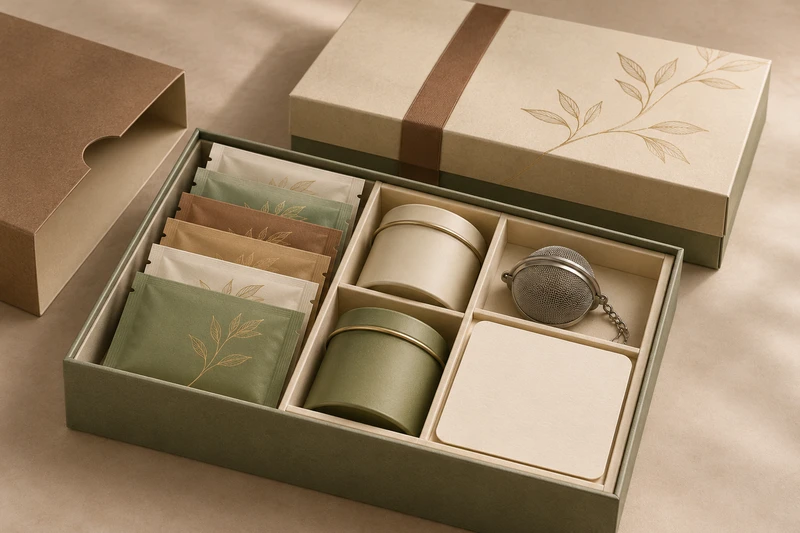
Tea sampler packaging should make a tasting collection easy to understand, open and repack. For a tea brand, that means arranging sealed sachets, tins and brewing accessories in a deliberate sequence, giving every blend clear identification, and protecting the presentation through retail handling, gifting and dispatch preparation.
For packaging buyers in South Africa, a tea gift set may be intended for a retail shelf, online order, corporate gift, hotel welcome pack or event presentation. The same outer box can look polished in each setting, but the internal layout, product access and information requirements should be planned around the actual components. XGolden Print designs and produces custom paper packaging boxes, gift packaging, labels and stickers, with support from structural design and artwork through to fitted inserts, sampling and production.
A tea tasting selection needs a clear order
A tea sampler is more than a group of products in one box. It is a guided tasting collection. The order should help the recipient move through the range without needing to sort loose sachets or guess which tea to try first.
Brands can create a logical tasting sequence in several ways:
- By tea type: for example, black tea, green tea, herbal infusion and rooibos.
- By flavour intensity: from lighter floral profiles to stronger spiced or smoky selections.
- By time of day: morning, afternoon and evening blends.
- By origin or collection: where the range is organised around a defined product story.
- By brewing style: teas prepared at different temperatures or steeping times.
The chosen sequence should be visible as soon as the box opens. Numbered compartments, printed dividers, a tasting card or colour-coded product positions can all help. A customer should be able to remove one item without disturbing the rest of the tea gift set.
For a compact retail sampler, the sequence may run left to right or front to back. In a drawer box, it can be revealed as the tray slides open. In a larger gift presentation, a central brewing accessory may sit beside product sections that follow a clear progression.
Do not let an attractive exterior substitute for organisation inside. If several blends use similar sachet packs, a customer may struggle to identify them after opening unless the insert and product labels make each variant obvious.
Sealed sachets, tins and accessories in one set
Tea sampler packaging can accommodate individually sealed sachets, tea tins, pouches, sample envelopes, a tea infuser, a measuring spoon or a printed tasting guide. These components should be specified as a complete set before the box structure is finalised.
The outer gift box is a presentation layer, not an aroma or freshness barrier. Tea should remain in its own sealed primary packs, sachets, tins or other suitable containers. The outer box can organise and present those products, but it should not be relied on to preserve the contents’ freshness or prevent aroma transfer between blends.
A fitted insert can be useful where the set includes mixed formats. It can:
- Keep sachets stacked in defined groups;
- Hold tins upright and separated;
- Create a dedicated cavity for an infuser or spoon;
- Prevent small items from moving around during normal handling;
- Maintain a consistent reveal when the box is opened;
- Support faster, repeatable packing by the brand or fulfilment team.
Before selecting an insert arrangement, record the dimensions and weight of every component, including any outer wrap, lid, tag, string or seal. Small changes matter. A sachet stack may become significantly thicker once it is packed in its final envelope, while a tin lid or accessory handle may determine the necessary internal height.
| Tea set use case | Main contents | Packaging requirement | Suitable presentation approach |
|---|---|---|---|
| Retail tea discovery box | Sealed sachets in several flavours | Fast blend identification and tidy stock display | Compartments, printed flavour order and a shelf-facing outer panel |
| Premium tea gift set | Sachets, tins and a brewing accessory | A considered opening sequence and stable component positions | Rigid gift box with a fitted insert and tasting card |
| Online tea sampler | Sealed tea products and printed guide | A presentation box that fits within the wider dispatch packing plan | Structured internal layout; assess separate transport protection for shipping |
| Corporate or event tea gift | Curated tea selection, message card or branded item | Coordinated branding and efficient assembly | Custom insert layout with a dedicated space for the card or additional item |
The box dimensions should be based on the packed contents, not only the loose product dimensions. Allow for the way tea products are counted, stacked and inserted during packing. If components are placed manually, a layout that is visually impressive but difficult to fill consistently can slow the process and increase packing errors.
Packaging material selection should also relate to the set’s weight, the opening style, the desired retail appearance and expected handling. XGolden Print can support material selection for the individual project, but the suitability of a specific material, finish or insert should be confirmed against the final contents and packing conditions.
Identifying flavours and brewing information
Clear identification helps a tea sampler work after the recipient has removed products from the box. Every tea variant needs a recognisable name, while brewing information should be easy to locate without overcrowding the main presentation.
Useful information can include:
- Blend or flavour name;
- Tea type or infusion category;
- Recommended brewing guidance supplied by the tea brand;
- Tasting notes or a short flavour description;
- A numerical tasting sequence;
- Pack count or tin contents where applicable;
- Batch, date or other product information required by the brand’s own product process.
Place essential product information on the individual sealed tea pack or tin rather than relying only on the outer gift box. The outer box may be retained for storage or discarded, and individual products may be shared separately.
Labels and stickers can support tea tins, jars, boxes and bags when product information needs to be added to a specific surface. The label dimensions, shape, adhesive choice, roll or sheet format and application method should suit the actual container and production workflow. For example, a label intended for a curved tin needs to be planned against that tin’s usable labelling area, rather than against the full container diameter.
For South African retail and gifting projects, artwork can be prepared for the language approach and information hierarchy chosen by the brand. Keep the front panel focused on the collection and brand message, then use side panels, internal cards or individual packs for fuller brewing guidance. This gives the tea sampler packaging a calm, premium appearance while preserving practical clarity.
Common mistakes include using colour alone to distinguish flavours, placing small type over busy artwork, and repeating the same information on every surface. A tasting collection benefits from one visible system: flavour name, order number and a repeatable visual cue that works across the box, sachets, tins and guide card.
A tea-sachet drawer-box presentation
A drawer box is a practical tea sampler packaging format when the set mainly contains sealed sachets or slim sample packs. The outer sleeve provides a branded retail-facing surface, while the pull-out tray creates a controlled reveal of the tea selection.
The DB-315 tea-sachet drawer-box style is a relevant structural reference for brands considering a tea-sachet drawer presentation. It illustrates the drawer-box format for this type of collection. Any new tea assortment still needs to be checked against the actual sachet dimensions, number of variants, stack height and any accompanying printed material.
A drawer format can suit a tasting collection where the intended opening experience is gradual rather than immediate. As the tray is pulled out, the customer can see flavour groups, a tasting card or an ordered row of sachets. A ribbon pull, thumb cut or other access detail may be considered during structural design, depending on the chosen layout and intended use.
When developing a drawer-box tea sampler, clarify:
- How many sachets each flavour includes. A single sample per blend needs a different layout from a multi-sachet selection.
- Whether all sachets are identical in size. Mixed sachet dimensions can require separate compartments or an adaptable insert.
- How the tray is packed. The packing team needs enough access to place each group without creasing packs or disrupting the order.
- What remains visible when the drawer is closed. The sleeve should communicate the collection clearly in retail and gift settings.
- Whether a tasting guide is loose or retained. A card can sit above the sachets, in a defined recess or within the sleeve, depending on the opening sequence.
A drawer box is presentation packaging, not a complete transport-protection system. Tea brands selling through e-commerce should plan an appropriate outer dispatch pack around the finished gift box. Consider the route from fulfilment area to delivery destination, the quantity packed per shipper and whether the customer is likely to receive the box as a gift. These decisions should be assessed with the wider logistics plan rather than assumed from the gift box alone.
Developing a magnetic tea gift-box layout
A magnetic closure box can give a tea collection a more ceremonial opening, particularly where the set includes tins, accessories or a larger tasting card. The lid opens to present the entire arrangement at once, making this format suitable for premium gifting, seasonal collections, corporate presentations and afternoon-tea themed sets.
The MC-307 afternoon-tea magnetic-box structure is a useful reference for brands exploring this style of tea gift box. Use its magnetic opening and afternoon-tea presentation as a starting point, then develop the interior around your own range. Confirm the final layout against the real tins, sachets, accessory dimensions and insert requirements.
The most effective magnetic tea gift-box layout normally gives each category a defined role. For example, tins may occupy the main cavities, sachets may sit in a side compartment, and an infuser or message card may have its own recess. Avoid using a large open cavity for mixed loose contents: this can make the set feel less deliberate and may allow components to shift.
Consider the following layout decisions:
Product access
The customer should be able to remove a tin or accessory without tipping neighbouring products. Finger notches, open-sided cavities or lift points can be considered where the component shape makes removal difficult. The design should be tested with the actual product, including any lid, shrink wrap or tag.
Lid message and first reveal
The inside of the lid can carry a tasting introduction, serving suggestion, collection story or gift message. Keep the message separate from compulsory individual product information. This allows the unboxing experience to remain clean while each tea product retains its own identification.
Insert depth and visual balance
An insert should hold products at an appropriate visible height. If items sit too low, the set can be difficult to access. If they project too far, the lid may not close correctly. Structural design and a sample approval process are valuable at this stage because visual layout alone cannot confirm the final fit.
Retail and gifting finish
Printing and finishing choices should serve the intended presentation. A restrained finish may support a calm wellness-oriented collection, while a more formal treatment may suit a corporate gift. Confirm the selected material, print treatment and finish against the project artwork, handling needs and budget rather than choosing from a photograph alone.
XGolden Print provides structural design, material selection, artwork support, printing, finishing, fitted inserts and sample approval before production. For a tea gift box, these services bring the box, insert and visual system together around the actual tasting collection.
Checking set contents and packing consistency
A tea sampler packaging project should be checked as a set, not as separate box and product decisions. A disciplined review before production helps prevent gaps, cramped cavities, omitted information and inconsistent packing.
Use this pre-production checklist for a tea tasting collection:
- Final list of tea variants and quantity of each;
- Exact dimensions of sealed sachets, tins, pouches and accessories;
- Component weights and total packed set weight;
- Chosen tasting order and product positions;
- Individual-product identification and brewing information;
- Outer-box artwork, internal printing and tasting-card copy;
- Insert layout, product access points and any retainers;
- Packing sequence for the fulfilment or assembly team;
- Retail display orientation, if relevant;
- Outer dispatch packaging requirements for online orders;
- Required delivery date and delivery destination;
- Artwork files and version approval process.
It is worth packing a complete proposed set before approving the final arrangement. Check whether each product can be inserted in the intended order, whether it remains stable when the box is handled, and whether the customer can remove it easily. If the tea selection has seasonal variants or different pack counts, decide early whether one box must accommodate multiple configurations or whether each collection needs its own insert.
Sample approval is especially useful for tea sampler packaging because it allows the team to review physical fit, product access, printed hierarchy and opening experience together. A sample is not simply a visual stage; it is where the relationship between the sealed tea products, insert and outer presentation can be assessed before production.
For a broader starting point on formats and gifting applications, explore XGolden Print’s gift packaging options. Where the project needs a custom structure built around a particular tea range, our custom box service can support the brief from layout development through sample approval.
To discuss tea sampler packaging with XGolden Print, provide the dimensions and weights of each tea product and accessory, the quantity required, artwork or branding direction, required delivery date and delivery destination.
