
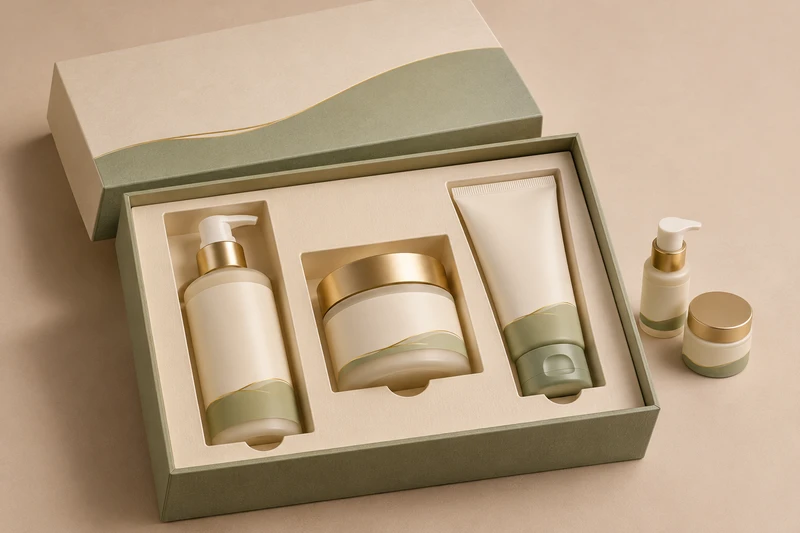
Skincare gift boxes bring a complete routine or miniature collection into one retail-ready presentation. For brands, the job is not simply to place several products in a larger box: bottles, jars and tubes need a stable shared layout, clear routine guidance and a considered opening experience.
For packaging buyers in South Africa, this makes skincare gift packaging useful for retail launches, online orders, festive gifting, promotional bundles and event gifts. XGolden Print designs and produces custom paper packaging boxes, gift packaging, labels and stickers, supporting the structural design, material selection, artwork, printing, finishing, fitted inserts and sample approval needed for a specific skincare set.
Skincare routines and mini sets that need a shared box
A shared skincare box is suited to products that are intended to be used together, such as a cleanse-treat-moisturise routine, a morning-and-evening regimen, or a travel-size introduction to a range. It gives the set a coherent identity while helping the buyer understand what is included and how the products relate to one another.
Common skincare gift-box applications include:
- Full-size routine sets with a cleanser, serum, moisturiser and eye product
- Discovery sets containing miniature bottles, jars and tubes
- Seasonal or occasion-led gifts, including festive, thank-you and corporate gifting
- New-product bundles that introduce complementary formulas
- Retail bundles that combine established individual SKUs
- Online-exclusive sets prepared for a campaign or product launch
- Event gifting where branded skincare products form part of a welcome or appreciation pack
The outer box is a presentation and organisation layer. It should not be treated as the primary container for the skincare product, nor assumed to provide the complete protection required for transport. Products remain in their own bottles, jars or tubes, with their own closures and product-contact components. The gift box and insert should then be planned for presentation, controlled product placement and normal handling; any separate shipping carton or protective transport packaging should be specified according to the delivery journey.
A routine set also needs to accommodate real variations between components. A glass jar may be short and wide, a pump bottle tall, and a tube narrow but flexible. Mini sets can be especially deceptive: a collection of small containers may require more footprint than expected once caps, shoulders, pumps and finger space are considered.
| Skincare set use | Typical contents | Key packaging requirement | Suitable box and insert approach |
|---|---|---|---|
| Full routine set | Bottles, jars and tubes | Stable layout for mixed heights and weights | Rigid box or lid-and-base box with fitted compartments |
| Mini discovery set | Travel-size bottles, mini jars, sachets or tubes | Precise sizing and easy removal of small items | Compact box with removable insert and finger access |
| Retail gift set | Coordinated product range | Shelf-facing brand presentation and clear contents | Printed outer box with routine information and orderly product layout |
| Online bundle | Existing individual SKUs packed together | Consistent packing workflow and presentation on arrival | Insert designed around actual containers; separate transit protection assessed as needed |
| Corporate or event gift | Selected skincare products with campaign branding | A polished reveal and practical recipient guidance | Gift box with coordinated artwork, insert and optional message area |
Before selecting a format, decide whether the packaging is designed for a permanent retail set, a limited campaign bundle or an adaptable box for changing product combinations. A box sized tightly for one fixed set may not suit later variants if jar diameters, bottle heights or component count changes.
Matching bottles, jars and tubes to one layout
The most important decision in skincare gift-box development is to work from the actual containers rather than estimated product descriptions. “30 ml serum”, for example, does not define the outside dimensions of its bottle, cap, dropper or pump. The same applies to jars, where lid diameter can be wider than the vessel body.
A practical layout starts with accurate information for each item:
- Overall width, depth and height of every filled, closed container
- The widest point, including caps, pumps, droppers and overcaps
- Product weight, particularly where glass containers are included
- The number of products and whether any item is optional between variants
- Required orientation: upright, flat or deliberately angled
- Whether components can touch or need separation
- How the packing team will place each product into the insert
- Whether the recipient needs a clear route to lift the products out
The internal layout should balance visual rhythm with practical packing. A tall bottle placed beside a low jar may look intentional when planned well, but it can leave unused space or create an uneven opening view if the insert is not shaped around both items. Grouping products by routine order can make the layout easier to understand, while grouping by height can help create a neater visual presentation. The best option depends on the product story and container shapes.
Allow for real handling space
A close-fitting insert can hold a product in position, but it must not make the item difficult to remove. This is particularly relevant for smooth jars, small mini bottles and tubes that sit below the top edge of the insert. A finger notch, a lifting gap or a removable insert can make access more practical without disrupting the set’s appearance.
Weight distribution deserves equal attention. If one side of a skincare gift box contains heavy glass jars and the other contains lightweight tubes, the box may feel unbalanced when lifted. Product placement, insert support and the chosen box construction should be considered together.
For multi-SKU programmes, identify which dimensions are fixed and which may change. It is often better to develop an insert around confirmed containers than to force a future product into an existing cavity that is too loose, too tight or too shallow.
Routine order and product identification
Skincare gift boxes should make the routine understandable without requiring the customer to guess which product comes first. The outer packaging can introduce the collection, while the inside layout and printed information guide the opening and use sequence.
A clear routine structure may use numbered positions, product names, icons or short descriptors such as “Cleanse”, “Treat” and “Moisturise”. If a set includes products for different times of day, identify that distinction clearly. The goal is not to overload the packaging with claims, but to help recipients recognise each product and its place within the set.
For a three-piece set, left-to-right positioning may be enough. Larger routines can benefit from a numbered insert, a printed inside panel or a separate information card. Make sure the visual order matches the physical layout; a sequence printed on the lid is less useful if the containers are rearranged in the insert.
Product identification should account for the way the set will be sold:
- On shelf: The front and side panels may need the set name, contained products, variant name and other brand-approved retail information.
- Online orders: Recipients should be able to identify the set easily when they open the parcel, even if they have not seen a retail display.
- Gift purchases: The outer presentation should explain the collection without relying on the recipient already knowing the range.
- Event or corporate gifting: A message panel, campaign reference or co-branded artwork may need to sit alongside product identification without obscuring it.
Where labels or stickers are used on the individual bottles, jars, boxes or bags, specify the surface, label dimensions, shape, placement and whether labels will be supplied on rolls or sheets. Artwork should be planned for the actual application position: a curved bottle, narrow tube or small jar lid offers a different usable area from a flat outer box. Labels and stickers support identification, but they do not replace the need for a coherent set-level presentation.
For brands preparing local-language artwork for South African retail or gifting, allow enough space for all approved product and set information in the required language versions. This decision affects panel space, type size and the amount of room available for decorative elements, so it should be settled before artwork is finalised.
Lid-and-base and rigid-box examples from XGolden
The right box format depends on the desired reveal, set weight, product arrangement and retail presentation. A lid-and-base box gives a familiar gift-box opening, with the lid separating from the base to reveal the arranged products. A rigid box can provide a more substantial presentation for a skincare routine where the packaging itself forms part of the gift experience.
The LB-302 skincare-trio lid-and-base box is a relevant structural example for a three-product skincare presentation. Its value as a reference is the lid-and-base format, not a fixed promise of fit for every trio. Actual bottle, jar and tube dimensions must be checked before a similar layout is developed.
For a broader routine presentation, the RB-302 skincare-routine rigid box provides another existing structure to consider. It can help a buyer discuss the type of rigid-box presentation they want for a multi-product routine. It does not establish a standard mini-set size, material specification or ready-made layout for other containers.
Neither example should be used to assume that all miniature skincare products will fit. Mini bottles can vary considerably in height and shoulder profile, while jar lids and tube caps affect the internal space required. Any new skincare gift-box layout should be agreed against the actual containers and planned insert.
For buyers comparing formats, a lid-and-base structure can suit a traditional gift reveal, while a rigid box may support a more substantial routine-set presentation. The final choice should consider how the box will be displayed, opened, packed and handled, as well as the product weight and dimensions. Explore further gift packaging options when the skincare set is being planned primarily as a gifting experience.
Inserts that support packing and product removal
An insert does more than fill an empty box. For skincare gift boxes, it creates defined positions for different container shapes, helps the packing team place products consistently and contributes to the first impression when the lid is lifted.
A removable insert can be especially useful where the customer should be able to access the whole set easily after opening. It can also support packing by showing the intended position for each component. The insert design should be considered with the box depth: containers should sit securely, but the recipient should still be able to grip and remove them.
Questions to resolve during insert planning include:
- Which products need individual cavities, and which can sit together?
- Is the product expected to remain upright?
- Does the insert need cut-outs for fingers, pull areas or removal gaps?
- Are product cavities shaped for the exact container or made more adaptable for variants?
- Will the packer need a specific loading order?
- Can the recipient see product labels or names when the set is opened?
- Is there space for a leaflet, routine card or campaign message?
- Does the insert need to accommodate a replacement component in future?
A common mistake is to prioritise a tight visual layout without considering removal. Another is to allow for the bottle body but overlook a cap, pump or tube shoulder. A third is treating the insert as transport protection without assessing the complete delivery system. The insert may help manage movement inside the presentation box, but external shipping requirements need their own assessment based on the route, handling and destination.
Material and finishing choices should serve the set’s intended use. A gift set may need a refined outer appearance, while an online bundle may place more emphasis on a repeatable packing layout. XGolden Print can support material selection and finishing discussions for the individual project, with suitability confirmed against the proposed structure, contents and use.
Approving artwork and a complete set sample
Artwork approval is most effective when it happens alongside structural planning rather than after every panel and insert position has been fixed. The box must accommodate the brand’s visual identity, product identification, routine guidance and any retailer or campaign requirements without compromising legibility.
Provide final or near-final artwork content early, including:
- Brand marks, colours and typography
- Set name and product variant names
- Product sequence or routine instructions
- Contents list and any required brand-approved information
- Language versions and approved copy
- Barcodes or retailer references where applicable
- Promotional, gifting or event messaging
- Information for labels or stickers on individual containers, if included in the project
A complete set sample is valuable because it brings the decisions together. It allows the buyer to review the box opening, product fit, insert access, artwork placement and overall presentation with the actual containers or agreed representations. It can also reveal practical issues in the packing sequence before production.
XGolden Print offers sample approval before production, alongside structural design, artwork support, printing, finishing and fitted inserts. Material suitability, insert construction, finishing, order quantity, sample terms, pricing and schedules should be confirmed for the individual skincare gift-box project.
When preparing a brief, include photos and dimensions of every closed container, product weights, the number of set variants, intended sales channel, artwork status and the desired unboxing experience. If products will be shipped to different destinations, include the delivery destination and explain whether a separate outer shipping solution is planned.
For a skincare routine or mini collection that needs a purpose-built presentation, discuss your custom box project with XGolden Print. Share the product or container dimensions, quantity, artwork, required delivery date and destination so the box, insert and approval sample can be planned around the complete set.
