
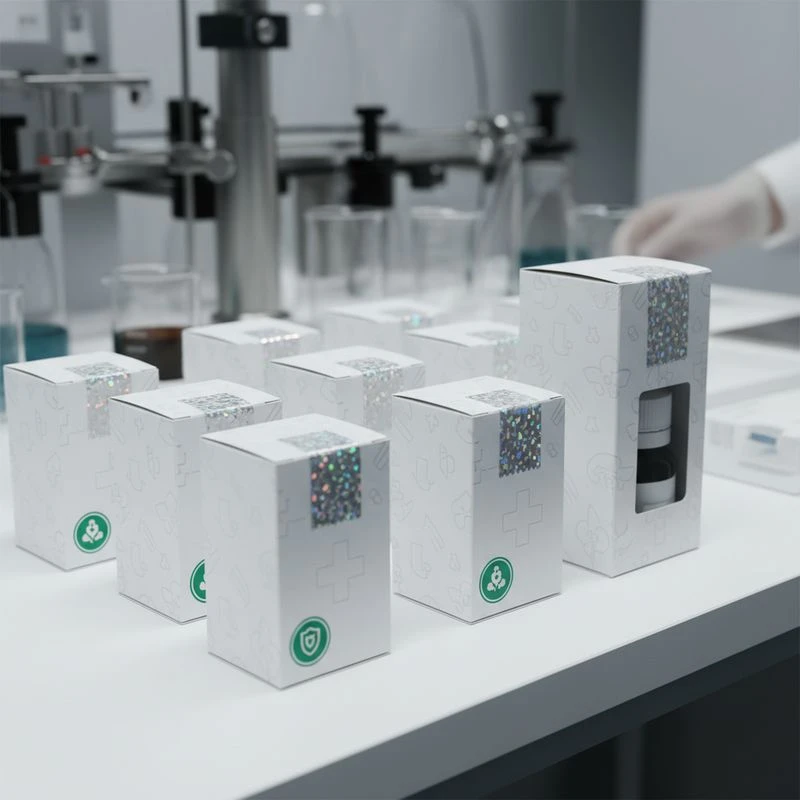
Pharmaceutical custom packaging with safety compliance means designing every pack component to protect the medicine, communicate essential information clearly and support the applicable South African requirements. It is not achieved by adding a warning label at the end of the process. The container, closure, carton, leaflet, label, tamper-evident feature and printed artwork need to work as one controlled system.
For brand owners and procurement teams, the practical priority is to define the product’s risks first: what must be protected, who may handle the pack, what information must remain readable, and which pack changes require formal approval. Confirm the final requirements with your regulatory, quality and product teams before production.
Pharma Packaging
Pharmaceutical packaging has several jobs at once. It needs to contain the product safely, preserve its intended condition during its shelf life, provide legible instructions and prevent avoidable confusion or interference. The correct solution depends on whether you are specifying primary, secondary or tertiary packaging.
| Packaging level | Main purpose | Common examples | Key specification questions |
|---|---|---|---|
| Primary packaging | Directly contacts the medicine | Blister cavities, bottles, sachets, vials, tubes | Is the material compatible with the formulation? Does it provide the required barrier and closure performance? |
| Secondary packaging | Protects and identifies the primary pack | Folding cartons, printed sleeves, inserts and leaflets | Does it hold the primary pack securely and present mandatory information accurately? |
| Tertiary packaging | Supports storage and distribution | Transit cases, dividers, outer cartons and pallets | Does it prevent crushing, mix-ups and damage through the supply chain? |
Custom printed cartons are usually secondary packaging. They can provide product identification, instructions, dosage information, warning statements, batch-specific details and space for traceability features. However, a carton alone does not make a medicine safe or compliant. It must be compatible with the primary container and the wider packaging process.
Start with a packaging specification, not an artwork file
Artwork is only one part of a pharmaceutical packaging brief. A useful specification should set out the functional, material and print requirements before design approval begins.
Include the following where relevant:
- Product name, strength, dosage form and pack count
- Primary-pack dimensions, weight and closure profile
- Carton style, internal fit and opening direction
- Required information panels and language requirements
- Barcode, data matrix, serialisation or other coding needs, where applicable
- Batch number, expiry date and variable-data print areas
- Tamper-evident requirements
- Storage, handling and transport conditions that may affect the pack
- Approved substrates, finishes, inks and adhesives
- Artwork version, approval status and change-control process
- Inspection criteria, sampling expectations and documentation required from the supplier
For printed packaging, also identify which information is fixed and which is applied later. A pre-printed carton may carry the product identity and fixed instructions, while batch and expiry data may be added during packing. That distinction affects available print space, contrast, orientation and the checks required on the production line.
Protect readability throughout the pack’s life
Legibility is a safety feature. Important information should not disappear into folds, glue flaps, dense graphics, reflective finishes or low-contrast printing. The same applies to variable information such as batch and expiry details.
When reviewing a carton or label design, check:
- Whether essential text remains clear at the smallest intended size
- Whether contrast is sufficient under ordinary retail and clinical lighting
- Whether barcodes have adequate quiet zones and are kept away from folds
- Whether overprinting areas are flat, accessible and free from decorative interference
- Whether different strengths or variants can be distinguished quickly
- Whether the product name is more prominent than marketing language
- Whether warnings remain visible after the pack is opened or partially used
A visual mock-up can reveal structural issues, but it does not replace formal quality and regulatory review. Confirm which artwork proofs, samples and approvals are required before authorising production.
Regulatory Design
Regulatory design is the practice of building required information and risk controls into the packaging from the first layout. For medicines supplied in South Africa, requirements can differ according to the product category, schedule, route of administration, target user and sales channel. The product owner should verify the current applicable requirements with the relevant regulatory and quality specialists.
The core design principle is straightforward: required information must be accurate, readable, durable and consistently associated with the correct product.
Build an information hierarchy
A well-designed pharmaceutical carton allows the user to find critical information without searching. While the precise content must be confirmed for each product, a practical hierarchy often places these items prominently:
- Product name and dosage form
- Strength or concentration
- Pack quantity
- Key route-of-administration or storage information
- Important warning statements
- Batch and expiry information
- Product code or scan-ready identification
Avoid treating all text as equally important. Overcrowding can make a compliant information set harder to use. A designer should create clear spacing and a predictable panel structure before decorative brand elements are introduced.
Manage look-alike and sound-alike risks
Packs that appear too similar can contribute to selection errors, especially where multiple strengths, flavours, formulations or related products are stored together. Colour can assist recognition, but colour should not be the sole differentiator because it may reproduce differently across print runs and is not equally accessible to all users.
Use several distinguishing cues:
- A clear strength display in the same position on each variant
- Meaningful descriptors such as dosage form or route of administration
- Distinctive layout elements beyond a simple colour change
- Sufficient whitespace around product names and strengths
- Consistent positioning for batch, expiry and barcode areas
- Separate artwork controls for each stock-keeping unit
Common mistakes include reusing an old artwork file for a new strength, changing a product name without reviewing all panels, and allowing a marketing redesign to alter the visibility of regulated information.
Treat artwork changes as controlled changes
Even a small packaging change can create risk if it affects text, a barcode, a colour identifier, carton dimensions or the placement of variable data. Establish a documented review route that includes the people responsible for regulatory, quality, product, artwork and operations decisions.
Before release, confirm:
- The correct approved artwork version is in use
- Product codes match the intended item
- Text has been checked against the approved source
- The cutter guide and carton dimensions match the packed product
- Finishes do not compromise legibility or code scanning
- All previous versions are removed or segregated appropriately
- The printer receives an unambiguous production specification
For packaging that incorporates security devices, data carriers or anti-counterfeit elements, establish who owns the data, how it is verified and what happens when a code cannot be read. These controls should be agreed before manufacture, not after a shipment has been packed.
Child Resistant
Child-resistant packaging is designed to reduce the chance that young children can open a pack, while still allowing intended users to access it. It is not the same as childproof packaging: no packaging should be described as completely childproof.
Whether a child-resistant feature is appropriate depends on the medicine, its risk profile, intended use and applicable requirements. Confirm the need for a child-resistant closure or outer pack with the product’s regulatory and quality teams.
Choose the right level of protection
Child resistance may be incorporated in a primary closure, a blister design, a secondary carton or a combination of these. The selected solution must work with the actual product and user group.
| Format | Potential child-resistant approach | Key checks before selection |
|---|---|---|
| Bottle or jar | Push-and-turn or squeeze-and-turn closure | Compatibility with the neck finish, opening torque, reseal performance and usability |
| Blister pack | Peel-push construction or a protective outer layer | Push-through force, opening instructions and suitability for intended users |
| Sachet | Tear-resistant construction or controlled opening feature | Ease of opening for adults, seal integrity and clear opening guidance |
| Folding carton | Child-resistant locking mechanism | Reliable closure, pack fit, repeat opening and interaction with the primary pack |
A secondary carton cannot compensate for an unsuitable primary pack. For example, a child-resistant carton may be opened and discarded while the medicine remains in an accessible bottle. Consider how the pack will be used after purchase, including repeated dosing and storage in the home.
Balance safety with accessibility
A pack that is too difficult for its intended users may lead to unsafe workarounds, such as decanting medicine into an unlabelled container or leaving it open. This is particularly relevant for older adults, people with limited dexterity and users managing chronic treatment.
Clear opening instructions matter. They should be placed where the user sees them before attempting to open the pack, and should not rely on faint symbols alone. If an opening feature requires a sequence of actions, show the sequence plainly.
Where child-resistant performance testing or a particular standard is relevant, confirm the exact test method, sample requirements, acceptance criteria and documentation expected for the intended South African market. Do not assume that a feature used on another product automatically meets the requirement for a new product.
Secure Containers
Secure containers protect against unintended opening, product loss, substitution and visible interference. The right solution depends on the product format and the point at which a user should be able to recognise a compromised pack.
Tamper evidence and child resistance address different risks. A tamper-evident feature helps reveal opening or interference; a child-resistant feature makes opening more difficult for children. Some products may need both, while others may need a different form of protection.
Common secure-packaging options
Potential options include:
- Induction seals or liner seals for compatible bottles
- Shrink bands around caps or closures
- Breakable rings or bands integrated into closures
- Perforated carton seals or sealed end flaps
- Destructible labels that show visible disruption when removed
- Security labels with controlled serial or verification features
- Blister lidding designed to show prior access
- Inner trays or inserts that prevent movement and concealment
Each feature has limitations. A shrink band may show that a cap has been removed, but it does not verify the authenticity of the contents. A sealed carton can indicate first opening, but it does not necessarily protect the primary container once the carton is discarded. Security printing features may deter casual copying, but their effectiveness depends on design control and verification processes.
Check compatibility before committing to a feature
A secure container is only effective when it suits the actual product, material and packing method. Confirm the following during development:
- Does the seal adhere to the intended substrate and coating?
- Will adhesives, inks or labels remain suitable under expected storage conditions?
- Does the feature interfere with automated filling, cartoning or coding?
- Can the package still be opened by the intended user?
- Does the feature conceal any required information?
- Will scanning or variable-data printing remain reliable?
- What does an opened or compromised pack look like to a user?
- Can quality staff inspect the feature efficiently during packing?
Gloss varnishes, laminates and soft-touch coatings can make a carton look premium, but they may also affect label adhesion, coding contrast or tamper-label performance. Specify the intended finish early and test it with the relevant secure feature rather than treating it as a late artwork choice.
Make disposal and returns part of the plan
Medicines should not be returned to saleable stock simply because outer packaging looks intact. Your internal procedures should address damaged packs, suspected tampering, obsolete artwork and product returns. The exact approach depends on the product and operating model, but the principle is consistent: uncertain product status should be clearly controlled rather than repacked casually.
B2B Production
B2B pharmaceutical packaging production requires more control than ordinary retail print because an artwork error, mixed version or poor-fitting carton can have consequences beyond appearance. Buyers should select a packaging partner based on the supplier’s ability to work to a documented specification, communicate clearly and support a controlled approval process.
What to ask a packaging supplier
Before placing an order for pharmaceutical cartons, labels or inserts, ask practical questions such as:
- Which materials and finishes are available for the specified format?
- Can the supplier provide samples or prototypes for fit checks?
- How are artwork versions identified and approved?
- What information should be supplied for variable-data areas?
- What production tolerances should be considered for folding, gluing and fitting?
- How are print colours, finishes and structural details checked against the approved brief?
- What packaging and handling method will protect finished cartons from scuffing, crushing or mix-ups?
- What lead times apply after artwork, materials and specifications are approved?
- What quantity allowances or production terms need to be agreed?
- What records can be supplied with the order, if required?
The answer to these questions should be documented in the purchase order, artwork approval and technical specification. Verbal assumptions are difficult to manage once production is under way.
Use a staged approval process
A disciplined process reduces avoidable rework. A typical sequence may include:
- Define the pack: Record product dimensions, pack count, intended use, security needs and mandatory information.
- Develop the structure: Select the carton style and confirm fit around the primary pack.
- Prepare artwork: Build required information into an approved layout with clearly marked variable-data zones.
- Review the proof: Check content, panel placement, orientation, colour coding and barcode position.
- Approve samples where needed: Assess structural fit, opening behaviour and interaction with labels or seals.
- Release controlled artwork: Supply one final, clearly identified production file.
- Inspect delivered packaging: Check quantity, version, physical condition and visible conformance before release to packing.
For wider custom carton requirements outside pharmaceutical applications, review XGolden Print’s custom packaging box options alongside your technical specification.
Avoid these procurement pitfalls
The lowest unit price is not always the lowest total cost. A carton that does not fit correctly, has insufficient space for coding, or is printed from an outdated file can create expensive delays and unusable stock.
Watch for these common issues:
- Ordering cartons before the primary pack dimensions are final
- Leaving batch and expiry placement until after design approval
- Selecting colours without reviewing strength differentiation
- Approving digital artwork without checking the physical fold and glue areas
- Using decorative finishes in areas intended for codes or security labels
- Failing to specify how multiple variants must be packed and identified
- Assuming prior artwork remains valid after a formulation, product name or legal-text change
- Treating a tamper-evident feature as proof of product authenticity
XGolden Print provides custom packaging boxes and printing solutions. When comparing suppliers, share the same controlled brief with each one so that material options, production terms and approval requirements can be evaluated on a like-for-like basis.
Frequently asked questions
Is a custom pharmaceutical carton enough to make a product compliant?
No. A carton can support compliance by presenting required information, protecting the primary pack and carrying security features, but the complete product packaging system must be assessed against the requirements that apply to that medicine and market.
What is the difference between tamper-evident and child-resistant packaging?
Tamper-evident packaging shows visible signs that a pack may have been opened or interfered with. Child-resistant packaging is designed to make opening more difficult for young children. A pack may have one feature, both features or neither, depending on the product requirements.
Can batch and expiry information be printed on a carton after it has been made?
Often, yes, but the carton must have a suitable reserved area. Confirm the print method, code size, contrast, orientation, substrate, coating and inspection process before approving artwork.
Should pharmaceutical packaging use a glossy finish?
A glossy finish may be suitable for some cartons, but it should not be selected solely for appearance. Check whether it affects readability, overprinting, barcode scanning, label adhesion or tamper-evident components.
The most reliable next step is to prepare a pack specification that covers the product, primary container, mandatory information, security needs and approval controls. Use it to review prototype samples and compare packaging suppliers before committing to a production run.
