
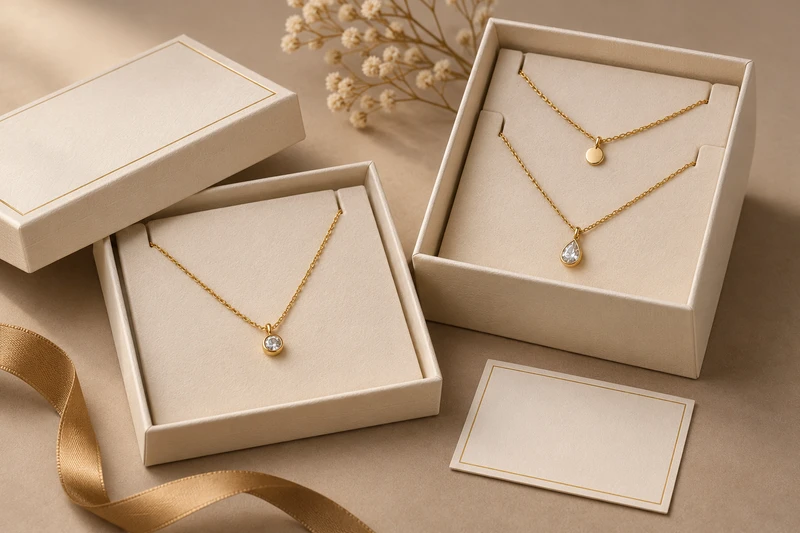
Necklace boxes should be specified around the jewellery’s actual chain length, pendant profile and display position—not simply around the jewellery category. A pendant necklace may need enough depth for the focal piece to sit neatly at the front, while a layered necklace needs separate routing and retention points so each chain can be presented as intended.
For jewellery brands, retailers and e-commerce teams in South Africa, the right necklace gift box supports a more considered unboxing experience for retail sales, online orders, launch sets and event gifting. XGolden Print designs and produces custom paper packaging boxes, including rigid, magnetic closure, drawer and lid-and-base formats, with structural design, material selection, artwork support, printing, finishing, fitted inserts and sample approval available for the project.
A pendant and a layered necklace need different layouts
A single pendant necklace and a layered necklace may look similar when laid flat, but they place different demands on necklace boxes. The pendant is usually the visual focus, whereas layered jewellery needs the chains and focal details to remain distinct enough for a clear presentation when the box is opened.
For a pendant necklace, the insert should establish three things:
- where the pendant rests;
- where the chain passes or is retained;
- how the buyer lifts the jewellery out without pulling at the pendant or clasp.
The pendant should sit in a deliberate display area rather than appearing to drop randomly into the base of the box. Its thickness, width and any projecting details affect both insert depth and the clearance required beneath the lid.
Layered necklaces introduce additional decisions. Two or more chains may have different lengths, pendant sizes or fastening positions. A single central slot can make the layout look crowded, while closely positioned slots can cause chains to cross during packing or removal. Instead, the insert brief should identify each necklace layer and its intended route separately.
| Jewellery application | Main presentation requirement | Insert and layout considerations | Suitable box direction |
|---|---|---|---|
| Fine pendant necklace | Keep the pendant as the focal point | Recess or display zone for pendant, chain route and accessible lifting point | Compact lid-and-base necklace box |
| Pendant with a larger focal piece | Create sufficient clearance around the pendant | Confirm pendant depth, width, profile and lid clearance | Deeper box or adjusted insert structure |
| Long-chain necklace | Control excess chain length within the box | Longer route behind or around the insert, with planned fastening position | Rigid or lid-and-base box with a tailored insert |
| Layered necklace set | Show each chain separately | Individual slots, routes and removal access for each chain | Rigid box developed for layered jewellery |
| Gifted necklace with message card | Combine jewellery and a personal message | Space for care card or gift card without covering the necklace | Gift box with a planned card position |
A common mistake is treating an insert as a decorative surface only. In necklace packaging, it is also part of the packing process. The person preparing the order needs a clear sequence for placing the jewellery, routing the chain and closing the box. If the route is overly complicated, the final retail presentation can vary from one packed unit to the next.
For gift sets, determine whether the necklace is the only item in the box. A card, certificate, small message insert or additional jewellery item changes the internal layout. Rather than adding these items after the necklace box has been designed, include them in the first packaging brief.
Box depth and the pendant's display position
The depth of necklace boxes should be based on the pendant’s assembled profile, not only on the chain. A slim chain may require very little space, but a pendant with a raised setting, textured feature or dimensional shape can need more clearance between the insert and the lid.
Start by measuring the pendant as it will be packed. Include the jewellery’s highest point, any bail or hanging element, and the way the chain naturally sits once fastened. It is also useful to provide images showing the front and side profile. These details help establish whether the pendant should be positioned on top of the insert, partly recessed or placed within a more protected cavity.
The chosen display position affects the opening experience:
- Centred display: Suitable where the pendant is the immediate focal point when the lid is lifted.
- Lower display position: May be appropriate where a larger pendant needs more visual clearance from the lid.
- Offset display: Can work for a branded card, a care card or a layered composition, provided the jewellery still looks balanced.
- Recessed position: May help create a defined place for the pendant, but the jewellery must remain easy to remove.
Avoid assuming that a deeper box is always better. Excess space can make a small necklace look visually lost, while an overly shallow box may put pressure on the pendant when closed. The required internal depth, insert thickness and closure clearance should be checked during sampling with the actual jewellery or representative samples.
Retail presentation also matters. On a counter or shelf, the box needs to communicate the value of the necklace without making it difficult for staff to open and re-pack. For online orders, the presentation box is usually one part of the customer experience, but it is not a complete transport protection system. Buyers should plan suitable outer packaging separately for shipment, including the expected delivery destination and handling conditions.
Routing long chains behind the insert
Long chains often need a planned route behind, around or through the insert so excess length does not dominate the visible display area. The purpose is to create an orderly presentation and a practical packing sequence; it should not be treated as a promise that a necklace will never move or tangle during handling or transport.
A long-chain brief should state:
- The full chain length and whether it is adjustable.
- The clasp type and where it should sit when packed.
- The pendant size and preferred front-facing position.
- Whether the necklace is packed fastened or unfastened.
- Whether an extender, charm or secondary chain needs a separate location.
- Whether the necklace is placed in the box by hand, as part of a retail packing workflow, or within a pre-assembled gift set.
Behind-insert routing can keep the front face clean, particularly where the pendant is intended to sit in the centre. However, the insert needs suitable access points for both packing and removal. If the route is too tight, staff may struggle to place the chain consistently. If it is too loose, the chain may not present in the intended position after ordinary handling.
The number and placement of slots should follow the necklace rather than a standard template. A thin chain, a heavier chain and a necklace with multiple pendants can each require different slot widths and locations. The jewellery’s finish, plating, stones and delicate elements should also be shared during project review so that material and insert choices can be assessed for the specific product. Material suitability must be confirmed for the individual project.
For jewellery brands selling online in South Africa, it is practical to assess the complete packing journey: how the necklace is fitted into the insert, whether a care card is added, how the box is closed, and how the presentation box is then placed into outer packaging. This helps distinguish a refined necklace gift box from the separate protection needed for distribution.
A lid-and-base style and a layered-necklace rigid style
A lid-and-base structure is a familiar choice for a single necklace because it can give the jewellery a composed reveal when the lid is lifted. The LB-311 necklace lid-and-base box is a relevant style example for brands considering a separate lid and base for pendant necklace presentation. Its final dimensions, insert layout, material selection and suitability for a particular necklace should be developed around the product rather than assumed from the style name alone.
For a layered necklace, a rigid box can provide a structured presentation format with room to plan distinct insert positions. The RB-311 layered-necklace rigid box is a relevant example for a packaging brief where each necklace layer needs its own routing and display consideration. The actual jewellery should guide where slots, tabs, recesses and removal points are placed.
When comparing these directions, focus on the customer’s use of the box:
- A lid-and-base necklace box can suit a pendant necklace, a single chain or a gift presentation that benefits from a classic opening sequence.
- A rigid layered-necklace box can suit sets with two or more chains where visual separation is important.
- A drawer box may suit an opening experience where the jewellery is revealed progressively, but the insert and removal access still need to be planned around the necklace.
- A magnetic closure box may be considered for broader gift packaging concepts, especially where a necklace forms part of a coordinated set. Its structure should be confirmed against the contents and intended use.
Branding should support the jewellery rather than compete with it. Artwork can include a logo, collection name, pattern, message or product information, but the hierarchy should remain clear on a compact format. Retail buyers may also need barcode space, style information or collection identifiers. Where packaging is intended for more than one market or language group, provide the required artwork and text early so the available panels can be planned appropriately.
XGolden Print can support the structural design, artwork and finishing decisions for custom gift packaging that brings together the necklace box, coordinated branding and the intended opening experience. If a necklace is sold as part of a broader gift set, specify all items that will share the box from the outset.
Care cards and removal access for gifts
Care cards can add useful product information and strengthen a gifting moment, but they should not obstruct the necklace or make the box difficult to open. In a compact necklace box, even a small card can affect how the pendant sits, how the lid closes and how easily the recipient can remove the jewellery.
Decide first what the card needs to do. It may contain jewellery care guidance supplied by the brand, a collection story, a gift message, product identification or a QR code. Once its purpose is clear, the packaging layout can allocate a suitable position.
Possible approaches include:
- placing a slim card beneath the insert where access is intentional;
- positioning a card inside the lid, where the structure and artwork allow;
- adding a card in a separate compartment within a larger gift set;
- using a removable top card, provided it does not press against the pendant or catch on chain slots.
Removal access deserves equal attention. A necklace that looks excellent in an unopened box can still create a poor experience if the recipient has to tug at the chain to lift it out. The insert can be designed with finger access, pull points or other planned opening features where suitable. These should be considered alongside the jewellery’s fastenings and the likely way the item will be packed.
For wedding party gifts, corporate gifts and special-event presentation, a necklace box may carry personalised artwork or include a message card. Confirm whether every box has the same message, whether names vary, and whether the jewellery itself changes between recipients. Variable contents can affect both artwork planning and the packing workflow.
Do not use a care card as a substitute for testing the layout. The card, necklace, insert and closure must be assessed together in a representative sample.
Checking presentation after normal handling
Sample approval is an important stage for necklace boxes because the intended display needs to be assessed after the box is packed, closed, opened and handled in ordinary ways. A flat mock-up or empty box cannot show whether the chain route, pendant position and removal access work with the actual jewellery.
When reviewing a sample, check the following:
- Does the pendant remain in the intended display position after the box is closed and reopened?
- Does the long chain follow the planned route without interfering with the visible jewellery area?
- Are layered chains sufficiently separated for a clear presentation?
- Can staff pack the necklace consistently using the agreed insert layout?
- Can the recipient remove the necklace without unnecessary pulling or confusion?
- Does a care card, certificate or gift message sit in its intended place?
- Does the lid or closure have sufficient clearance around the jewellery and insert?
- Does the branded artwork remain legible and appropriately positioned for retail display?
This review should include the normal handling expected for the presentation box, but it should not be confused with a complete transport-protection assessment. Where necklace boxes will be dispatched through online orders, the outer packaging, cushioning approach and packing method should be considered as separate parts of the fulfilment brief. The necklace box is the retail and gifting presentation layer; it is not automatically the shipping carton.
XGolden Print has 27 years of experience in packaging production and can support a necklace packaging project from structural design and material selection through to artwork, fitted inserts, printing, finishing and sample approval before production. The factory covers 15,000 square metres, employs 500+ people and has 10M+ production capacity. Specifications, quantities, finishes, sample terms, schedules and material suitability remain subject to the individual project.
To discuss custom necklace boxes, share the necklace dimensions and chain lengths, pendant or layered layout, required quantity, artwork, delivery date and delivery destination. Our team can help develop the brief through custom box packaging for your intended retail, gifting or online-order application.
