
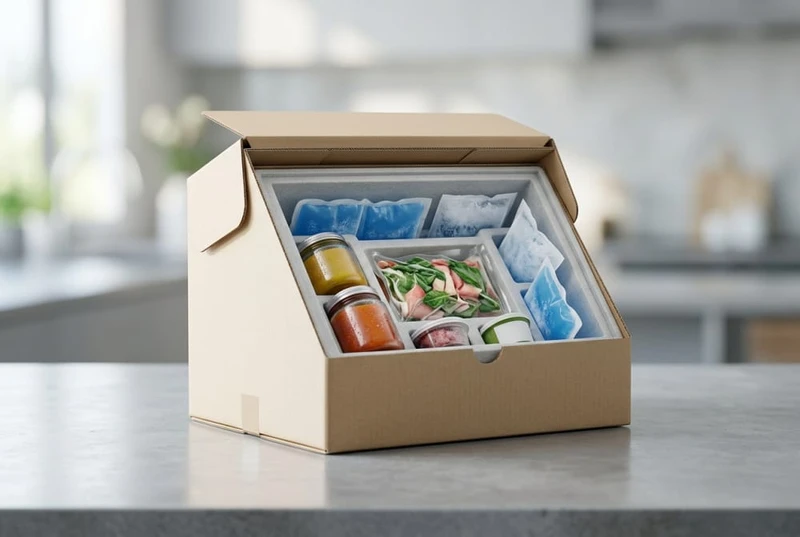
For food businesses in South Africa, cold-chain packaging is not a decorative extra; it is the barrier between saleable stock and temperature-damaged loss. From Cape Town seafood routes to Johannesburg fulfilment hubs, from Durban port imports to Pretoria retail distribution, packaged chilled and frozen products move through variable ambient conditions, long road miles and mixed handling environments. That means outer box strength, insulation choice, internal fit, labels and packing speed all need to work together.
The most effective approach is to match packaging to product sensitivity, journey length, handover points and packing line speed. Chilled dairy, frozen ready meals, meal kits and direct-to-consumer grocery boxes do not behave the same in transit. A box that performs well for a same-day urban delivery in Sandton may fail on a regional route to Bloemfontein or Gqeberha. Businesses therefore need packaging systems, not just boxes: structural cartons, liners, dividers, coolant placement, handling labels and expiry controls designed as one unit.
In practice, buyers in South Africa are looking for packaging that protects temperature, resists compression, packs quickly and still presents the brand professionally. That is especially true in e-commerce grocery, food subscription models, dairy distribution and export-linked chilled products. If you are sourcing custom cold-chain boxes or planning a new programme, the goal is to reduce temperature excursions without building a pack format so slow or expensive that operations become unstable.
This guide explains the major packaging decisions for chilled logistics, frozen shipping and rapid-delivery food fulfilment in the South African market. It also covers practical testing checkpoints, sticker and label applications, supplier assessment criteria and 2026 trends shaping cold-chain packaging investment.
How chilled foods, frozen foods and short-delivery formats differ
Chilled foods, frozen foods and short-delivery grocery formats may all sit inside a cold-chain programme, but they demand different packaging logic. Chilled products usually need to remain within a narrow positive temperature range. Examples include yoghurt, fresh dairy, salads, fresh sauces, cut fruit, premium meal kits and some ready-to-cook protein assortments. These items are highly sensitive to warming but often also sensitive to excess moisture and compression. Packaging for chilled applications must prioritise thermal hold for several hours or overnight while preserving product appearance.
Frozen foods behave differently. They often tolerate a broader handling window if the pack is properly insulated, but once thaw-refreeze cycles begin, quality falls quickly. Frozen prepared foods, ice cream inclusions, frozen bakery products and portioned proteins need stronger insulation and often tighter coolant planning. The packaging challenge is less about a narrow chilled band and more about preventing thermal gain over a longer route or more complex handover chain.
Short-delivery formats, such as online grocery dispatch within major metros like Johannesburg, Cape Town and Durban, often use a hybrid strategy. The distance may be short, but delivery density, rider delays, staging time and repeated door opening can destabilise temperature. In these cases, the packaging should support fast pick-and-pack operations, manageable cube efficiency and enough protection for the realistic last-mile delay, not just the ideal dispatch schedule.
The operational distinctions can be simplified into three questions: how cold must the product remain, for how long, and through how many touchpoints? Chilled dairy shipped from a distribution centre to a retailer in Centurion has different packaging needs from a frozen lasagne going through a courier network, and both differ again from a same-day grocery order delivered to a home in Umhlanga.
| Format | Typical products | Temperature risk | Transit profile | Main packaging priority | Operational note |
|---|---|---|---|---|---|
| Chilled retail | Dairy, sauces, fresh meals | Warming above target range | Store or DC routes | Moderate insulation with fit control | Condensation management matters |
| Frozen retail | Prepared foods, proteins, desserts | Thaw during delays | Longer or mixed routes | High thermal resistance | Coolant planning is critical |
| Same-day grocery | Mixed baskets | Delay at dispatch and doorstep | Urban last-mile | Fast packing with balanced insulation | Pack speed affects success |
| Meal kits | Protein, vegetables, sauces | Different component sensitivities | Scheduled home delivery | Zoning and internal separation | Leak control is essential |
| Dairy subscriptions | Milk, yoghurt, cheese | Chilled stability | Repeat routes | Reliable chilled hold and box integrity | Returns data helps optimisation |
| Export-adjacent inland transport | Premium chilled items | Time and climate exposure | Port-linked or inland transfer | Stronger structure and validated thermal design | Documentation and compliance increase |
The table shows why one standard box rarely works across every cold-chain application. Businesses that standardise too aggressively often end up overspending on insulation for easy routes or under-protecting on difficult ones.
The trend line reflects a realistic growth pattern driven by online grocery adoption, stronger chilled distribution networks, premium food categories and more specialised direct-delivery models across South Africa.
Aligning outer box strength with insulation and internal packing requirements
One of the most common mistakes in cold-chain packaging is treating structural board strength and insulation as separate decisions. In reality, the outer box, liner and inner supports must be engineered together. A well-insulated liner inside an under-specified outer carton still fails if the carton crushes in stacking, deforms under moisture or allows air gaps that shift coolant packs away from the product.
Outer box strength should be selected according to journey length, pallet stacking, courier handling and product mass. In South Africa, routes may include warehouse staging, long-distance trucking, cross-docking and last-mile transfer in warm weather. Corrugated board grade therefore needs to account for humidity exposure and real handling conditions, not only laboratory compression values. Frozen foods and mixed meal kits often require stronger outer cartons because coolant weight, product density and liner bulk place more load on the structure.
Insulation then needs to fit the actual thermal demand. There is no value in using a thick insulated liner if the box dimensions create large voids or if coolant placement is inconsistent. The right setup often includes a right-sized outer carton, a thermal liner or insert, strategic coolant placement and internal partitions that prevent contact damage or leakage transfer. Meal kits, for example, may need proteins isolated from ambient-tolerant dry goods while preserving cube efficiency.
Inner packing components do more than protect appearance. They stabilise product orientation, reduce dead air space and help ensure that the cold source cools the intended area. Dividers, sleeves, pads and corrugated inserts can also speed packing when designed for repeatable assembly. That is why custom formats often outperform generic cartons in chilled logistics.
For businesses evaluating packaging suppliers, access to tailored structures is important. A supplier able to design and manufacture custom box formats for chilled and frozen distribution can align board strength, dimensions and internal configuration with your route conditions instead of forcing your product into a standard mailer.
| Packaging element | Main function | Best used for | Risk if underspecified | Cost effect | Practical advice |
|---|---|---|---|---|---|
| Outer corrugated carton | Compression and handling resistance | All cold-chain formats | Crush, tearing, deformation | Moderate | Match board grade to route stress |
| Thermal liner | Slows heat gain | Chilled and frozen delivery | Temperature drift | Moderate to high | Fit liner tightly to reduce air gaps |
| Ice gel packs | Provides cold reserve | Short to medium routes | Product warms too fast | Variable | Position near most sensitive items |
| Dry ice system | Deep frozen support | Special frozen applications | Insufficient freeze retention | High | Use only with safe venting protocols |
| Dividers and inserts | Stops movement and damage | Dairy, glass, meal kits | Leakage, breakage, poor presentation | Low to moderate | Design for fast assembly |
| Absorbent pads | Controls leaks and condensation | Protein and fresh meal formats | Cross-contamination risk | Low | Use where proteins or sauces are packed |
This comparison makes clear that performance comes from system design. The best thermal result usually comes from a balanced pack, not from simply adding more coolant or thicker insulation.
Packaging configurations for meal kits, dairy items and frozen prepared meals
Different product categories create different packaging layouts. Meal kits require compartment thinking. Dairy needs compression stability and moisture awareness. Frozen prepared foods require stronger thermal retention and format efficiency. While these categories may overlap in the same distribution business, each benefits from a different box architecture.
Meal kits often contain proteins, vegetables, chilled sauces and dry pantry components. The packaging must separate unlike products while keeping the assembly process practical for staff. A common configuration uses a corrugated outer carton, fitted liner, top and side coolant placement, and internal corrugated compartments or sleeves. Proteins may sit at the base in sealed pouches, with absorbent material and a protective divider. Vegetables may be grouped in a separate zone to avoid bruising and moisture transfer. Recipe cards and dry items remain isolated from condensation-sensitive chilled products.
Dairy products, especially yoghurt multipacks, cultured drinks, cheese assortments and premium milk subscriptions, need stable orientation and low product movement. Dividers are important where rigid containers can knock against each other. For family-pack distribution or retail replenishment, the focus often shifts to stack strength and carton efficiency. For direct-to-consumer dairy, thermal retention and clean presentation matter more.
Frozen prepared foods such as lasagnes, soups, pies, ready curries and portioned meals perform best in box systems that reduce voids and keep packs tightly grouped. If the products are individually boxed, designers need to avoid wasted space that increases thermal loss. For pouches and trays, internal sleeves can create dense pack patterns that use coolant more efficiently. Stronger outer board is often justified because the combination of frozen product mass and coolant weight can be significant.
| Product category | Suggested outer box | Internal setup | Cooling method | Special risk | Best for |
|---|---|---|---|---|---|
| Meal kits | Double-wall or strong single-wall corrugated | Compartment inserts and sleeves | Gel packs top and side | Cross-contamination | Scheduled home delivery |
| Fresh dairy bundles | Rigid corrugated shipper | Dividers for cups or bottles | Light to medium gel packs | Compression and condensation | Urban grocery delivery |
| Cheese assortments | Premium corrugated carton | Tight-fit partitions | Moderate chilled support | Presentation quality | Subscription or gifting |
| Frozen ready meals | Heavy-duty corrugated | Dense stack arrangement | High-capacity gel packs or specialised coolant | Thaw on delay | Regional delivery |
| Frozen protein packs | Moisture-resistant corrugated shipper | Leak barrier and absorbent base | High thermal hold | Leakage and weight load | Direct-to-consumer fulfilment |
| Mixed grocery cold basket | Modular delivery carton | Zoned internal separators | Route-based coolant plan | Mixed sensitivity in one order | Online supermarket dispatch |
The right configuration also depends on your pick profile. If your team assembles 500 meal kits in a morning, the internal layout must support repeatable speed. If your frozen product moves through weekly courier drops to smaller towns, thermal endurance matters more than premium unboxing.
The bar chart highlights why online grocery, dairy and frozen meals are major decision points for packaging investment in South Africa’s cold distribution landscape.
Using stickers for handling instructions, storage guidance and expiry control
Stickers are often underestimated in cold-chain packaging, yet they solve several operational problems at low cost. They communicate handling instructions, reinforce storage requirements, support inventory control and reduce delivery errors. In chilled logistics, where one missed instruction can shorten shelf life or trigger rejection, stickers become part of the protection system.
Handling labels can signal “keep refrigerated”, “keep frozen”, “this side up”, “perishable” or “deliver immediately on arrival”. Storage note stickers help drivers, warehouse teams and customers understand the urgency of unpacking. Expiry control stickers can identify production date, packed-on time, use-by window, route code or customer order grouping. In meal kit operations, colour-coded labels can separate vegetarian, family-size or allergen-controlled units without slowing picking.
For South African operations, label durability matters. Condensation, liner friction and low temperatures can weaken adhesives if the stock is not chosen properly. Stickers applied to outer cartons should remain legible after cold room storage and vehicle loading. Inner labels may need food-safe use or moisture resistance depending on product contact risk. A supplier offering custom stickers for cold-chain handling and expiry control can help align material, adhesive and print legibility with the actual temperature environment.
Stickers also support customer experience. A direct-delivery dairy box that clearly states “refrigerate immediately” and “best enjoyed within 3 days of opening” reduces misuse at the doorstep. For subscription meal kits, well-placed labels reduce customer confusion and lower support tickets. For retailers, batch and shelf-life visibility supports faster backroom processing.
| Sticker type | Main purpose | Where applied | Best for | Material consideration | Operational benefit |
|---|---|---|---|---|---|
| Handling instruction sticker | Shows care requirements | Outer carton | All cold-chain shipments | Moisture-resistant face stock | Reduces mishandling |
| Storage note label | Informs unpacking behaviour | Outer carton or inner lid | Direct delivery | Readable in condensation | Improves customer compliance |
| Expiry date sticker | Tracks freshness window | Primary pack or carton | Dairy and fresh meals | Print clarity at low temperature | Supports stock rotation |
| Batch code sticker | Supports traceability | Case level | Manufacturing and recalls | Scannable surface | Speeds issue isolation |
| Route colour label | Sorts by delivery region | Outer carton | Metro dispatch | Bold ink contrast | Faster loading accuracy |
| Promotional or brand seal | Reinforces trust and branding | Closure point | Premium subscriptions | Adhesion on coated board | Better unboxing experience |
The value of sticker systems is that they add clarity without forcing a redesign of the core carton. They are especially useful when brands need to adapt quickly to product launches, seasonal SKU shifts or route-specific packing rules.
Ship-ready packaging options for online grocery and direct-to-consumer delivery brands
Online grocery and direct delivery brands need packaging that can move from packing bench to vehicle with minimal repacking. Ship-ready cold-chain packaging should protect the product, support fast fulfilment and present the brand well enough that the customer feels confidence on delivery. In South Africa, where delivery networks can vary from highly organised metro fleets to more fragmented courier arrangements, ship-ready formats must be robust.
The most common ship-ready choice is a corrugated carton designed around standard order sizes. The carton may include a fold-in thermal liner, die-cut insert positions for coolant and internal dividers for mixed baskets. This approach works well because it reduces assembly variability. Another option is the premium branded shipper used for subscription food services. These often combine improved print finish, stronger board and cleaner internal presentation, while still serving as the transport carton.
Some direct delivery brands use modular systems with several standard carton footprints: small chilled, mixed chilled, frozen heavy and family-size. This reduces stock complexity while still allowing decent fit across order patterns. For online supermarkets, shipping-ready packs should also support route staging and scanning. External printable areas for order labels and route stickers can materially improve dispatch flow.
Returns and reverse logistics should also be considered. Although many cold-chain cartons are single use, some sectors test reusable totes or hybrid outer systems for predictable routes. However, for many South African operations, corrugated-based custom shipping boxes remain the practical balance of hygiene, branding, transport efficiency and cost control.
| Packaging format | Strengths | Limitations | Best use case | Branding value | Operational fit |
|---|---|---|---|---|---|
| Standard insulated corrugated shipper | Versatile and scalable | Less premium look | Online grocery | Moderate | High |
| Premium branded cold box | Strong customer impression | Higher unit cost | Meal kits and subscriptions | High | Moderate to high |
| Modular carton family | Good order-size flexibility | Requires planning discipline | Growing DTC brands | Moderate | High |
| Courier-optimised frozen shipper | Better endurance | More bulky | Regional frozen delivery | Moderate | Moderate |
| Retail-ready plus transit sleeve | Dual-use potential | More design complexity | Omnichannel brands | Moderate to high | Moderate |
| Reusable tote model | Repeat route sustainability appeal | Return management burden | Dense subscription routes | High | Low to moderate |
The right choice depends on whether your priority is speed, brand impact, route endurance or carton standardisation. Many brands end up using a mixed portfolio rather than one universal shipper.
Where packing speed and thermal protection usually clash in real operations
In real fulfilment environments, packing speed and thermal protection often pull in opposite directions. The most protective pack may involve multiple inserts, careful coolant positioning and tightly controlled sequence steps. But every additional step adds labour time and increases the chance of inconsistency during peak shifts. On the other hand, a packaging format optimised only for speed may leave products exposed to avoidable temperature drift.
This conflict is common in grocery picking centres, meal kit assembly lines and dairy dispatch rooms. For example, a liner that performs well thermally may be awkward to open and fit under time pressure. A dense frozen configuration may protect product but slow item counting and order verification. A complex divider system may reduce breakage but become a bottleneck during promotional peaks.
The answer is not to sacrifice thermal performance blindly. It is to redesign the pack for repeatable speed. That may mean pre-folded inserts, clearer packing sequences, route-based coolant kits, standardised order bands or box sizes that reduce operator decision-making. In our experience across high-quality paper box and packaging production, good cold-chain packaging is not only a matter of material selection. It depends on technological capability: precise die-cutting, consistent board conversion and reliable repeatability from batch to batch so assembly remains stable at scale.
Manufacturing capability also matters. Advanced machinery helps keep structural tolerances consistent, which is critical when liners, inserts and cartons must fit correctly every time. Professional production teams and final inspection controls reduce the variation that can otherwise slow a packing line. Service capability is equally important, especially when clients need small-batch trials before rolling into large-scale production, or when a fast seasonal adjustment is needed for a new chilled SKU in the South African market.
The companies that solve the speed-versus-protection problem usually map the full packing process, time each action, then redesign the packaging to remove wasted motion without reducing the thermal safety margin.
The area chart shows the market shift toward pack designs that preserve temperature while reducing fulfilment complexity. This is expected to intensify into 2026.
Testing checkpoints before launching a cold-chain packaging programme
No cold-chain packaging programme should launch without structured testing. A carton that looks correct on a sample table may still fail in a loaded vehicle in summer conditions outside Durban or on a delayed route from Johannesburg to Polokwane. Pre-launch testing should therefore combine laboratory logic, operational simulation and live-route validation.
The first checkpoint is dimensional and structural validation. Confirm that every item fits as intended, that inserts lock correctly and that the outer carton holds expected weight. The second is thermal validation: test the packaging in realistic ambient conditions for the full expected transit time plus a delay allowance. The third is handling validation: stack, move, drop and vibrate the package in ways that reflect actual warehousing and transport. The fourth is pack-line validation: observe whether staff can assemble the format consistently at commercial speed.
Businesses should also test label readability after exposure to cold and moisture, as well as carton integrity after condensation cycles. If your products contain liquids, sauces or proteins, leak-path testing is necessary. Finally, real-route pilot shipments should include data loggers or at least timed temperature checks. These practical trials often reveal issues that controlled tests miss, such as prolonged staging before vehicle departure or uneven coolant placement by new staff.
| Checkpoint | What to test | Why it matters | Recommended method | Typical failure sign | Decision impact |
|---|---|---|---|---|---|
| Dimensional fit | Product, liner and insert fit | Controls movement and voids | Trial packing | Loose contents or crushed corners | Adjust dieline or insert design |
| Compression strength | Box stacking endurance | Prevents crush in warehousing | Load simulation | Panel bowing or collapse | Upgrade board specification |
| Thermal hold | Temperature retention over time | Core food safety measure | Ambient chamber or route simulation | Temperature threshold breach | Change insulation or coolant |
| Drop and vibration | Transit shock performance | Replicates handling events | Courier-style test cycle | Broken seals or shifted product | Add internal stabilisers |
| Condensation resistance | Surface and adhesive stability | Protects labels and carton integrity | Cold-warm exposure cycle | Peeling labels or softened board | Change coating or sticker stock |
| Pack-line speed | Assembly time and consistency | Ensures operational viability | Timed pilot shift | Slow throughput or errors | Simplify pack sequence |
These checkpoints should be reviewed not only once, but again after any material change, size revision, route extension or major seasonal climate shift. Cold-chain packaging is a living operational system, not a static printed box.
What to check in a supplier for custom chilled-logistics packaging
Choosing a supplier for custom chilled-logistics packaging requires more than comparing unit prices. Buyers should look for a partner that can understand route conditions, packaging mechanics and production consistency. In South Africa, where temperature exposure, distance and handling conditions can vary sharply across regions, a supplier’s ability to adapt designs is often more important than simply offering catalogue boxes.
First, assess technological capability. Can the supplier translate product and route data into practical packaging structures? Advanced converting equipment, accurate die-cutting and dependable print alignment matter because cold-chain packs often rely on precise insert and liner fit. If you use stickers for handling and traceability, ask whether the supplier can also coordinate those components so packaging and labels work together operationally.
Second, assess manufacturing capability. A supplier should be able to support both pilot runs and scaled production without quality drift. Flexible output is useful for South African brands moving from regional launch to national rollout. Consistency in material selection, board conversion and inspection helps protect pack performance, especially where minor dimensional variation could affect thermal retention or assembly speed. High-quality production discipline from material choice to final inspection is a strong sign of reliability.
Third, assess service capability. Cold-chain packaging projects often need quick revisions, sample rounds and collaborative problem solving. Suppliers that can respond efficiently to small-batch customisation as well as larger-volume orders are usually more valuable than low-cost vendors with rigid processes. Ask about sampling lead times, engineering feedback, issue escalation and how they support changes when a customer adds new SKUs or distribution regions.
It is also wise to ask whether the supplier has experience with paper boxes, stickers and broader packaging solutions under one service model. That can reduce coordination delays and improve consistency in launch preparation.
This comparison reflects what buyers usually discover after launch: consistent execution and practical engineering support are often worth more than a slightly cheaper box price.
South African market realities shaping cold-chain packaging decisions
The South African market creates a specific set of packaging pressures. Climate exposure can be severe in summer. Delivery routes may combine efficient urban logistics with less predictable regional transport. Retail and direct-to-consumer channels often overlap. Imported ingredients may move through Durban or Cape Town before inland distribution, while domestic food producers may ship across long distances between manufacturing sites, DCs and end customers.
Urban hubs such as Johannesburg, Cape Town and Durban are leading adoption of direct-to-consumer chilled formats, online grocery fulfilment and premium prepared meals. Pretoria, Centurion and Ekurhuleni support distribution and industrial food movement, while inland routes to places like Bloemfontein, Mbombela and Polokwane test route endurance. This geography means pack formats often need tiered specifications rather than one universal national design.
Cost pressure is another market reality. Food producers and retailers want thermal protection, but not at the expense of unsustainable material use or labour-heavy pack formats. That is why right-sizing, modular box families and targeted insulation are becoming more common. Rather than using maximum packaging everywhere, leading brands define route classes and product classes, then match packaging accordingly.
There is also rising attention on sustainability and compliance. Buyers increasingly ask for recyclable paper-based structures where possible, lower material waste, better cube efficiency and smarter label communication. By 2026, the strongest programmes in South Africa are likely to combine performance validation with material efficiency and clearer environmental accountability.
Applications across industries and practical case patterns
Cold-chain packaging decisions do not belong only to supermarkets. They affect subscription meal brands, dairy processors, premium butchers, seafood suppliers, health-food retailers, convenience food manufacturers and omnichannel grocery platforms. Each industry adapts the same basic tools differently.
A meal kit business shipping weekly from Johannesburg may use compartment-based cartons with repeatable insert geometry and customer-specific stickers. A dairy brand supplying both retailers and home delivery in Cape Town may use transit cartons for bulk replenishment plus more presentation-led ship-ready boxes for subscription packs. A frozen ready-meal producer moving stock between Durban and inland metros may prioritise stack strength and route endurance, accepting a simpler visual finish.
One practical case pattern is route segmentation. A brand serving Sandton, Midrand and Pretoria on same-day runs can use lighter insulation and faster-packing formats than for overnight distribution to the Free State. Another pattern is product zoning. Mixed baskets perform better when products are grouped by sensitivity instead of packed simply by size. A third pattern is sticker-led control: colour-coded carton labels for route, use-by date and category can improve dispatch speed without redesigning the box.
Businesses that achieve the best results usually monitor spoilage complaints, delivery exceptions, packing time and carton failure rates together. Temperature performance alone is not enough. The packaging has to support commercial reality.
Our role in custom packaging for chilled distribution
For companies entering or improving cold-chain shipping in South Africa, the most useful packaging partner is one that can connect design, production and delivery practicality. Our work in packaging supports that need through three strengths.
On the technology side, we use advanced machinery and a skilled team to produce high-quality paper boxes, stickers and coordinated packaging solutions with close attention to detail. That matters in chilled logistics because accurate converting, print consistency and repeatable sizing all affect assembly speed and packaging performance.
On the manufacturing side, we manage both smaller customised runs and larger production volumes with the same focus on material selection and final inspection. This helps food brands test new chilled or frozen formats before scaling, while still keeping a path open for higher-volume rollout.
On the service side, we aim to stay flexible and efficient so that packaging can adapt to client requirements, whether that means revising a meal kit insert, improving an outer carton for dairy handling or integrating sticker solutions for clearer cold-chain control. In a market where delivery formats and product ranges evolve quickly, that flexibility is often as important as the box itself.
Buying advice for brands planning a 2026-ready cold-chain packaging strategy
Looking toward 2026, cold-chain packaging strategy in South Africa should be built around five priorities. First, use route-based design rather than one-size-fits-all packaging. Second, validate packs under realistic heat and delay conditions. Third, simplify packing steps without reducing thermal safety. Fourth, incorporate better label and sticker systems for traceability and customer guidance. Fifth, improve sustainability by reducing excess space, unnecessary layers and overbuilt board where it is not needed.
Technology will continue to influence the sector. More brands will use temperature data, route analytics and digital order sorting to refine packaging specifications. Policy and retailer expectations are also likely to move toward stronger accountability on food safety, recyclable materials and clearer date coding. Sustainability trends will favour efficient corrugated design, reduced waste inserts and smarter ship-ready formats that eliminate redundant secondary packaging.
Buyers should request samples, test reports, production detail and revision support before committing. A low headline unit cost means little if spoilage, returns or packing delays rise. The correct question is not “what is the cheapest box?” but “what packaging system protects margin, product and customer trust on our real routes?”
Frequently asked questions
What is the best packaging for chilled food delivery in South Africa?
The best packaging depends on product type, route duration and handling conditions. For many chilled deliveries, a strong corrugated outer carton with fitted insulation, correctly sized coolant and clear handling labels provides the best balance of cost and protection.
Do frozen foods always need thicker insulation than chilled foods?
Often yes, but not always. Frozen products generally need stronger thermal retention, especially on longer routes. However, pack fit, coolant placement and outer box strength are just as important as liner thickness.
Why are stickers important in cold-chain packaging?
Stickers improve handling, storage communication, expiry control and route sorting. They help warehouse teams, drivers, retailers and consumers act correctly and quickly.
Can one box format work for meal kits, dairy and frozen foods?
Usually not. These categories have different thermal, structural and packing-speed requirements. A modular family of related box formats is often more effective than one universal design.
What should be tested before launch?
At minimum, test dimensional fit, compression strength, thermal hold, drop and vibration resistance, condensation performance, label readability and pack-line speed.
What should I ask a packaging supplier?
Ask about design capability, material options, production consistency, sample support, inspection processes, scale flexibility and whether they can integrate boxes with sticker and labelling requirements.
