
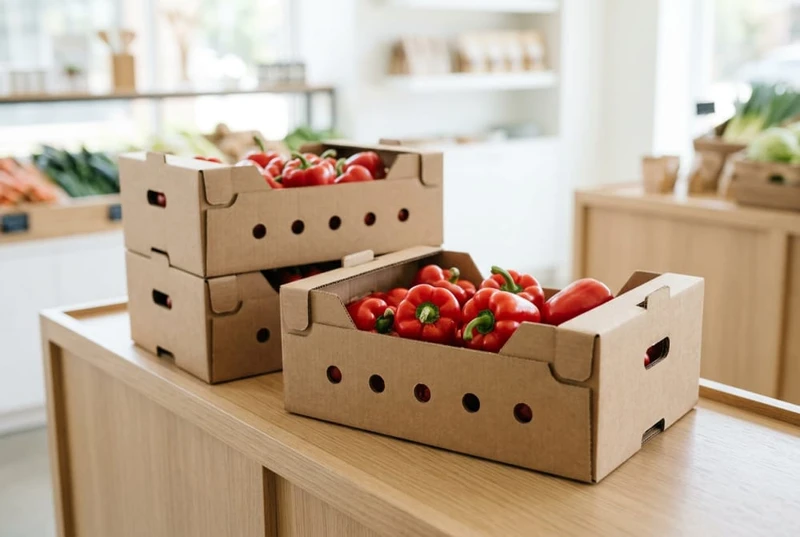
Fresh produce packaging in South Africa has to do far more than hold produce in place. A box for citrus leaving the Western Cape, avocados moving through Johannesburg market channels, potatoes packed near Limpopo, or mixed vegetables supplied to retailers in Durban all face different pressure points. Ventilation, stacking strength, sizing, moisture tolerance, shelf presentation and traceability all affect whether produce arrives in saleable condition. The right structure reduces bruising, limits heat build-up, improves handling speed and helps stores present produce more cleanly.
For growers, packers and distributors, custom packaging becomes practical when it solves real operating problems. A well-designed custom produce box solution can match crop weight, carton dimensions, pallet footprint and outlet requirements instead of forcing every crop into one generic pack. In South Africa, where supply routes may run from farms to municipal markets, cold rooms, cross-docks, supermarkets and export staging points, packaging must perform consistently across different environments. That is why box design, board grade, vent placement and label strategy should be planned together rather than as separate decisions.
This article explains how fruit, vegetables, mixed produce and farm-packed goods benefit from tailored carton design, where standardisation helps, where custom sizing matters, and how packaging can support merchandising as well as protection. It also covers the practical mistakes that often damage produce before sale and shows how professional packaging workshops with advanced machinery, flexible production and reliable quality checks can support South African buyers from trial runs to larger ongoing orders.
Packaging considerations for fruit, vegetables, mixed produce, and farm-packed goods
Different produce types create different risks inside the same logistics system. Fruit such as apples, pears, citrus, stone fruit and avocados is often sensitive to compression, vibration and rubbing. Leafy vegetables need airflow and moisture management. Root vegetables can handle more weight but may still suffer from scuffing, heat or poor pallet stability. Mixed produce packs face the added challenge of combining items with different respiration rates, firmness and shelf cycles.
In South Africa, these differences become clear across major production areas. Table grapes and citrus from the Western Cape often move through highly organised cold-chain handling. Tomatoes, onions and potatoes supplied inland may pass through wholesale markets or regional distributors where speed and repeated handling are common. Produce packed directly on farms for nearby retail programmes may need shelf-ready features rather than long-haul export durability. Packaging cannot be judged only by unit cost; it has to be judged by delivered condition, labour efficiency and retail presentation.
| Produce category | Main packaging risk | Useful box feature | Preferred handling style | Typical local route | Packaging note |
|---|---|---|---|---|---|
| Citrus | Compression and heat retention | Vent slots with strong corners | Cold-chain pallet movement | Ceres to Cape Town or export depots | Needs stack strength with controlled airflow |
| Apples and pears | Bruising from movement | Accurate fit and smoother internal surfaces | Careful stacking and low drop handling | Elgin to retail DCs | Box depth should limit top load damage |
| Tomatoes | Side pressure and crushing | Shallow tray style with top visibility | Fast market handling | Limpopo to Joburg Market | Overfilling quickly reduces saleable quality |
| Leafy vegetables | Heat build-up and moisture imbalance | Generous ventilation and lighter pack weights | Rapid chilled movement | KZN to retail stores | Ventilation must support freshness, not dehydration |
| Potatoes and onions | Tear risk and rough movement | Robust board and stable pallet dimensions | Bulk stacking | Free State to wholesale channels | Strength matters more than display finish |
| Mixed farm packs | Uneven weight distribution | Custom sizing and partitions where needed | Retail replenishment | Regional farm to local stores | Needs balance between protection and shelf appeal |
The table shows why category-specific choices matter. A single board grade or box depth will not suit every crop. For farm-packed goods sold through local chains or neighbourhood greengrocers, the best structure may be one that moves from packing line to shelf with minimal repacking. For wholesale routes, a stronger transport-focused structure may be more important. In both cases, carton design should reflect the produce’s respiration, weight, sensitivity and route length.
Customisation also matters for packed produce sold as part of promotions or origin-based branding. South African growers increasingly use packaging to communicate farm identity, region and varietal information. This gives the carton a dual role: physical protection and commercial communication. When box shape, print area and sticker placement are considered early, the final pack works better operationally and visually.
Ventilation, stackability, and box sizing decisions that affect real-world performance
Ventilation is often discussed in broad terms, but real performance depends on where vents are placed, how many there are, how they align in stacked loads and whether they weaken structural integrity. A vent pattern that looks sufficient on a flat drawing may fail once boxes are palletised tightly in a truck. South African summer transport conditions, route delays and ambient loading areas make airflow especially important for produce that still respires actively after packing.
At the same time, vent area cannot compromise stackability. A produce carton must support vertical loads in warehouses, vehicles and store back rooms. If vents cut too deeply into corner strength or side-wall support, cartons may bow or collapse, especially in humid conditions or under long-distance transport vibration. That is why vent placement should be engineered together with board choice, fold design and expected stacking height.
| Decision point | Too little | Too much | Best practice | Operational effect | Commercial outcome |
|---|---|---|---|---|---|
| Vent area | Heat build-up | Loss of strength | Balance by crop and route | More stable temperature control | Longer shelf life |
| Box depth | Overflow and rubbing | Empty headspace movement | Match produce size range | Reduced bruising | Better pack presentation |
| Base footprint | Poor pallet use | Awkward handling | Fit pallet patterns exactly | Fewer load shifts | Lower freight waste |
| Board grade | Crush failure | Excess cost | Choose for humidity and load | Safer stacking | More predictable landed cost |
| Hand holes | Rough lifting | Weakened side panels | Reinforce around grip zones | Cleaner handling | Less handling damage |
| Top opening style | Difficult inspection | Reduced protection | Align with retail or wholesale use | Faster receiving checks | Improved stock flow |
Custom sizing is often one of the most valuable improvements because it affects several performance points at once. If a box is too large, produce shifts during transport, corners knock against each other, and empty air increases wasted truck space. If a box is too small, overpacking becomes common and side pressure rises. The ideal carton leaves enough room for safe loading without creating unstable voids. For round fruit, exact height control can reduce top-layer compression. For mixed vegetables, accurate compartment planning can stop one item from damaging another.
Stackability also depends on consistency. When growers use multiple ad hoc box sizes across similar lines, pallets become irregular. That increases wrapping difficulty, creates unstable loads and complicates truck loading. A standard family of dimensions across crop groups can improve warehouse flow without forcing every product into the same unsuitable pack. Many South African operations benefit from a modular packaging plan that aligns with common pallet sizes used by distribution centres and transporters.
The chart reflects a realistic market trend: stronger demand for produce cartons that combine structural performance with retail-ready design. Buyers increasingly look beyond basic containment and focus on measurable gains such as lower damage rates, faster receiving and better on-shelf appearance. As this trend continues toward 2026, sizing and ventilation decisions will remain central to supply performance.
How handling needs change between wholesale markets, retail stores, and transport routes
Produce packaging is handled differently depending on where it goes. A box moving through the Johannesburg Fresh Produce Market may be loaded, unloaded, restacked and inspected multiple times in a short period. A retail distribution centre may value uniform pallet patterns and scan-friendly labels. A direct-to-store route may prioritise fast shelf replenishment. A long-distance transport route from Polokwane to Durban or from the Hex River Valley to Gauteng may expose produce to vibration, changing temperatures and delays at loading points.
Because of this, the “best box” is not a universal box. Wholesale channels usually need strong edges, easy carrying features and resilience against rougher touchpoints. Retail channels often need cleaner printing, easier opening and better presentation when the carton is placed on shelf or in produce bins. Long-haul transport requires stable pallet geometry, reliable crush strength and ventilation suited to route conditions. Farm gate deliveries to local stores may need lightweight cartons that still present produce neatly without additional trays or repacking.
| Channel | Main handling condition | Key packaging demand | Common failure if ignored | Recommended box style | Benefit |
|---|---|---|---|---|---|
| Wholesale market | Frequent manual handling | Grip access and corner strength | Torn sides and dropped produce | Reinforced carry carton | Lower handling loss |
| Retail DC | Uniform pallet intake | Standard dimensions and labels | Slow receiving and restacking | Barcode-ready standard box | Faster processing |
| Direct-to-store | Quick shelf replenishment | Easy-open display front | Extra labour in-store | Display-ready tray carton | Cleaner presentation |
| Long-haul truck route | Vibration and stacking pressure | Strong board and load stability | Bruising and box collapse | Heavy-duty vented carton | Better arrival quality |
| Cold-chain route | Moisture and temperature change | Humidity-resistant structure | Softening board | Moisture-tolerant corrugated pack | Maintained stacking integrity |
| Farm shop or local market | Short route, visible selling | Branding and clean display | Untidy shelf appearance | Small branded tray or box | Higher visual appeal |
For South African buyers supplying more than one route, a packaging matrix is often useful. Instead of creating one package per customer, operations can use a structured range: one heavy-duty wholesale option, one retail display option, one mixed-produce option and one local-market economical option. This keeps procurement manageable while still aligning packaging to real handling conditions.
Transport routes also shape damage patterns. Produce travelling through Cape Town port precincts, Durban logistics zones or inland hubs around City Deep can face delays, transfers and variable storage conditions. When cartons are not matched to these realities, losses often show up as soft fruit, rubbed skins, bottom compression or poor shelf appearance rather than outright carton failure. That makes packaging underperformance easy to underestimate. In practice, good box design protects margin as much as it protects produce.
Sticker uses for origin, variety, traceability, and merchandising support
Stickers are a small packaging component with large operational value. In fresh produce, they help confirm origin, identify variety, support batch traceability, guide store staff and improve shelf communication. For South African growers and packers, sticker systems are especially useful when a business supplies different grades, sizes or regional programmes under one umbrella brand. A well-planned label strategy can make receiving, rotation and product recognition much easier across farms, depots and stores.
Origin stickers are important when buyers want to highlight local sourcing, provincial identity or farm-specific branding. Variety stickers help distinguish premium fruit types or retail promotions. Traceability stickers support recall readiness and internal stock control. Merchandising stickers can also guide shoppers with ripeness notes, pack size, serving ideas or promotional messaging. When these functions are combined thoughtfully, stickers improve both compliance and sales support.
A reliable custom sticker programme can be matched to box surfaces, cold-chain conditions and print needs. Adhesive choice matters because labels may face chilled storage, moisture, handling friction and uneven carton textures. For produce businesses serving multiple channels, using coordinated sticker formats across cartons, inner packs and display trays helps staff identify stock quickly and reduces labelling errors.
| Sticker use | What it communicates | Best placement | Operational value | Retail value | Typical South African example |
|---|---|---|---|---|---|
| Origin label | Farm or region | Front panel or top edge | Supports source verification | Builds local trust | Western Cape citrus line |
| Variety label | Cultivar name | Visible side panel | Prevents pick errors | Supports premium pricing | Different apple varieties |
| Traceability code | Batch and pack date | Consistent scan zone | Improves recall control | Indirect quality confidence | Retail supply packs |
| Grade sticker | Class or size range | Top and side panel | Speeds dispatch sorting | Clarifies assortment | Wholesale tomatoes |
| Promo sticker | Offer or seasonal note | Display front | Supports campaign execution | Drives impulse buying | Holiday fruit displays |
| Handling label | Store or transport instruction | Side near hand hold | Reduces misuse | Protects appearance | Do not overstack notices |
The value of stickers increases when they are standardised across crop families. If one tomato line uses a different code structure from another, receiving teams may misread stock. If farm origin appears in inconsistent locations, store staff lose time identifying product. Standard position, colour logic and data fields can improve flow without making the packaging look generic. This is particularly useful for businesses supplying municipal markets, independent retailers and chain supermarkets at the same time.
From a merchandising perspective, sticker design should support the visual hierarchy of the carton, not clutter it. A clear brand mark, readable variety name and concise traceability block usually work better than too many small elements. For shelf-level performance, shoppers should be able to identify product type and quality cues quickly. For back-of-house operations, staff should be able to scan or confirm stock without opening every box.
Display-ready packaging ideas that help produce sell more cleanly at shelf level
Display-ready packaging has become more relevant as retailers look for cleaner produce presentation, faster replenishment and less in-store waste. In practical terms, display-ready means the carton can move from back room to selling area with little or no repacking. For fresh produce, this requires a careful balance: enough structure for transport, enough openness for visibility, and enough design clarity to support the store environment.
Common formats include front-cut trays, perforated tear-away cases, shallow produce crates lined with printed sleeves, and reinforced open-top cartons. For citrus, apples and avocados, a front display panel can show the fruit while holding the stack securely. For tomatoes, mushrooms and mixed vegetables, shallow trays help avoid over-stacking and allow staff to rotate stock more easily. For farm shops and premium retailers, printed tray walls can reinforce origin messaging and make produce look more organised.
Display-ready packs are especially useful in urban retail environments such as Sandton, Pretoria East, Umhlanga and Cape Town’s supermarket clusters, where shelf neatness and quick restocking support sales. In smaller independent stores, they also help because staff resources are limited. A carton that opens cleanly and sits neatly on shelf saves labour and reduces rough handling during unpacking.
The bar chart shows realistic differences in retail demand. Tomatoes and mixed packs often benefit most from display-ready structures because shelf turnover is fast and presentation affects buying decisions immediately. Potatoes tend to require less visual merchandising support, although selected branded premium packs may still use display trays effectively.
Good display-ready packaging should also consider store hygiene and produce rotation. Smooth-opening perforations reduce tearing and keep shelves tidy. Stable tray walls prevent fruit from rolling. Clear label placement helps staff identify stock without moving cartons repeatedly. These details may seem minor, but they influence shelf cleanliness, labour time and customer perception.
For packers that want to use display-ready formats across more lines, packaging development should involve both logistics and merchandising teams. A carton that looks attractive but fails during transport is not a useful innovation. Likewise, a strong wholesale box may still underperform in retail if opening it is awkward or if the front edge hides the product. The most successful designs work through the whole chain, from packing station to checkout.
Where custom sizing reduces bruising, wasted space, and transport inefficiency
Custom sizing directly affects product protection and logistics cost. In produce, bruising often comes from movement inside the carton rather than from dramatic impacts. If produce is free to roll, bounce or settle unevenly, minor transport vibration becomes cumulative damage. This is common with apples, pears, stone fruit and avocados packed in boxes that are slightly too wide or too deep. The same issue can affect mixed produce when heavier items shift into lighter ones.
Wasted space is another hidden cost. Oversized cartons reduce pallet density and truck fill rates. This matters in South Africa, where long inland routes can make freight a major cost driver. A poorly sized box may mean fewer cartons per pallet, more voids in loads, less stable stacking and higher wrap consumption. On export-linked supply routes, dimension inefficiency can also affect cold room planning and staging efficiency.
Custom sizing works best when developed around real produce dimensions, target fill weight, pallet pattern and channel requirement. In some cases, only a small adjustment in box height or footprint can improve performance significantly. For example, reducing internal height may prevent top-layer fruit shift. Narrowing the width of a mixed vegetable carton may stop bunches from collapsing sideways. Aligning outer dimensions with standard pallet patterns can improve stacking integrity and reduce dead space in vehicles.
| Packaging issue | Effect on produce | Effect on logistics | Custom sizing fix | Best suited crops | Expected result |
|---|---|---|---|---|---|
| Too much box height | Top layer movement | Unstable stacks | Reduce internal depth | Apples, pears, tomatoes | Less bruising |
| Too wide footprint | Side-to-side rolling | Poor pallet density | Tighter width tolerance | Citrus, avocados | Better fit and fuller loads |
| Irregular box family | Mixed load pressure points | Awkward pallet layouts | Modular dimension set | Multi-crop operations | More stable transport |
| Undersized box | Overfilling compression | Difficult closing | Increase height or side wall | Tomatoes, onions | Reduced crush damage |
| Loose mixed packs | Items knock together | Higher returns | Add internal fit planning | Farm veg boxes | Cleaner arrival condition |
| Non-standard outer size | Indirect damage from instability | Truck space waste | Match pallet footprint | All categories | Lower freight inefficiency |
These gains are especially relevant for growers scaling from farm-packed local supply into broader regional distribution. A box that works for short trips to nearby outlets may become inefficient over longer routes to Gauteng or coastal metros. Reviewing sizing at that stage often delivers measurable savings in damage reduction, pallet use and labour handling.
Well-equipped packaging workshops can support this process by testing dimensions, mock-up samples and production consistency. With advanced converting equipment and careful inspection processes, suppliers can produce both small custom runs and larger repeat orders with better dimensional reliability. That matters because even a good design loses value if manufacturing tolerances are inconsistent.
Transport and stocking mistakes that often damage produce before sale
Many produce losses blamed on “bad fruit” actually begin with packaging and handling mistakes. Overstacking is one of the most common. When cartons are stacked beyond their design limit, bottom layers take extra pressure and the board may soften in humid conditions. Another frequent issue is misaligned pallet stacking, where top cartons bridge awkwardly or rest on unsupported vent areas. This can lead to crush points and gradual deformation during transport.
Incorrect box selection is another common mistake. Using a retail display carton for a rough wholesale route or using a lightweight box for a long-haul summer journey often leads to quality loss. Poor ventilation alignment on pallets can trap heat. Overfilling cartons can create bruising before the truck even leaves the packhouse. At store level, staff may cut cartons open roughly, place them on damp floors or stack incompatible sizes together, which damages both produce and packaging appearance.
The table below highlights the mistakes that occur most often and how to avoid them.
| Mistake | Where it happens | Damage caused | Why it happens | Prevention | Commercial impact |
|---|---|---|---|---|---|
| Overstacking cartons | Warehouse or truck | Compression bruising | No stack limit control | Print and train on max stack height | Higher rejects |
| Using wrong box grade | Packing stage | Box crush and product movement | Cost-driven substitution | Match board to route and crop | False savings |
| Blocked ventilation | Pallet wrapping | Heat build-up | Poor vent alignment | Plan vent layout with stacking pattern | Shorter shelf life |
| Overfilling produce | Packhouse | Rubbing and top pressure | Inconsistent fill control | Use fill guides and exact box depth | Lower saleable quality |
| Rough shelf opening | Retail back room | Torn trays and spillage | No easy-open design | Use perforated display-ready fronts | Untidy merchandising |
| Mixing box sizes on one pallet | Dispatch and store | Load instability | Unplanned standardisation | Use modular size families | More handling loss |
One practical way to cut these losses is to build packaging instructions into normal operating routines. Cartons should include clear handling cues where needed, while supervisors should standardise pallet patterns and stack limits. Where multiple product categories run through the same site, colour-coded labels or size families can help teams choose the right pack more reliably.
This is also where service capability from a packaging supplier matters. Buyers often need more than manufacturing alone. They need sample adjustment, advice on structure choice, flexibility for seasonal changes and reliable repeat supply during peak harvest windows. A supplier that can respond quickly to changes in pack format or volume helps reduce the chance that operations fall back on unsuitable stock when demand shifts suddenly.
How growers and packers can standardize packaging across different crop categories
Standardisation does not mean forcing all products into one carton. It means building a packaging system that simplifies procurement, improves logistics and keeps enough flexibility for crop-specific needs. For South African growers and packers handling fruit, vegetables, mixed produce and farm-packed goods, the best approach is usually a modular structure: a limited set of footprints, board grades and label positions, with crop-specific venting, depths and display features added where necessary.
For example, a business might standardise outer footprint dimensions across apples, citrus and avocados for pallet efficiency, while still varying internal depth and vent pattern by crop. Another operation may use the same side-panel branding zone and traceability sticker area across all lines, even though tray heights differ. This creates consistency in warehousing and merchandising without ignoring produce behaviour.
The area chart reflects a realistic industry shift toward more crop-specific but system-based packaging. By 2026, sustainability reporting, traceability requirements and retail expectations are likely to push more growers toward documented packaging standards. At the same time, policy and buyer pressure around recyclability, transport efficiency and food waste reduction will make poor packaging choices more visible commercially.
Technology will shape this shift. Better die-cutting precision, improved print consistency, more accurate short-run sampling and data-linked labelling all support smarter packaging programmes. Packaging workshops with modern equipment can help customers refine vent placement, dimensions and branding across several crop categories without losing production efficiency. Flexible manufacturing is especially important in produce because volumes vary seasonally and pack requirements often change by retailer or harvest condition.
Manufacturing capability also matters at scale. Consistent board conversion, accurate creasing, dependable adhesion and final inspection help ensure that the box used in March performs like the box used in July. For agricultural customers, this reliability can be as important as the original design. In addition, service capability such as small-batch trial support, large-volume output and responsive scheduling makes it easier for packers to adopt better packaging without operational disruption.
The comparison chart shows the criteria South African buyers increasingly use when assessing packaging partners. Custom sizing, ventilation design and traceability support rank highly because they influence both operational outcomes and retail readiness. Buyers often discover that low-price supply without technical support leads to higher losses later in the chain.
Looking ahead to 2026, three themes are likely to shape standardisation decisions. First, sustainability expectations will reward right-sized recyclable packaging that reduces waste and transport inefficiency. Second, policy and retailer compliance demands will increase the importance of traceability and clearer labelling. Third, automation and data use in packing and warehousing will favour consistent carton footprints, standard scan zones and repeatable manufacturing quality.
South African market realities, applications, and buying advice
South Africa’s produce trade combines formal retail systems, busy municipal markets, regional distributors, export-linked cold chains and informal local selling points. That mix means packaging buyers should evaluate boxes according to route, customer type and crop behaviour rather than headline price alone. Durban and Cape Town matter for port-linked movement, while Johannesburg remains central for inland trade and redistribution. Pretoria, Polokwane, Mbombela, Gqeberha and Bloemfontein all reflect different demand patterns and transport realities.
Applications vary across industries. Growers need protection at harvest and dispatch. Packers need line efficiency and dimensional consistency. Wholesalers need robust handling performance. Retailers need shelf-ready presentation and traceability. Hospitality suppliers, meal-box programmes and fresh-cut support businesses may need smaller mixed-produce formats with stronger visual branding. Because one packaging style rarely serves all these applications well, buyers should assess their top two or three channels first and build a packaging range from there.
Buying advice starts with asking practical questions. How far does the produce travel? Is the route chilled or ambient? How many times is the box touched? Does the carton go straight to shelf? Does the customer need farm identity, variety visibility or scan-ready traceability? What is the acceptable damage percentage, and where does damage usually occur? The answers determine the right mix of board grade, vent design, dimensions, print treatment and stickers.
A short case example illustrates the point. A mixed-produce supplier in Gauteng serving both independent retailers and a supermarket programme may use one generic carton for everything. The result is usually wasted space for smaller vegetable assortments, overfilling on heavier lines and inconsistent shelf presentation. By moving to two modular sizes with one shared branding system and standard sticker zones, the supplier can improve truck fill, reduce bruising and make store replenishment simpler. The packaging cost per unit may rise slightly, but total delivered value improves.
Another case involves fruit packed in the Western Cape for inland retail. If the pack is designed mainly for warehouse stacking but not for display, store staff may repack or cut open boxes poorly. Adding a controlled tear-front and a better visibility panel can reduce in-store handling damage while preserving enough strength for transport. In this kind of scenario, the box becomes part of the merchandising strategy, not just the transport system.
Our company for South African produce packaging needs
For buyers looking for a practical packaging partner, our operation supports South African requirements through a combination of technical equipment, careful manufacturing and flexible service. On the technology side, our workshop uses advanced machinery to produce carton and sticker solutions with accurate sizing, repeatable cutting and clean finishing. That helps when customers need vent patterns, display openings, branding zones and traceability labels to align consistently across repeated orders.
On the manufacturing side, we focus on quality from material selection through final inspection. This is important for produce packaging because board performance, fold accuracy and print clarity all affect real-world use. Whether the need is a shorter customised run for a seasonal line or a larger recurring volume for established programmes, our production approach is built to stay efficient without losing detail control. That supports growers, packers and distributors who need dependable packaging across different crop categories.
On the service side, we work flexibly with customers on custom boxes, paper boxes, stickers and broader packaging solutions. Produce buyers often need packaging that can evolve with harvest size, store programme requirements or route changes. We support that need with responsive coordination, practical customisation options and production planning suited to both smaller tailored orders and larger scale supply. For South African fruit and vegetable businesses, that means access to packaging support that is structured, adaptable and focused on fit for purpose.
FAQ
What type of box is best for mixed produce?
A mixed-produce box usually performs best when sized around the heaviest and most fragile items in the assortment. It should prevent shifting, allow enough airflow and present the produce neatly if it goes to retail shelf.
Do all vegetables need heavy ventilation?
No. Ventilation should be matched to crop respiration, moisture behaviour and route conditions. Too little airflow can trap heat, while too much can reduce strength or increase dehydration.
Why is custom sizing worth the extra effort?
Custom sizing reduces internal movement, improves pallet efficiency, cuts wasted truck space and often lowers bruising. These gains can easily outweigh a small increase in packaging complexity.
Are stickers only for branding?
No. They also support origin claims, variety identification, traceability, grading and handling instructions. In produce operations, they are often operational tools as much as merchandising tools.
How can growers standardise packaging without losing flexibility?
Use a modular range with shared footprints, label positions and pallet logic, while adjusting depth, venting and display features by crop. This keeps procurement simpler and performance more consistent.
What will matter most by 2026?
Expect greater focus on sustainability, recyclability, traceability, efficient transport utilisation and packaging designs that work across logistics and retail display. Buyers who plan now will be better positioned for policy and market changes.
