
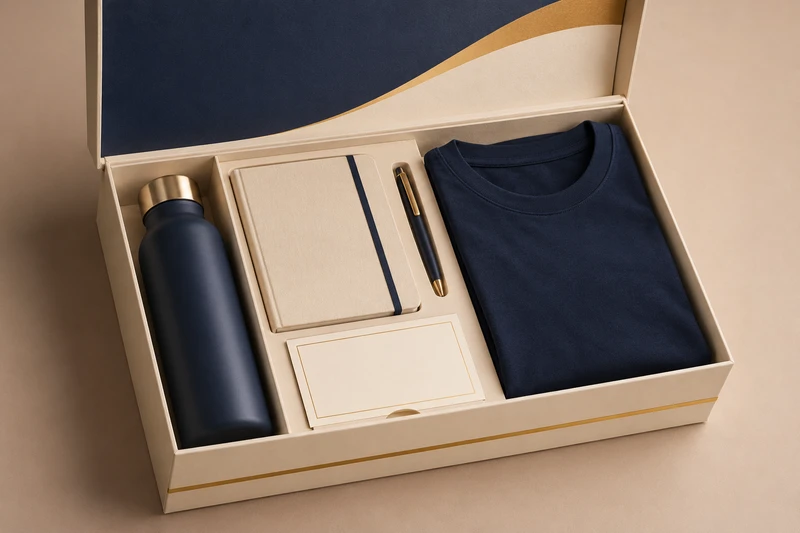
Employee welcome boxes are empty presentation boxes designed to hold customer-supplied onboarding gifts in a considered, orderly way. They help HR teams, branded-gift buyers and event planners present items such as notebooks, pens, desk accessories, drinkware or apparel as one coordinated first-day kit.
For buyers in South Africa, the most useful starting point is not the box style but the final contents list. Each item’s dimensions, weight, surface sensitivity and packing order affect the box footprint, insert layout and whether the finished welcome box is best handed over in an office or prepared for a separate delivery process. XGolden Print designs and produces custom paper packaging boxes and gift packaging, with structural design, material selection, artwork support, printing, finishing, fitted inserts and sample approval available for the packaging project.
Define the gifts before choosing a welcome box
An employee welcome box should be specified around the actual gifts, not a generic idea of an “onboarding kit”. A compact set containing a notebook, pen, lanyard and card needs a very different structure from a larger set with a tumbler, hoodie and desk accessory.
Start with a physical inventory of every customer-supplied item intended for the box. Record:
- Length, width and height of each item, including its own retail carton or sleeve
- Weight of each item and the total packed kit
- Fragile, glossy, scratch-prone or loose components
- Whether products must remain upright
- The intended packing sequence
- Items that may be optional, personalised or different between departments
- Whether a recipient’s name, job title or start date needs to appear on a card, label or outer box
Measurements should include the item as it will be packed. For example, a branded mug in its own carton occupies more space than the mug alone, while folded apparel needs its folded dimensions rather than its garment size. If paper filler, tissue, a welcome letter or a protective sleeve is required, include these in the layout from the beginning.
A good employee welcome box makes each item easy to identify and remove. It should not require staff to pull one gift out before reaching another, nor allow a heavier object to rest on a paper card or delicate desk accessory. The opening experience matters: recipients should see the welcome message and key items in the intended order when the lid or drawer is opened.
For multi-item onboarding programmes, a custom gift packaging project can be planned around coordinated branding and the intended opening sequence. The final material, finish, insert type and dimensions must be confirmed against the individual brief.
Build a contents matrix before design
A simple contents matrix prevents costly assumptions. List every item in rows, then note which kit variants include it. This is particularly useful when one group receives a standard starter kit while managers, graduate recruits or event guests receive additional items.
| Welcome-box use case | Typical customer-supplied contents | Main packaging requirement | Suitable planning approach |
|---|---|---|---|
| New-starter desk kit | Notebook, pen, card, small desk items | Neat separation and easy access | Compartments or a fitted insert for small components |
| Executive onboarding gift | Premium stationery, gift card, small accessory | Presentation and controlled reveal | Rigid outer box with an organised interior |
| Event or induction pack | Printed material, badge, small branded gifts | Clear identification and fast distribution | Consistent outer branding with named or variant cards |
| Hybrid-work starter pack | Desk items, paperwork and optional apparel | Variable contents and packing clarity | Separate item zones and a defined packing checklist |
| Larger recognition kit | Drinkware, apparel and several gifts | Space, weight distribution and handling | A separately specified larger box and insert arrangement |
The table is a planning guide, not a fixed product range. A welcome box with drinkware, clothing or several heavy items needs its own dimensions and structural review.
Separating stationery, drinkware and apparel
Mixed-product welcome kits are common, but the items should not be treated as interchangeable. Their packing requirements differ significantly.
Stationery usually benefits from defined positions. A pen can roll, a cable can look untidy and small components can disappear beneath a notebook if there is no separation. A shallow compartment, recess or divider can make the contents easier to pack and easier for the recipient to understand at first glance.
Drinkware can be comparatively heavy and may have protruding handles, lids or removable parts. It needs a layout that prevents movement against lighter gifts. Do not assume that a small office-gift box designed around stationery will fit a mug, bottle or tumbler. The actual packed dimensions, weight and desired protection level should be supplied for structural assessment.
Apparel creates a different issue: it is soft, variable in bulk and often supplied in several sizes. A folded T-shirt may suit a broad, shallow area, whereas a hoodie can require considerably more depth. If each recipient receives a different size, the packing team needs an agreed method for keeping the right garment with the right named card and box.
A practical arrangement often places flatter paper-based items on top, holds small accessories in a dedicated section and keeps the heaviest item stable at the base. This is not a universal rule, however. The right sequence depends on the chosen box opening, insert design and contents.
Do not confuse presentation packaging with transport protection
Employee welcome boxes can create a polished gifting and handover experience, but they are not automatically a complete transport-protection system. The welcome box is the presentation layer around the customer’s gifts. It is separate from:
- Primary containers, such as a drink bottle or skincare jar supplied by the buyer
- The item’s own retail carton or protective sleeve
- Any outer carton, cushioning and handling process used for a delivery journey
For a remote onboarding programme, consider both layers early. The recipient-facing welcome box may need to be placed within a separate outer shipping solution selected for the route and handling conditions. Confirm responsibility for that outer packing and any protective materials rather than assuming the presentation box alone is sufficient.
Office handover and remote delivery are different uses
An office handover allows the welcome box to be presented directly to a new employee, often at a desk, induction session or team event. This use can prioritise a polished reveal, coordinated printed graphics and straightforward opening. The box may be carried a short distance by staff and placed directly in the recipient’s hands.
Remote delivery introduces extra decisions. The kit may be packed by an internal team, a merchandise provider or another appointed party before it goes into an outer delivery pack. The box must still look appropriate when opened, but the project also needs clear instructions for packing, variant identification and handover between teams.
Before choosing an employee welcome box format, decide which use applies:
- Office-only handover: Focus on presentation, convenient carrying, internal distribution and a consistent desk-side reveal.
- Remote-only programme: Plan the presentation box alongside the separately managed outer transport pack and confirm who packs each layer.
- Hybrid onboarding: Define whether one box design will serve both situations or whether office and remote versions need different packing instructions.
For South African organisations with teams working across different sites or from home, a hybrid approach can make kit control more important than decorative complexity. A simple, repeatable layout with clear variant markers may be more useful than a design that is difficult to pack consistently.
Artwork should also reflect where the box will be used. Consider whether the welcome message, product guide or insert card requires more than one language version, whether recipients’ names will be printed individually or added later, and which information belongs on an outer label rather than the main box artwork. XGolden Print can provide artwork support for the packaging elements, while the buyer should provide approved brand assets, copy and any variable recipient data.
Small office-gift box styles as structure references
Small office gifts can be a useful starting point for selecting a structure, provided the contents match the reference. Two XGolden Print product examples illustrate different ways small desk-related components may be presented.
The DB-329 stationery-kit drawer box is a drawer-box reference for stationery-kit presentation. A drawer format can create a deliberate opening action and keep flatter office items together. It is relevant when the proposed kit consists of similarly compact stationery or small desk components.
The LB-327 desk-accessory box is a lid-and-base reference for smaller desk accessories. A lid-and-base structure can suit a straightforward lift-off presentation where the contents are arranged in a compact interior.
Neither reference proves an existing complete employee welcome kit, and neither should be assumed to fit drinkware, apparel or a large mixed-gift set. A larger onboarding box must be specified separately with the full packed contents, internal dimensions, weight and desired opening sequence.
| Box structure | Relevant employee welcome-box use | Access experience | Points to confirm |
|---|---|---|---|
| Drawer box | Compact stationery or small desk-kit gifts | Contents slide out in a controlled sequence | Drawer clearance, pull direction, insert retention and packed weight |
| Lid-and-base box | Smaller desk accessories and card-led gift sets | Recipient lifts the lid to view arranged contents | Lid fit, component layout, stacking needs and base depth |
| Larger custom gift box | Mixed kits with apparel, drinkware or multiple gifts | Depends on separately developed structure | Overall dimensions, weight, internal support and packing workflow |
| Magnetic closure box | Presentation-led gift sets where the contents suit the format | Hinged opening with a closing flap | Content clearance, closure interaction and insert layout |
Rigid boxes, magnetic closure boxes, drawer boxes and lid-and-base boxes are among the packaging formats XGolden Print can produce. The chosen format should serve the contents and use case, rather than being selected solely for appearance.
Personalised cards and checks for kit variants
Personalisation can make employee welcome boxes feel more considered, but it also introduces opportunities for packing errors. A named card placed in the wrong box, an incorrect apparel size or a missing department-specific item can undermine an otherwise well-designed onboarding gift.
Separate fixed packaging artwork from variable information wherever possible. The core box can carry the employer’s identity, while a card, sticker or printed slip identifies the individual recipient, team or kit version. Labels and stickers can be specified for boxes and bags in custom dimensions and shapes, with agreed roll or sheet formats. Confirm the intended application method: a label applied by hand during packing needs a practical size, position and finish for that workflow.
Use a simple variant-control system before production and packing:
- Give each kit version a clear internal name or code.
- Create one approved contents list per version.
- Assign a matching card, label or packing instruction.
- Decide where the identifier will sit: outer box, underside, internal card or packing list.
- Keep recipient data separate from permanent box artwork unless every box is genuinely unique.
- Review names, spelling, job titles, language versions and artwork approval before printing.
For retailer-style presentation or event gifting, the outer face may need only the brand identity, while a removable label carries recipient information. For internal office handover, a named envelope or card inside the box may be more suitable. The best option depends on whether the kit will be displayed, distributed at a reception desk or prepared individually for delivery.
Avoid putting sensitive personal information on a visible outer box. Consider who handles the box before the employee receives it and what information is necessary for sorting.
Approving the layout and agreed packing responsibilities
A sample approval stage is the point to verify whether the employee welcome box works with the real gifts, not just drawings or estimated measurements. Assemble the complete customer-supplied kit in the proposed arrangement and check the opening sequence, item clearance, insert fit and overall presentation.
A useful approval review should answer:
- Does every specified item fit in its final supplied form?
- Can staff pack the kit in the agreed order without forcing components into place?
- Does the insert hold small or heavier items in the intended position?
- Is the welcome card visible and easy to remove?
- Does the box close properly with the full contents inside?
- Are there separate instructions for each kit variant?
- Who supplies the merchandise, cards, labels and protective inner materials?
- Who packs the contents into the welcome boxes?
- For remote distribution, who prepares the separate outer transport packing?
- What delivery date and destination must the packaging project support?
Clear responsibility is essential. XGolden Print is described as designing and producing custom paper packaging boxes, gift packaging, labels and stickers. Do not assume that XGolden Print supplies the branded merchandise, assembles complete onboarding kits or manages a delivery process unless those responsibilities are specifically agreed for the project.
For the packaging itself, we can support the brief through structural design, material selection, artwork support, printing, finishing, fitted inserts and sample approval before production. With 27 years of experience, a 15,000 square metre factory, 500+ employees and 10M+ production capacity, XGolden Print has established packaging production resources; material suitability, finishes, inserts, quantities, sample terms, pricing and schedules still need confirmation against your particular employee welcome-box brief.
A custom box project is the appropriate next step when your contents, dimensions and intended handover method are defined. Share the packed dimensions and weight of each gift, required quantity, artwork, kit variants, target delivery date and destination, along with who will pack the customer-supplied items.
