
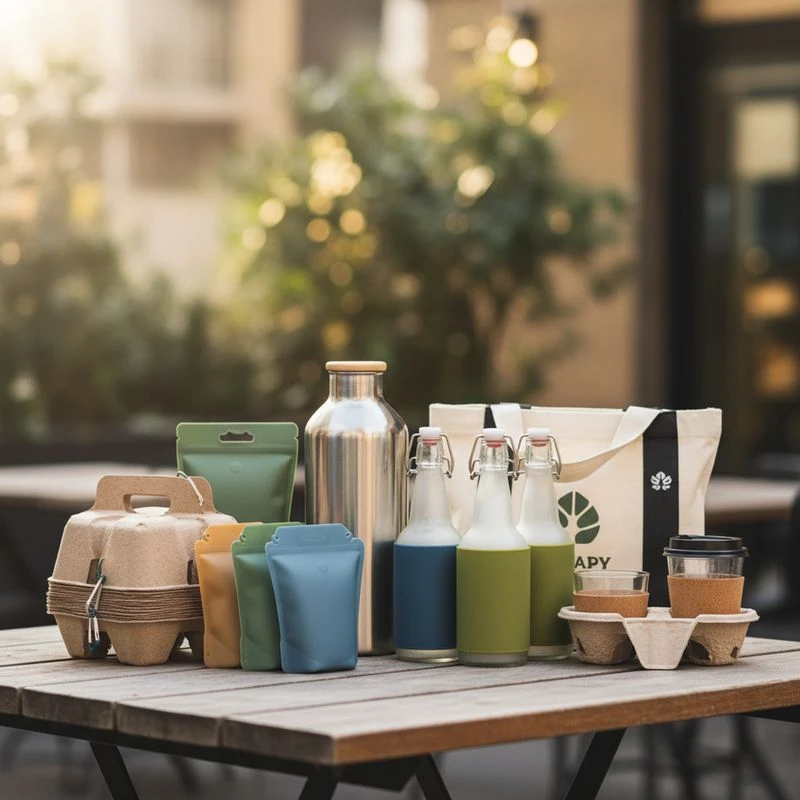
Eco reusable custom packaging for beverage companies works best when it is designed as a system, not simply as a greener-looking bottle or box. The container, closure, label, outer packaging, collection method, washing process and repeat-use instructions all need to work together.
For beverage brands in South Africa, the practical starting point is to choose packaging that suits the product, expected number of handling cycles and return model. A durable refillable bottle may be appropriate for a controlled return programme, while a reusable gift crate or transit box may offer a more realistic first step for premium, direct-to-consumer or business-to-business orders.
Reusable Packaging
Reusable packaging is intended to remain useful for multiple cycles rather than being discarded after one sale. In beverages, this can include refillable bottles, returnable crates, sturdy presentation boxes, reusable carriers and refillable dispensing formats.
The environmental value of reuse depends on actual repeat use. A heavy container that is returned only once may not deliver the intended benefit, while a durable format used consistently through a local collection and cleaning loop can reduce reliance on continually replacing packaging. For this reason, brands should define the full reuse journey before approving artwork or placing a production order.
Begin with the right reuse model
There is no single reusable packaging model for every beverage category. Match the format to how customers buy, consume and return the product.
| Reuse model | How it works | Suitable applications | Key planning question |
|---|---|---|---|
| Refillable primary container | The customer returns the bottle or vessel for cleaning and refilling | Selected water, dairy, soft drinks, beer and other suitable beverage formats | Can the container be collected, inspected and hygienically processed? |
| Refill-at-home format | Customers retain a dispenser or bottle and buy refills | Concentrates, syrups, powdered drinks and selected low-risk products | Is the refill pack easy to use without spills, confusion or contamination? |
| Reusable secondary packaging | A crate, carrier, box or sleeve is retained or returned while the beverage remains in its original container | Gift sets, wholesale orders, premium ranges and e-commerce deliveries | Will customers have a reason to keep or return the outer pack? |
| Deposit or return scheme | A financial or account-based incentive encourages packaging return | Managed retail, hospitality, events and direct delivery networks | Can deposits, records and refunds be administered clearly? |
| Closed-loop B2B packaging | Packaging moves between a supplier and known business customers | Hospitality, offices, distributors and event supply | Who owns the packaging and who checks it at every handover? |
A closed or semi-closed loop is generally easier to manage than an open public return model. When the same businesses, retailers or delivery partners repeatedly handle the packaging, a brand has more control over collection, sorting and condition checks.
Map the return journey before choosing materials
A reusable pack should be designed around its real handling conditions. Map the journey from filling to customer use and back again:
- Filling and packing: Check whether the container fits the filling line, closure process, storage racks and case-packing method.
- Distribution: Consider stacking, vibration, temperature exposure, breakage risk and weight for workers and customers.
- Customer use: Make opening, pouring, resealing and return instructions simple.
- Collection: Decide where returns will be accepted, how they will be counted and whether damaged items are excluded.
- Sorting and inspection: Create clear criteria for retaining, cleaning, repairing or removing packaging from circulation.
- Cleaning and refilling: Confirm that the wash, inspection and refill process is appropriate for the beverage and packaging material.
- Re-entry into circulation: Use batch controls and packaging condition checks that suit the product category and business model.
Food and beverage packaging has hygiene and product-safety implications. Brands should verify applicable South African requirements, food-contact suitability, cleaning procedures, labelling obligations and any retailer-specific rules with relevant specialists before introducing a return or refill programme.
Design for repeated handling, not just shelf appeal
Reusable beverage packaging needs a more robust design brief than a single-use pack. Useful considerations include:
- Strong contact points: Handles, corners, bases and closure areas receive repeated stress.
- Scuff-tolerant decoration: Ink coverage, varnish, labels and printed panels should be selected with abrasion and moisture exposure in mind.
- Easy cleaning: Avoid unnecessary grooves, loose parts or decorative features that complicate inspection and washing.
- Clear ownership markings: A durable brand mark, return message or identifier can help separate reusable assets from ordinary waste.
- Simple separation: If parts wear at different rates, consider whether closures, labels, dividers or sleeves can be replaced without discarding the full pack.
- Safe ergonomics: Weight, grip and shape affect staff and customer handling, particularly in multipacks.
- End-of-life plan: Even long-life packaging eventually reaches its limit. Determine how materials and components will be recovered or recycled where practical.
One common mistake is treating durability as the only requirement. A container can be physically strong yet still fail as reusable packaging if it is awkward to return, too costly to collect, difficult to clean or poorly recognised by customers.
Beverage Bottles
Beverage bottles are at the centre of most reuse systems, but material selection should follow product needs and operating conditions rather than visual preference alone. The best option depends on carbonation, light sensitivity, filling temperature, shelf-life requirements, closure type, transport distance and intended wash-and-return process.
Comparing common bottle directions
| Bottle direction | Potential strengths | Limitations to assess | Best fit when |
|---|---|---|---|
| Glass refillable bottle | Familiar premium feel, good barrier properties and a solid reuse proposition when managed well | Weight, breakage, transport handling and compatible washing processes require attention | The brand has a controlled collection and refill system |
| Durable plastic bottle | Lower weight and reduced breakage risk compared with glass | Material suitability, scratch visibility, odour retention, heat limits and recycling route must be assessed | Ease of carrying and distribution weight are major considerations |
| Aluminium bottle or canister | Light protection, distinctive appearance and durability in some formats | Closure compatibility, denting, lining suitability and cleaning processes need validation | Product protection and a premium reusable format are priorities |
| Reusable dispensing vessel | Can reduce individual container use in workplaces, hospitality or events | Cleaning, refill controls, dispensing hygiene and customer responsibility need clear management | Consumption happens at defined locations |
| Standard bottle with reusable outer pack | Easier to introduce than a full refill model | Does not make the primary container reusable by itself | The brand wants a lower-complexity reusable packaging step |
Do not assume that one material is inherently reusable in every situation. A reusable container must be compatible with the beverage, its production process and the intended number of cycles. Suppliers and technical advisers should confirm relevant material properties, food-contact suitability and closure performance for the final product.
Labels and closures can determine success
A durable bottle is only one part of the system. Labels and closures often create the practical difficulty.
For returnable bottles, consider whether the label must survive several uses, wash off during processing or be replaced between refill cycles. Each approach has trade-offs. A permanent label may simplify brand recognition, but it needs to remain legible and presentable. A removable label can support refreshed campaigns or variable information, but the removal process must be practical.
Closures should protect product quality, be easy for customers to use and align with the refill process. Confirm whether a closure is intended for one opening, repeated resealing, or removal and replacement at refill. Tamper-evidence expectations should also be assessed for the product and sales channel.
Use a clear on-pack message that explains:
- whether the bottle is returnable, refillable or simply recyclable;
- where and how it should be returned;
- whether a deposit or reward applies;
- whether the cap or closure should be returned with the bottle;
- what condition is expected on return; and
- how customers can identify the packaging in-store or at collection points.
Avoid vague statements such as “eco bottle” or “green packaging”. Specific instructions are more useful and help prevent customers from placing reusable containers into the wrong waste stream.
B2B Branding
Custom reusable packaging can strengthen B2B relationships when it makes ordering, handling and brand presentation easier for retailers, hospitality groups, distributors and corporate customers. In this setting, the packaging should function as an operational asset as well as a marketing surface.
A branded returnable crate, presentation case or multipack carrier can help a beverage range stay identifiable between the warehouse, point of sale and customer venue. However, decoration should not make the packaging less practical. Excessive finishes, fragile add-ons or hard-to-clean materials may work against a repeat-use objective.
Build branding around real touchpoints
For reusable beverage packs, identify where branding has value throughout the cycle:
- On shelf or at service: Product name, flavour, pack count and clear customer-facing instructions.
- In storage: Product codes, orientation marks and space for handling labels where needed.
- During returns: Return prompts, ownership information and identifiers for sorting.
- For corporate gifting: Reusable boxes or carriers with an understated branded design that customers are likely to retain.
- At hospitality venues: Durable table or display elements that support the beverage identity without obstructing cleaning or service.
For seasonal campaigns or limited editions, a reusable outer pack can be more flexible than permanently decorating every primary bottle. A well-made carrier, gift box or sleeve may be used across several product releases if the graphics are designed with longevity in mind.
When specifying custom printed packaging boxes, provide the expected product weight, bottle dimensions, number of units, storage conditions and whether the box is meant for one delivery, customer reuse or a return loop. These details influence board choice, structure, inserts, handles and print finish.
Keep brand information adaptable
Product details can change more often than the reusable container itself. Batch information, ingredients, warnings, dates and variable retail information may need a separate, compliant labelling solution rather than permanent printing on a reusable asset.
This approach can help preserve the usability of the main pack while allowing necessary information to be updated. The final information architecture should be reviewed for the beverage category and target sales channel. Confirm which information must remain visible on the container, which can appear on a removable label, and which needs to accompany a multipack or delivery unit.
Eco Design
Eco design for beverage packaging means reducing unnecessary material and waste while ensuring the pack can still protect the product and operate reliably. It is not limited to selecting recycled-looking textures, earthy colours or a recycling symbol.
The strongest approach is to make deliberate decisions about material use, reuse, repair, recyclability and communication.
Practical eco design principles
Use only the material the job requires. Overbuilt packaging can increase resource use and transport weight. Underbuilt packaging can cause damage and product loss. Specify protection based on actual handling risks.
Prioritise a long useful life. If a box, crate or bottle is marketed for reuse, its construction, print treatment and structural design should support repeated handling.
Avoid unnecessary mixed materials. Complex combinations of substrates, laminations, magnets, foams and decorative components can complicate end-of-life sorting. Where multiple materials are necessary, make separation as straightforward as possible.
Design for repair or replacement. Replaceable dividers, sleeves, handles or labels can extend the useful life of a reusable outer pack.
Make disposal instructions honest and specific. A reusable item may eventually be recyclable, but local collection capabilities and material streams vary. State only claims that can be supported and understood by the intended customer.
Reduce empty space. A more efficient pack size can improve storage and transport density while keeping the product secure. This must be balanced against accessibility and presentation.
Claims need evidence and precision
Environmental wording deserves the same care as nutritional or product claims. “Reusable”, “recyclable”, “compostable”, “plastic-free” and “made with recycled content” can all be misunderstood if the relevant conditions are not stated.
Before printing any environmental claim, confirm:
- what the claim applies to: bottle, cap, label, box, insert or full pack;
- whether the packaging can realistically be reused through the intended system;
- whether local collection or recycling options support the claim;
- whether required facilities or customer actions are clearly explained;
- whether the claim remains accurate after coatings, adhesives and other components are added; and
- whether the wording meets applicable consumer, packaging and retailer requirements in South Africa.
A smaller number of accurate claims is more useful than a label crowded with unqualified symbols.
Innovation
Innovation in reusable beverage packaging is often operational rather than dramatic. The most valuable ideas make return, cleaning, identification and reordering easier for everyone involved.
Focus on practical innovation
Return-friendly structures: Foldable carriers, stackable crates and modular dividers may improve storage and handling when empty packaging moves back through the system.
Digital identification: Scannable codes or durable identifiers can support return instructions, product information or asset tracking. Their value depends on a clear process and responsible data handling, not the code alone.
Refill-ready product design: Concentrated products, compatible dispensers and measured refill formats can reduce the need for repeated packaging purchases where the product category allows it.
Modular gift packaging: A premium outer box can be designed to hold different bottle combinations, allowing brands to update contents without replacing the full structure.
Component-based packs: Separating a long-life outer shell from replaceable inserts or product information panels can reduce waste when only one element changes.
Better customer guidance: A simple return message, visual instructions and a clear explanation of the benefit can be more effective than a complicated sustainability campaign.
Innovation should be tested against everyday realities: wet hands, storage rooms, crowded shelves, repeated stacking, return confusion and changing stock formats. A visually impressive concept that adds friction to filling, cleaning or collection may not be the right commercial choice.
Questions to ask before approving a reusable pack
Use this checklist with your packaging supplier, operations team and product specialists:
- What exact product will the packaging hold?
- Is the main aim refill, return, customer keep-use, or reusable B2B transport?
- How many handling cycles is the pack expected to withstand, and how will this be checked?
- What happens when the pack is scratched, damaged, contaminated or incomplete?
- Can the pack be cleaned and inspected appropriately?
- Which parts are permanent, replaceable or removable?
- Does the closure suit the beverage and intended reuse model?
- Are return instructions visible and easy to understand?
- Does the design fit existing filling, packing, storage and transport processes?
- Which environmental claims can be verified for the final finished pack?
- What is the end-of-life route when reuse is no longer possible?
A clear answer to these questions will usually reveal whether a full returnable bottle programme is appropriate or whether reusable secondary packaging is a better initial investment.
FAQ
Is reusable packaging always more sustainable than single-use packaging?
Not automatically. Reuse can be beneficial when packaging is returned, cleaned and used enough times to justify the materials and transport involved. The actual outcome depends on the container, return rate, transport distances, cleaning process and how long the packaging remains in use.
Can a beverage brand start with reusable boxes instead of reusable bottles?
Yes. Reusable gift boxes, bottle carriers, crates and delivery packs can be a practical option where a refillable bottle system would be too complex. They are particularly relevant for corporate gifting, subscription deliveries, hospitality and premium multipacks.
What should be printed on returnable beverage packaging?
Include the brand identity, clear return or refill instructions, relevant product information and any identifiers needed for sorting or asset management. Check which legal and channel-specific labelling requirements apply before finalising artwork.
Should reusable packaging carry a deposit?
A deposit can encourage returns, but it also introduces administrative and customer-service considerations. Assess how deposits will be collected, recorded, refunded and communicated across every sales channel before committing to the model.
Reusable packaging succeeds when the design supports a workable return cycle, not just an attractive sustainability message. Start with the beverage, customer journey and operational constraints, then develop the bottle, box or carrier around those realities. XGolden Print can assist brands that need custom packaging structures and print solutions aligned with a well-defined reusable packaging brief.
