
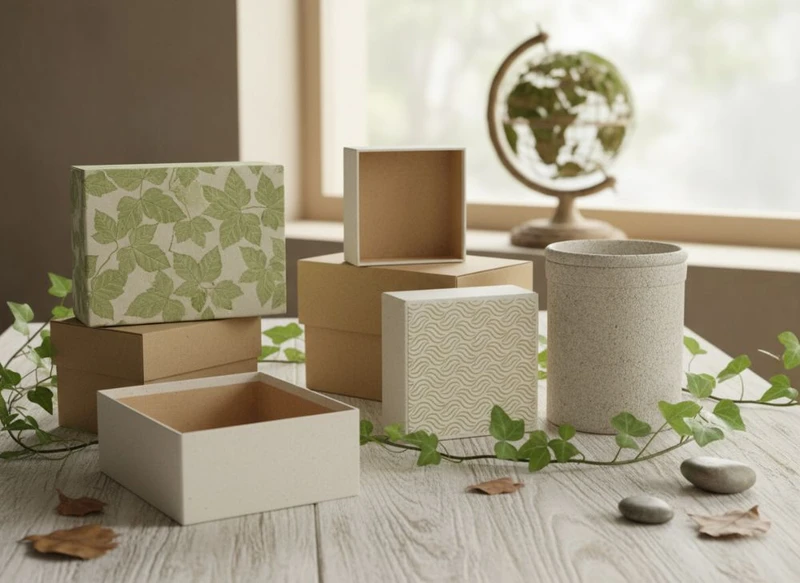
Eco-friendly paper box packaging can reduce unnecessary plastic use and help a brand make more responsible material choices, but paper is not automatically sustainable. The best option is a box designed for the product, made from appropriately sourced or recycled fibre, printed with suitable inks, and easy for the customer to separate, reuse or recycle through available local channels.
For South African brands, the practical goal is to balance environmental considerations with protection, shelf appeal, food or product compatibility, transport needs and honest customer communication. This guide explains where paper packaging can work well, what to specify, and which trade-offs to discuss with a packaging supplier.
The Business Case for Biodegradable Custom Packaging
Biodegradable custom packaging can support a brand’s sustainability objectives when the material and disposal route match. A paper-based box may break down under suitable conditions, but coatings, laminates, adhesive layers, metallic decoration and attached plastic components can change how it behaves at end of life.
The strongest business case is usually broader than biodegradability alone. Well-specified paper packaging can help brands:
- Replace avoidable plastic components in secondary or presentation packaging.
- Use recycled fibre where it is appropriate for the application.
- Create a simpler unboxing experience with fewer separate parts.
- Give customers clearer disposal instructions.
- Build sustainability claims around specific, supportable design choices.
- Improve visual consistency across boxes, inserts, labels and gift packaging.
Avoid treating “biodegradable” as a universal environmental claim. The term can be misleading if a box is unlikely to reach the conditions needed for breakdown, or if it contains non-paper elements that are difficult to separate. Where recyclability is the more realistic end-of-life route, say so instead.
Before approving a custom box, define what outcome matters most:
- Lower plastic content – replace a plastic sleeve, tray or overwrap where paperboard can do the job.
- Recyclability – select a format that can be readily separated into recyclable components.
- Recycled content – use recycled fibre where product, print and strength requirements allow.
- Reuse – design a sturdy presentation box that customers are likely to retain.
- Responsible sourcing – ask for documentary evidence for any sourcing claim you plan to make.
- Reduced material use – remove excess volume, inserts and decorative layers.
These objectives can overlap, but they are not identical. A robust reusable rigid box, for example, may use more material than a lightweight folding carton. The appropriate choice depends on product value, protection needs and how likely reuse genuinely is.
Best Alternatives to Plastic: Cardboard and Kraft Paper
Cardboard and kraft paper are versatile alternatives to plastic for many boxes, sleeves, mailer-style packs, wraps and inserts. They are not interchangeable, however. The right substrate depends on how much protection, print coverage, moisture resistance and premium finish the product needs.
| Material option | Best suited to | Key strengths | Points to check |
|---|---|---|---|
| Folding carton board | Cosmetics, retail goods, small consumer products | Lightweight, printable, efficient for product boxes | Board grade, crush resistance, coating and product compatibility |
| Corrugated cardboard | E-commerce, transit boxes, larger or fragile products | Good cushioning and structural strength | Flute type, right-sizing, tape requirements and storage conditions |
| Brown kraft paper or board | Natural-looking retail packs, wraps, sleeves and inserts | Recognisable paper appearance, strong visual sustainability cue | Print contrast, scuffing, fibre content and finish options |
| White kraft or coated paperboard | Branded consumer packaging | Clean print surface and flexible branding | Whether coatings affect recycling and whether they are necessary |
| Moulded fibre inserts | Product stabilisation and internal protection | Can replace some foam or plastic trays | Fit, surface finish, moisture exposure and product fragility |
Folding cartons for retail presentation
Folding cartons use paperboard that is creased, cut and folded into shape. They can suit products that need branded shelf presence without the weight and bulk of a rigid box. A well-designed carton can often incorporate product support through folds or paper inserts, reducing the need for separate plastic trays.
Ask whether a simpler closure, lock tab or tuck end can replace magnets, plastic windows or excessive sealing. These features may be appropriate in specific cases, but they should earn their place through function rather than decoration alone.
Corrugated boxes for delivery protection
Corrugated cardboard is often the practical choice for shipping and e-commerce packaging because its fluted inner layer adds rigidity and cushioning. Its environmental advantage improves when the box is right-sized: a box that is too large can require extra void fill and use more material than necessary.
Consider whether paper tape, a paper void-fill solution or an integrated cardboard insert is compatible with the box and fulfilment process. If tape, labels or protective materials are used, make sure customers can identify whether they should be removed before recycling.
Kraft paper: useful, but not a shortcut to a green claim
Kraft paper has a natural appearance that many buyers associate with environmentally responsible packaging. Yet appearance is not evidence of recycled content, responsible sourcing or recyclability. A brown box with a plastic laminate may be harder to recycle than an uncoated white carton.
Use kraft paper when its surface, strength and visual character suit the product. Pair it with restrained graphics and clear material information rather than relying on colour alone to make a sustainability claim.
For product-specific formats, explore custom packaging boxes with a clear specification covering board, dimensions, closure, print and inserts.
Navigating Eco-Friendly Certification Labels
Certification labels and environmental symbols can be useful only when they are accurate, current and relevant to the exact packaging material. They should not be copied from a supplier’s general brochure or applied simply because a component appears to be paper.
When assessing a label or claim, ask five questions:
- What does it cover?
Confirm whether it applies to the paper fibre, coating, ink, adhesive or the finished box as a whole.
- Which organisation issued it?
A credible label should identify the scheme or independent body behind it.
- Is the chain of documentation available?
If you intend to claim certified or responsibly sourced fibre, request the relevant paperwork from the supplier and check how the claim may be used.
- Does it apply to your chosen specification?
Changing board stock, print process or finish may affect the claim.
- What does it mean for customers?
A technical label may not explain whether the pack belongs in a recycling stream, a composting system or general waste.
Common terms such as “recyclable”, “compostable”, “biodegradable”, “recycled content” and “responsibly sourced” should be used with care. Each carries a different meaning. For example, a package may contain recycled fibre but still have a finish that complicates recycling. Likewise, compostability may depend on controlled facilities that are not available to every customer.
Keep certification claims separate from disposal claims
A fibre-sourcing certification and a recycling instruction answer different questions. One relates to the origin or management of the fibre; the other relates to what a customer can do with the used pack.
Use plain-language instructions where possible, such as:
- “Remove the paper label before recycling the box.”
- “Reuse this box for storage where practical.”
- “Check local recycling acceptance for coated paper packaging.”
Do not state that every household or business can recycle a format unless you have verified that the relevant collection and processing options are available. Recycling services and material acceptance can differ between areas, property types and waste contractors in South Africa.
Reducing Waste with Minimalist Box Design
Minimalist box design reduces waste most effectively when it removes material without compromising product protection or usability. It does not mean every box must be plain, brown or unbranded. It means making deliberate choices about every panel, layer, insert and finish.
Start with the product rather than an existing box template. Measure the product, any essential accessories and the amount of clearance required for safe packing. Then consider whether the structure can protect the item through folds, locking tabs or paperboard dividers instead of multiple separate materials.
Practical ways to simplify a box
- Choose dimensions that limit empty space.
- Remove non-essential sleeves, wraps and duplicate cartons.
- Replace plastic windows where the product does not need to be visible before purchase.
- Use a printed instruction panel rather than a loose leaflet when appropriate.
- Design inserts to be removable and made from a compatible paper-based material.
- Avoid combining paper, foil, plastic film, magnets and foam unless the product need justifies them.
- Use one or two strong brand elements rather than covering every surface with ink.
A minimalist structure can still feel premium. Quality can come from good proportions, a tactile uncoated board, an elegant closure, restrained typography and careful colour selection. These choices often communicate more than extra layers do.
Do not under-package fragile products
Reducing material is not the same as reducing protection blindly. A box that fails during handling can create additional waste through damaged goods, replacement packaging and returns. Test the complete pack around the actual product before making a final material reduction.
Check likely stresses such as stacking, vibration, corner impacts, moisture exposure and repeated opening. The appropriate test method and acceptance criteria will depend on the product and supply chain, so confirm them for your own application.
Choosing Water-Based or Soy-Based Inks
Water-based and soy-based inks are often considered when brands want to reduce reliance on conventional ink systems. Neither is automatically the right answer for every paper box. Print performance depends on the substrate, design, coverage, drying requirements, finish and intended use.
Water-based inks
Water-based inks use water as a principal carrier. They can be suitable for certain paper and corrugated applications, particularly where a low-odour or paper-focused print approach is preferred. However, the final result depends on the board’s absorbency and the print process.
Confirm:
- Colour consistency on your chosen board.
- Rub and scuff resistance.
- Drying requirements and production compatibility.
- Whether a protective coating is needed.
- The recyclability implications of any coating or varnish.
Soy-based inks
Soy-based inks use soy oil as part of their formulation. They are not necessarily made entirely from soy, and their suitability varies by print method and packaging substrate. Do not assume that a soy-based ink makes a complete box compostable, recyclable or non-toxic.
Confirm the actual formulation, its intended substrate and whether it is appropriate for your product category. Where packaging will contact food or other sensitive goods, obtain product-specific guidance and verify applicable requirements for the target market.
Choose the complete print system, not only the ink
An environmental review should include the ink, varnish, laminate, adhesive and decorative finish. A low-impact ink choice may be undermined by an unnecessary film laminate or a mixed-material embellishment that is difficult to separate.
For many brands, a practical approach is to print directly on an uncoated or lightly coated board, limit heavy ink coverage where possible, and avoid finishes that do not materially improve protection or customer experience.
How to Communicate Your Sustainability Efforts to Customers
Sustainability communication should be specific, modest and easy to verify. Customers are more likely to trust a claim that explains what changed than a vague statement that a package is “100% eco-friendly”.
State the relevant attribute, not a broad conclusion. For example:
- “This carton uses recycled fibre content” — only if you can substantiate the percentage or the approved wording.
- “Paper-based box designed for recycling where accepted” — if the format and local recycling route support this.
- “Please remove the sticker before recycling” — when a label could affect sorting or material separation.
- “This box is designed for reuse” — where the structure is genuinely durable and useful.
Avoid claims such as “zero impact”, “planet safe”, “fully green” or “guilt-free”. These are difficult to define and can create expectations that the packaging cannot meet.
Put the message where it is useful
The inside flap, base panel, insert card or a small label can carry disposal and material information without dominating the front of the pack. A QR code can provide more detail, but it should complement rather than replace a short visible instruction.
Labels deserve the same attention as boxes. Select custom printed stickers that are no larger than necessary, use clear wording, and can be removed where separation is required. Confirm the label stock and adhesive are compatible with the intended disposal route.
Keep a simple internal record of claims, supporting documents, approved artwork and any specification changes. This makes it easier to maintain consistency as products, suppliers or materials change.
Design Inspirations for Green Gift Packaging
Green gift packaging does not need to look rustic or unfinished. The most convincing designs use materials and construction honestly, allowing the paper texture and considered details to carry the presentation.
Here are practical directions for more considered gift packaging:
Uncoated board with restrained printing
Use a tactile uncoated board with a limited colour palette, clean typography and a small brand mark. This approach can reduce reliance on film laminates while creating an understated, premium feel.
Reusable rigid box with a clear secondary purpose
For higher-value products, a durable rigid box may be suitable if it has a purpose beyond the initial gift. A removable divider can turn it into a keepsake, organiser or storage box. Avoid presenting reuse as a certainty; design for it and communicate the intended use.
Paper-based sleeve and simple closure
A simple carton or wrapped box with a printed paper sleeve can create an occasion without adding a permanent mixed-material feature. A paper seal, tab closure or ribbon-like paper band may be enough for the desired experience.
Seasonal graphics without seasonal waste
Rather than creating an entirely new box for every campaign, consider a neutral core box with a campaign-specific paper band, sticker or printed insert. This can help limit obsolete packaging inventory while still allowing seasonal differentiation.
For concepts that need a more elevated presentation, review gift packaging options and specify which features are essential: protection, reuse, presentation, or a particular retail display requirement.
Recycled vs. Virgin Pulp: What You Need to Know
Recycled pulp is made from recovered paper fibre, while virgin pulp comes from newly sourced fibre. Neither should be treated as universally better without considering the use case, fibre source, board performance and end-of-life plan.
Recycled fibre can help support a circular material flow by creating a use for recovered paper. It is often appropriate for shipping boxes, outer cartons, inserts and many non-sensitive retail applications. The available grades, appearance and strength can vary, so request samples of the exact board rather than approving from a generic description.
Virgin fibre may be necessary where particular strength, cleanliness, surface finish or product-contact considerations apply. It can also be used in board containing a blend of virgin and recycled fibre. If responsible sourcing is important to your brand, ask what evidence supports any claim about the virgin fibre.
| Consideration | Recycled pulp | Virgin pulp |
|---|---|---|
| Fibre source | Recovered paper materials | Newly sourced wood fibre |
| Appearance | May have natural variation or speckling | Often offers a more uniform surface |
| Strength requirements | Suitable for many uses; depends on grade and construction | May suit applications needing particular fibre performance |
| Sustainability question | Supports demand for recovered material | Requires credible sourcing information |
| Best buying approach | Confirm recycled content and board performance | Confirm source claims and suitability for the application |
Questions to ask before choosing
- What percentage of recycled content does the specified board contain?
- Is the percentage measured for the full board or only a component?
- Does the board meet the structural requirements of the product?
- Is it suitable for the intended print coverage and finish?
- Are there product-contact, hygiene or migration considerations?
- What sourcing or material documentation can support the claims on pack?
- Will coatings, labels and inserts allow the customer to separate materials easily?
The best choice may be recycled board for a shipping carton and a different grade for a product-facing box. Matching the material to the role is more credible than forcing one material into every packaging application.
A practical specification checklist
Before sending a brief to a packaging supplier, prepare a one-page specification covering:
- Product dimensions, weight and fragility.
- Box type and intended use: retail, shipping, gifting or storage.
- Required protection and any insert needs.
- Preferred paperboard or corrugated material.
- Recycled-content or sourcing requirements, stated precisely.
- Print colours, ink preferences and acceptable variation.
- Coating, varnish, laminate and decorative finish requirements.
- Closure method and sealing needs.
- Labelling and disposal instructions.
- Samples or trials needed before production approval.
- Any market-specific compliance requirements you must verify.
A clear brief prevents a common mistake: choosing an attractive “eco” material first, then adding layers of plastic, foam or heavy finishing later to solve protection and presentation issues.
Eco-friendly paper box packaging is strongest when the whole system is considered: material, dimensions, printing, protection, customer use and disposal. Start with one packaging format, identify the unnecessary elements, and compare a small number of complete specifications rather than judging sustainability by appearance alone.
When you are ready to develop a format, XGolden Print’s packaging team can help translate a defined brief into custom box and print options.
