
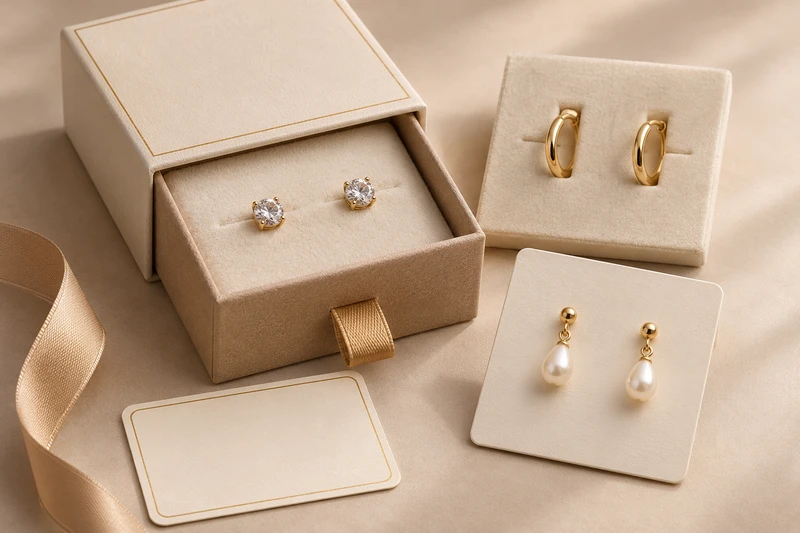
Earring packaging should hold a matched pair in a clear, balanced display while leaving enough room for the earring style and its backing. Studs need accurately positioned holes and space behind the card; hoops need room for their diameter and fastening; drop earrings need support that keeps the decorative part visible rather than compressed.
For jewellery brands, retailers and e-commerce teams in South Africa, the most useful earring packaging ideas begin with the real pair—not a generic box size. Measure the earrings when assembled with their backs, hooks or clasps, then plan the card, insert and outer box around how customers will see, remove and replace them. At XGolden Print, we design and produce custom paper packaging boxes, gift packaging, labels and stickers, with support for structural design, material selection, artwork, printing, finishing, fitted inserts and sample approval before production.
One earring layout does not suit every shape
A single earring card layout can create avoidable problems when a collection includes studs, hoops and drops. The position of the attachment holes, the usable depth inside the pack and the space around the jewellery all change according to the pair’s shape.
Start by grouping earrings according to how they attach and where their visual weight sits:
| Earring type | Main packaging requirement | Suitable display approach | Point to check |
|---|---|---|---|
| Studs | Accurate hole spacing and room for backs | Flat card or shallow fitted insert | The backs must not force the card forward |
| Small hoops | Clearance around the circular shape | Card with room around the perimeter | The hoop and closure should not overlap printed details |
| Large hoops | Greater face area and internal depth | Larger card or recessed insert in a box | Measure the full outside diameter and fastening |
| Drop earrings | Support for the upper fixing and visual alignment | Taller card or insert that presents the drop vertically | The hanging element should not bend against the packaging |
| Statement or uneven pairs | Controlled positioning for each component | Custom insert or carefully planned card positions | Check that the pair looks balanced when viewed face-on |
The display position matters as much as the overall card size. A small stud pair can sit close to the centre of a compact card, while a long drop earring may need its fixing point higher up to keep the lower portion within the visible panel. If the attachment point is too low, the earring can look crowded or extend into an area where a drawer, lid or sleeve makes removal awkward.
For retail presentation, leave a clear area for product information, a collection name, logo or care message without placing text directly behind the earrings. For gift packaging, the focus may be a more minimal reveal: the pair is visible immediately when the recipient opens the box, while brand and product details sit on an inner card, reverse panel or accompanying insert.
Avoid choosing a layout from photographs alone. Earrings can look similar in a flat image yet differ significantly in post length, hook position, hoop diameter or lower ornament. The packaging brief should identify each product variant that needs to use the same pack.
Stud spacing and room for the backs
Stud earrings usually require the simplest-looking packaging, but their small scale makes misalignment more obvious. The holes should present the pair evenly and should be spaced for the actual face diameter, not only for the posts. If the studs are close together, larger decorative fronts may visually touch. If they are too far apart, the pair can look disconnected on the card.
Back clearance is the key practical consideration. Butterfly backs, screw backs and other fastening types sit behind the display surface, so a card that appears suitable by itself may not sit flat once the earrings are loaded. Buyers should decide whether the back sits:
- behind a display card, with free space inside the outer box;
- within a recessed area of a fitted insert;
- through a card that is supported away from the box base; or
- in a separate small holder, if the product design calls for it.
The correct option depends on the assembled depth of the earring and its back. A shallow outer pack can be suitable only when the backing arrangement has adequate clearance. Do not assume that a thicker-looking card solves this issue; it may improve card stiffness but does not automatically create room behind it.
Stud packaging can also support efficient packing workflows. If several stud designs share one format, agree on a defined hole position and a maximum decorative-face size for that format. This helps a retail or fulfilment team identify which pairs use the same cards and boxes. Where collections vary widely, separate card layouts may give a more consistent result than trying to force every pair into one standard position.
For shelf-facing packs, include only the information customers need at that stage, such as the design name or product identifier. The reverse side can carry fuller details where needed. Artwork should also account for the portions covered by the earrings: a central logo may be obscured by a larger stud, whereas a border, small heading or lower panel may remain readable.
Giving hoops and drops enough depth
Hoops and drop earrings need packaging that accommodates their three-dimensional form. The widest or longest point is not always where the product attaches to the card, so measuring only the top fitting can lead to an unsuitable layout.
For hoops, record the outside diameter, the hinge or closure position and the total depth created when the pair is mounted. A card can display small hoops effectively, but larger hoops may require more open space around the outer edge. The hoop should not press into the inside wall of a box, catch on the opening, or sit across text intended to be visible at a glance.
Drop earrings need vertical space and support for the hanging element. A pair with a post at the top and an ornament below may need a taller card than a hoop of similar overall size. Consider where the drop rests when the package is closed. If it can move freely, it may present differently after handling. If it is held tightly against a card or insert, verify that the layout does not put pressure on decorative components.
Useful measurements to provide in an earring gift box packaging brief include:
- The width, height and depth of each earring when assembled.
- The spacing between left and right attachment points.
- The type and dimensions of the back, clasp, hook or closure.
- The maximum diameter for hoops or widest point for drops.
- Whether the earrings should face forward, hang freely or sit within a recess.
- Whether a product card, care card, pouch or gift message must share the pack.
Depth is especially important for a gift box. The outer box should be selected around the loaded display, not simply around the visible face of the earrings. A hinged, drawer or lid-and-base structure can all be considered, but their internal space and opening path must work with the chosen card or insert.
This retail or gifting presentation is not a complete transport protection system. If earrings will be sent in online orders, brands should separately plan suitable outer shipping packaging and packing materials for the journey. The earring card, fitted insert and gift box serve presentation, organisation and product access; the transport pack must be specified for the distribution method and destination.
Display cards and inserts inside a box
Display cards and fitted inserts are different layout tools, and either can work well for earring packaging. The right choice depends on the product, the intended opening experience and the amount of information that needs to be presented.
A display card is often useful when the earrings should remain visible immediately. It can carry the pair through holes or slots and provide space for branding, product details or a collection message. It may be packed directly into a box, placed in a sleeve or used as the visible top layer of a gift set.
An insert is useful when the box itself is the main presentation format. A fitted insert can define where the earring pair sits within a rigid box, magnetic closure box, drawer box or lid-and-base box. It can also help create a consistent layout alongside other customer products, such as a necklace, bracelet or gift message card. Insert dimensions, openings and material choice should be confirmed for the individual project.
Consider the intended customer action:
- Retail browsing: The earrings and key information should be readable from the front, with the pair positioned consistently across the range.
- Gift presentation: The opening sequence may be more important, with the jewellery revealed inside a box after the lid or drawer is opened.
- Online orders: The internal layout should make it easy for the packing team to load the pair correctly before the outer shipping pack is added.
- Event gifting: A coordinated box, insert and card can accommodate a matched pair for weddings, thank-you gifts or special events, subject to the final product dimensions and quantity.
For South African brands selling multilingual ranges, artwork can be planned for the languages and product information required for the particular sales channel. Keep variable details—such as style name, colour or SKU—separate from fixed brand artwork if the same box will serve several earring variants. This can make the layout easier to manage, but the final printing and packing approach should be agreed for the project.
Materials and finishes should serve the use case. A retailer may prioritise a clean shelf presentation and legible printed details, while a premium gift set may prioritise the tactile opening experience and a structured insert. Material suitability, finishes and insert construction need to be confirmed against the specific earring design, box structure and handling requirements.
An earring drawer-box style from XGolden
A drawer box is a practical option when the earring pair should be revealed by pulling out an inner tray rather than lifting a lid. The DB-307 earring drawer-box style is an existing XGolden Print product example relevant to earring presentation. It can be a useful starting point for discussing how a drawer format may suit a particular pair, but final dimensions, materials, inserts and fit must be established for the individual project.
The drawer structure can support a deliberate unboxing sequence: an outer sleeve presents the brand, then the inner tray reveals the earring card or insert. It may suit single-pair gifts, jewellery collections or coordinated gifting where the outer appearance needs to match other packaging in the range.
Before selecting an earring drawer box, clarify:
- whether the earrings sit on a card, inside an insert or with another item;
- the loaded height, including earring backs and any protective layer;
- the direction in which the tray is pulled out;
- whether the product needs to remain face-up during removal;
- the position of artwork on the sleeve and tray; and
- whether the box is a retail presentation pack, a gift pack or part of a larger set.
For projects needing a different format, XGolden Print can support custom box packaging across rigid boxes, magnetic closure boxes, drawer boxes and lid-and-base boxes. The selected format should follow the earring layout and use case rather than a visual preference alone.
Loading and removal checks with the real pair
The most useful packaging check is to load the real earring pair, close the package and remove it as a customer would. This exposes issues that flat artwork proofs and empty box samples cannot show.
A practical review should check the following:
- Can the packing team attach the earrings to the card or insert without struggling with the holes, slots or fastening?
- Do the backs, clasps or hooks sit within the available depth when the box is closed?
- Is the pair straight and evenly spaced when viewed from the front?
- Does any hoop, drop or decorative element catch on the insert, tray edge or box opening?
- Can a customer remove the card or jewellery without needing to pull on a delicate component?
- Does the card remain legible once the earrings cover their intended area?
- If the pack is a gift, does the product look considered at the first opening?
- Can the presentation pack then be placed into the separately specified outer transit packaging for online orders?
Sample approval before production is particularly valuable where a collection has multiple earring shapes, unusual fastening types or a shared box for several variants. It gives the buyer a chance to review the loading process, fit and customer-facing presentation before finalising production.
Common mistakes include using one hole spacing for every stud size, selecting a box based only on its outside dimensions, forgetting the depth of earring backs, and placing a large hoop or drop design over key artwork. Another frequent issue is approving an empty insert without testing the jewellery mounted in its final display position.
For a multi-item gift, make sure every component has an assigned place. A loose earring card placed alongside a pouch, message card or another jewellery item can shift the visual balance of the set. Gift packaging options can be planned around multiple products, coordinated branding and the intended opening experience, with the final layout confirmed against the actual contents.
Preparing an earring packaging brief
A clear brief helps move from general earring packaging ideas to a pack that can be assessed properly. Include:
- photos and physical dimensions of the assembled earring pair;
- the earring category: studs, hoops, drops or mixed styles;
- fastening and backing details;
- the preferred display method: card, insert or both;
- the number of pairs or other items in each pack;
- whether it is for retail, gifting, online orders or an event;
- required product information and available artwork;
- the desired box format, if one has already been considered;
- quantity, required delivery date and delivery destination.
XGolden Print can support the packaging brief through structural design, material selection, artwork support, printing, finishing, fitted inserts and sample approval before production. Share the real earring dimensions, quantity, artwork, required date and delivery destination with XGolden Print to discuss an earring packaging format suited to your range.
