
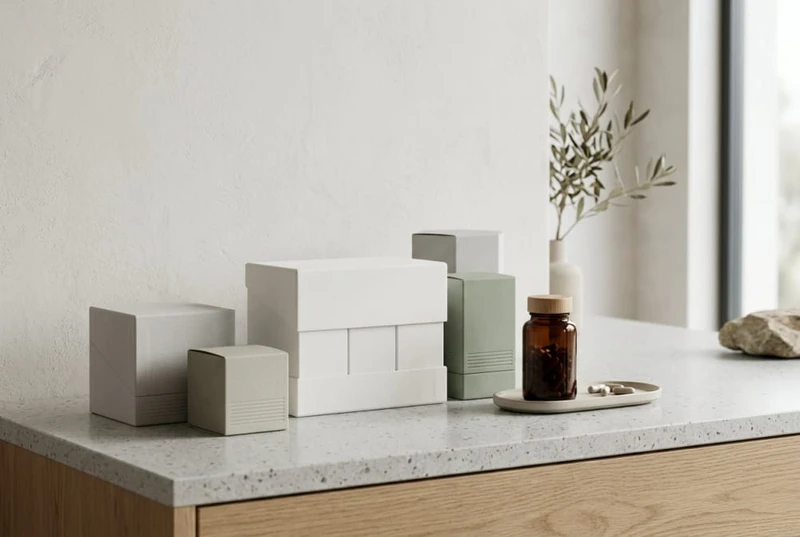
A well-planned supplement packaging system does two jobs at once: it gives buyers a credible, easy-to-read product presentation, and it gives your team a repeatable way to manage packs, labels and stock as the range grows. The strongest systems separate the roles of the primary pack, outer box, product label and distribution carton instead of expecting one component to solve every problem.
For South African supplement brands, the practical starting point is a packaging framework with fixed brand elements, flexible information areas and clear rules for product variants. Confirm all applicable local labelling, ingredient, advertising and product-category requirements with the appropriate qualified adviser before printing.
Outer packaging needs for capsules, gummies, powders, sachets and bundled kits
The product format should shape the outer packaging decision. A carton that works well around a capsule bottle may be unsuitable for a pouch of powder or a multi-item wellness kit. Start by defining the primary container, then design the secondary packaging around its dimensions, weight, opening method and protection needs.
| Product format | Common primary pack | Useful outer-packaging role | Key details to check |
|---|---|---|---|
| Capsules or tablets | Bottle, jar or blister pack | Protects the pack, carries product information and creates a retail-ready face | Bottle height and diameter, closure clearance, movement inside the box |
| Gummies | Jar, pouch or tub | Adds structure, supports presentation and keeps variant information clear | Container shape, product sensitivity, closure and tamper-evidence requirements |
| Powders | Tub, jar, stand-up pouch or sachet | Makes a larger format easier to merchandise and can group accessories | Pack weight, scoop or accessory fit, pouch stability and panel space |
| Single-serve sachets | Individual sachets | Organises a count of sachets and makes the range easier to display | Sachet count, dispensing method, tear resistance and pack orientation |
| Bundled kits | Multiple bottles, pouches or accessories | Holds products together and explains how the kit is organised | Internal fit, item sequence, kit contents and outer-carton weight |
A folding carton is often useful where a bottle or pouch needs a clean, printable retail presentation. It can hold the brand story, directions, product descriptors and mandatory information while allowing the primary pack to remain functional. However, the carton dimensions must be based on the actual filled pack, not an early container drawing. Small changes in cap height, pouch gusset or label thickness can affect fit.
For kits, consider internal partitions, sleeves, trays or inserts only when they solve a real handling problem. An insert can stop bottles from knocking together, separate morning and evening products, or make a gift-style set easier to unpack. If it only adds complexity without improving protection or presentation, it may not be worthwhile.
Before approving a box format, check:
- Filled primary-pack dimensions, including cap, seal and any protruding features.
- How much movement is acceptable inside the carton.
- Whether the product needs a particular upright orientation.
- Whether the pack must accommodate an insert, leaflet, scoop or measuring aid.
- Opening, resealing and disposal expectations for the intended sales channel.
- The available surface area for all information that must appear on the product pack.
How box design can improve shelf impact without complicating compliance panels
Shelf impact is not the same as visual noise. In a supplement aisle or online product grid, shoppers should be able to identify the brand, product type, flavour or format, and pack size quickly. A structured design system achieves this without crowding out important information.
A practical front panel usually establishes a hierarchy:
- Brand identifier – consistent placement across the range.
- Product name or main category – immediately legible at normal viewing distance.
- Clear differentiator – such as format, flavour or product focus, where appropriate and supportable.
- Pack count, mass or volume – positioned consistently.
- Variant cue – colour, pattern or an organised naming convention.
Keep regulated or required information separate from high-impact marketing areas during the design stage. This does not mean hiding important details; it means allocating enough space so that ingredients, directions, warnings, batch-related fields and other required content can remain readable rather than being squeezed into a leftover panel.
Build a panel map before designing artwork
A panel map is a simple layout plan that assigns a role to every side of the box. For example:
- Front: brand, product name, variant and pack format.
- Side panel one: product description and directions for use.
- Side panel two: ingredient and other required information.
- Back: brand story, storage guidance, contact information or supporting product details.
- Base or closure area: batch, date and production coding space, where suitable.
The exact content and placement must be checked for the product and market. The important design principle is to reserve these areas from the outset. Trying to insert necessary information after a visual concept has been approved commonly leads to tiny type, poor contrast and inconsistent packs.
Use distinction without making claims harder to control
Colour is one of the simplest ways to distinguish variants, but it should not be the only cue. People may shop quickly, view products online at a small size, or have difficulty differentiating certain colours. Pair colour with a clear product name, a format label and, where useful, a simple icon system.
Avoid making the design dependent on large claims that may later need to be changed or removed. If a panel is built around a bold statement, a compliance review can force a late redesign. A more resilient layout puts the product name, format and clear factual descriptors at the centre, with any claims treated as content that must be reviewed before print.
Sticker solutions for small batches, formula changes and private-label production
Stickers can make supplement packaging more adaptable, especially when product details may change or a brand is testing a limited range. They are commonly used on bottles, jars, pouches and sometimes outer cartons.
For small batches or private-label programmes, labels may reduce the need to hold numerous pre-printed carton versions. They also make it easier to revise variable information, provided that changes are controlled and all final artwork is reviewed before use.
Useful label applications include:
- Product labels for stock bottles or jars.
- Variant labels for flavours, strengths or pack sizes.
- Variable information labels for batch-related fields where appropriate.
- Promotional or channel-specific labels where these are properly managed.
- Overlabels to correct non-critical packaging information, subject to applicable requirements and product suitability.
The main limitation is that stickers are not a shortcut for poor information planning. A label must adhere reliably to the chosen substrate, fit the available panel and remain legible throughout expected handling and storage. Curved containers, textured surfaces, oils, moisture and cold conditions can all affect application and appearance.
When comparing custom printed stickers for supplement packs, ask for guidance on the container material, label shape, application method and finish. Supply the actual container or a representative sample where possible. A label that looks balanced on a flat artwork file can wrinkle, skew or appear undersized once applied to a tapered bottle.
For formula changes, version control matters as much as print choice. Use a clear internal artwork naming system that records the SKU, pack size, version and approval date. Ensure obsolete labels are separated from current stock to reduce the risk of mixed packaging.
Packaging differences between single-product launches and growing supplement lines
A single-product launch needs a focused pack that explains one offer clearly. A growing line needs a system that can add products without losing recognition or creating artwork chaos.
The difference is often visible in the design architecture.
| Decision area | Single-product launch | Growing product line |
|---|---|---|
| Brand identity | Can concentrate on one hero design | Needs fixed rules for logo, typography and layout |
| Variant coding | May need little distinction | Requires a consistent colour, naming or icon system |
| Artwork files | One or two versions may be manageable | Needs organised master files and version control |
| Box sizing | A tailored carton may work | A small family of sizes can simplify specification |
| Information panels | Designed for one formula | Must allow for different copy lengths and ingredients |
| Future additions | Often considered later | Planned from the start with flexible templates |
For an initial product, it can be tempting to create a highly customised shape, finish or layout. This may be appropriate for a premium positioning, but check whether future SKUs can use the same approach. A pack that only suits one bottle size or leaves no room for longer product information may become expensive to extend.
A scalable system usually includes:
- A core grid that fixes the placement of the logo, product name and key pack details.
- A standardised set of carton footprints where feasible.
- Defined locations for variable panels and coding.
- Approved colour families for categories or variants.
- A controlled naming convention for product files and print versions.
This does not require every pack to look identical. It creates enough consistency that customers can recognise the range while each product still communicates its own purpose.
Case-pack and distribution details that matter in wholesale supplement sales
Retail-ready individual cartons are only one layer of the packaging system. Wholesale orders also need outer case packs that protect products, simplify receiving and help retailers identify what is inside.
The distribution carton should be specified around the final retail pack, rather than treated as an afterthought. If individual cartons are too loosely packed, they can shift and crush. If they are too tightly packed, staff may struggle to remove them without damaging the retail presentation.
For each case pack, document:
- SKU name and internal product code.
- Number of retail units per case.
- Individual unit dimensions and case dimensions.
- Gross and net weight, where needed for operations.
- Carton orientation and stacking guidance, if relevant.
- Outer-case identification, including a readable product description.
- Batch or date traceability process where applicable to your operation.
- Whether cases are intended for shelf replenishment, storage or direct dispatch.
Wholesale buyers often value operational clarity. A case label that distinguishes closely related variants can reduce receiving and replenishment errors. This is especially important where a range includes similar flavours, pack sizes or capsule counts.
For e-commerce fulfilment, assess whether the retail carton can travel safely inside a suitable shipping pack. Do not assume a shelf carton is automatically a transit carton. The appropriate level of protection depends on the primary container, the distribution route and the way orders are packed and handled.
Simple ways to keep line extensions consistent across multiple SKUs
Consistency comes from documented decisions, not from relying on memory. Create a concise packaging style guide before the range becomes large.
Your guide can include:
- Logo size, clear space and permitted positions.
- Typefaces and minimum readable type sizes.
- Standard carton layout and panel allocation.
- Colour rules for categories and variants.
- Product-name format and hierarchy.
- Image and icon rules.
- Barcode placement and quiet-area requirements, where relevant.
- Locations reserved for variable or required information.
- Material, finish and structural specifications for each pack family.
Use an SKU matrix alongside the style guide. This is a working table that lists every product and its packaging variables: format, pack size, flavour, carton size, label size, artwork version and case quantity. It gives product, procurement and warehouse teams a shared reference point.
A simple colour structure can also prevent confusion. For instance, one colour family might identify powders, another capsules and another sachet products. Within each family, flavour or formula variations can use secondary colours or descriptive labels. Always ensure the product name remains the primary means of identification.
Packaging choices that can weaken trust even when the product is strong
Supplement buyers often use the pack itself as a signal of care and legitimacy. Poorly organised packaging can create doubt before they have assessed the product.
Common trust-reducing choices include:
Crowded or unreadable information
Too much text in too little space makes a pack difficult to use. It can also make essential directions or warnings easy to miss. Edit non-essential marketing copy before reducing type size.
Inconsistent variant names
If the bottle says one product name, the box uses another, and the online listing uses a third, customers and retailers may struggle to match stock. Keep naming aligned across all customer-facing materials.
Weak hierarchy
A large logo does not compensate for a product name that is hard to find. Buyers should not have to search for the format, flavour, count or intended product category.
Decorative packaging that does not fit the product
Overly elaborate boxes, excessive inserts or impractical finishes can make a product feel less considered rather than more premium. Choose features that improve handling, protection or the unboxing experience.
Uncontrolled print versions
Old labels, amended cartons and revised formulas can create avoidable errors if stock is not separated and artwork versions are unclear. Establish approval and stock-disposal procedures before updates go live.
Assuming every material suits every environment
A finish that looks attractive in a product photograph may scuff in handling or be unsuitable for the label adhesive and container surface. Review compatibility with real samples before committing to a full run.
How to create a supplement packaging framework that is easy to expand
An expandable framework starts with a clear brief and a manageable number of controlled components. It should allow you to launch one product confidently while making the second, fifth or twentieth SKU easier to specify.
1. Define the packaging hierarchy
List every layer involved:
- Primary container or sachet.
- Product label.
- Outer retail carton, sleeve or wrap.
- Insert or leaflet, if required.
- Wholesale case pack.
- E-commerce shipping protection, if applicable.
Assign a job to each layer. This prevents duplicated copy, unnecessary materials and confusion over where essential information belongs.
2. Standardise where it does not reduce usability
Select a limited family of box sizes, label dimensions and structural styles where products allow it. Standardisation can make artwork planning, storage and replenishment simpler. Do not force a product into an ill-fitting standard size merely to reduce variety.
Explore custom packaging boxes with the final product dimensions, primary-pack sample and a panel-content plan ready. Those inputs make it easier to assess whether a carton structure is practical for the product rather than simply visually appealing.
3. Create flexible content zones
Set aside areas that can grow or shrink for different formulas, directions and product descriptions. A capsule product and a flavoured powder may need very different amounts of information even when they sit within the same brand family.
4. Make approval a formal stage
Before ordering, check structural drawings, artwork, spelling, product names, information panels, barcode details and version identifiers. Review a physical sample or proof where available, particularly when a new substrate, finish, container or box style is involved.
5. Plan changes before they happen
Keep master artwork files, a change log and a record of component specifications. Decide who may approve changes to formula text, pack copy, colour, dimensions and print files. This is particularly valuable when several teams contribute to product development, procurement and sales.
A credible supplement packaging system is not defined by the most elaborate box. It is defined by clear information, reliable organisation, practical protection and a visual structure that customers can recognise across the range. Start with the product and its required information, then build the packaging hierarchy and design rules around it.
