
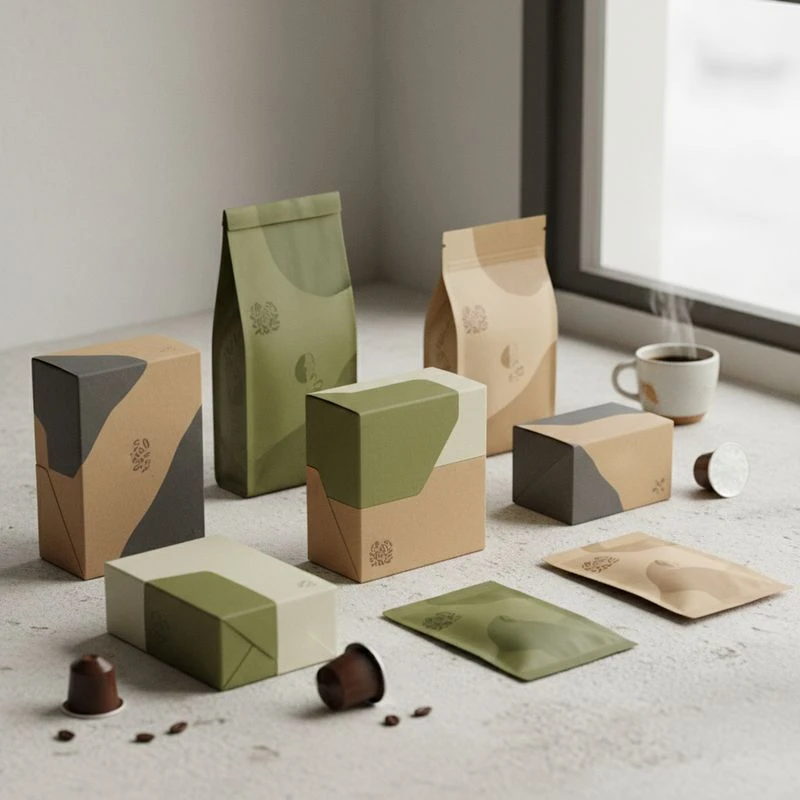
Custom packaging for coffee capsules and pods should protect each unit from crushing, present the product clearly, and suit the way it will be sold: in-store, online, as a gift set, or through wholesale channels. The right solution is usually a well-fitted carton with clear flavour information, sensible pack counts and materials selected for the intended product lifecycle.
For South African coffee brands, packaging decisions should start with the capsule or pod format, the outer pack quantity and the sales channel. A box that works well for a compact retail shelf pack may not provide enough protection for a multi-pack sent through e-commerce fulfilment.
Coffee Capsule Packaging
Coffee capsules and pods need packaging that balances protection, presentation and practical handling. The outer packaging does not usually replace the capsule’s own barrier properties, but it can prevent loose units from rattling, denting or becoming separated from the intended product information.
First, distinguish between the two common product types:
- Coffee capsules are typically rigid, single-serve units designed for use in a compatible coffee machine.
- Coffee pods may refer to soft coffee portions, often wrapped in filter material, or may be used broadly as a consumer term for single-serve coffee products.
- Compatible capsules are designed to work with a named machine system or a particular capsule format. Compatibility wording, if used, must be accurate and should be checked carefully before printing.
A custom coffee capsule box may contain a single row, multiple rows or a divided arrangement. The internal layout should keep the capsules stable without making the pack unnecessarily bulky. For softer pods, internal support and moisture-conscious product packing can be particularly important because the product is more easily compressed than a rigid capsule.
Choose the pack format around the purchase occasion
The number of units in a pack should reflect how customers are likely to buy and use the coffee. Common options include:
| Pack format | Best suited to | Packaging considerations |
|---|---|---|
| Small trial pack | New flavours, limited selections and gifting | Make flavour and compatibility easy to identify at a glance |
| Everyday retail carton | Regular household purchasing | Prioritise shelf visibility, easy opening and consistent sizing |
| Multi-pack | Value-focused or high-use buyers | Use stronger board and consider internal dividers where needed |
| Mixed-flavour selection box | Discovery sets and gifts | Clearly identify each flavour, roast or intensity within the pack |
| Subscription or e-commerce pack | Repeat online orders | Design for secondary shipping protection and efficient packing |
The exterior should communicate the key buying information without becoming overcrowded. Depending on the product, this could include the coffee origin or blend name, roast profile, flavour notes, capsule count, net contents, preparation guidance and compatibility statement.
Keep promotional design separate from essential information. A bold front panel can attract attention, but customers should still be able to find the pack count and product format quickly.
Match the box style to the product and channel
Folding cartons are a practical choice for many capsule packs because they are compact, printable and efficient to store flat before packing. A tuck-end carton may suit standard retail packs, while a sleeve-and-tray format can provide a more premium unboxing experience for gift assortments.
Other options may include:
- Display-ready cartons for shelf presentation where the outer case becomes part of the retail display.
- Drawer boxes for premium capsule collections, corporate gifts or seasonal ranges.
- Rigid gift boxes for high-value presentation, where additional material use is justified by the positioning of the product.
- Mailer-ready packaging for direct-to-consumer orders, particularly where the product will not be placed inside a separate shipping box.
- Labels or wraps for product bundles, provided the coffee units remain adequately protected.
When developing a full range, standardising the box footprint can make display and storage more consistent. Different flavour variants can then be distinguished through colour, illustration, pattern or a clearly structured naming system rather than changing the entire pack construction.
Compact Design
Compact packaging is not simply about using less board. It means designing a box around the real dimensions of the capsules or pods, with enough tolerance for packing and opening but without excessive empty space.
An oversized carton can make a small product appear poor value, allow contents to shift during handling and consume more storage space. A box that is too tight, however, may slow packing, scuff printed capsules or frustrate customers when removing individual units.
Measure the actual product, not a catalogue size
Use samples of the finished capsule or pod when specifying a box. Dimensions can differ according to the product construction, lid profile, wrapper shape and manufacturing tolerances. If the coffee range includes more than one capsule supplier or product variant, check whether all units genuinely fit the same internal layout.
A packaging specification should record:
- External length, width and height of the box
- Internal usable dimensions
- Number of units and arrangement per pack
- Orientation of capsules or pods
- Divider, insert or tray requirements
- Board type and intended finish
- Closure style and opening method
- Required printed panels and barcode placement
- Whether the finished pack will go into a shipping carton
It is wise to assess the complete pack, not only the open carton. Consider whether the closure remains secure when the box is carried, stacked or handled in a retail environment.
Design for easy selection and repeat use
Coffee is often stored in the original packaging after purchase. A resealable feature, dispensing opening or neatly designed tuck closure can improve daily use when it suits the pack format. However, these features should not weaken the carton or create avoidable complexity.
For larger packs, an opening that gives access to one or two capsules at a time can help keep the contents organised. For gift boxes, a clean reveal of the assorted capsules may matter more than dispensing convenience.
Avoid relying solely on colour to identify flavours. Use readable flavour names, roast descriptions or icons alongside colour coding. This supports clearer choice under varied lighting and helps customers distinguish similar-looking variants.
Print choices that support the coffee brand
Coffee packaging often needs to convey both sensory character and practical information. Matte finishes can create a restrained, craft-led appearance, while gloss elements may be used selectively to highlight the brand name, flavour cues or metallic details. Embossing, foil and spot finishes can add distinction, but they should support the positioning rather than obscure necessary product information.
Before selecting embellishments, consider:
- Whether the pack will be handled frequently on shelf
- Whether the design needs to reproduce consistently across several variants
- How easily small text will remain legible
- The impact of finishes on sorting and recycling considerations
- The available print area after barcodes, ingredients and other required information are included
Request a physical sample or prototype before final production where possible. Digital artwork alone cannot fully show how folds, seams, colour contrast, opening actions and capsule fit will work in practice.
B2B Manufacturing
For procurement teams and product developers, ordering custom packaging for coffee capsules and pods is a specification exercise as much as a design exercise. The strongest result comes from agreeing on the structure, artwork responsibilities, order quantity and quality checks before production begins.
A packaging supplier needs enough information to quote and manufacture the correct box, but the buyer should also retain control of product claims, legal wording and final artwork approval.
What to provide in a packaging brief
A useful brief includes the following:
- Product samples or accurate dimensions
Supply the actual capsule or pod where possible, along with the planned unit count per box.
- Sales channel
State whether the packs are for retail shelves, hospitality, gift distribution, online orders, wholesale or a combination.
- Box style and target presentation
Identify whether the requirement is a simple carton, a premium gift box, a display pack or a protective mailing format.
- Artwork requirements
Provide approved logos, colour references, copy, barcode files and any required product information. Confirm who is responsible for checking spelling, compatibility statements and legal text.
- Finishing preferences
Specify any required lamination, varnish, foil, embossing, windows, inserts or special closures.
- Order and repeat-order needs
Discuss expected quantities, version changes, seasonal variants and whether several coffee flavours will share a common structural design.
Custom box production can involve design development, sampling, printing, cutting, folding, gluing and packing. Each stage affects the final result. Small changes to a carton’s dimensions, finish or internal layout can alter material use, production complexity and cost, so settle core structural requirements early.
For a broader view of carton styles and specification options, explore custom printed packaging boxes before selecting a format for your capsule range.
Questions to ask before approving production
Ask your packaging partner to clarify the practical details rather than assuming them:
- What are the internal and external dimensions of the finished box?
- Will the chosen board suit the weight and arrangement of the capsules?
- Is an insert necessary to prevent movement?
- How will the carton be supplied: flat-packed, assembled or in another agreed format?
- Which artwork files and colour references are required?
- Is a physical sample, plain mock-up or production proof available to approve?
- Where will folds, glue areas and cut-outs affect the printed design?
- Can the same structure accommodate other flavours or pack counts?
- What information must be finalised before the order is released?
XGolden Print provides custom packaging boxes and printing solutions. For larger or repeat packaging programmes, its established production capability may be relevant, but buyers should still confirm the exact construction, artwork process, lead-time expectations and commercial terms for their own order.
Common B2B packaging mistakes
The most frequent problems are avoidable during planning:
- Designing artwork before the final dieline is confirmed
- Using approximate capsule measurements instead of physical samples
- Leaving too little space for mandatory or operational information
- Selecting a premium finish without considering the intended recycling route
- Ordering a box that fits the product but not the retail shelf or shipping method
- Assuming one capsule format is compatible with all versions in a product range
- Failing to approve a physical sample for packs with inserts, windows or complex folds
- Printing machine compatibility claims without verifying them
A clear sign-off process should identify who approves structural design, text, colours, barcode readability and final packaging samples. This reduces the chance of expensive revisions once printing has started.
Food Safety
Coffee capsule packaging must be considered as part of the product’s overall food-contact and information system. The capsule, pod wrapper, inner wrap, carton, inks, adhesives and any inserts may have different functions and different levels of contact with the product.
The outer box is commonly a secondary pack rather than the direct food-contact layer. Even so, it should be specified and handled appropriately for the intended use. Do not assume that a board, coating, ink or adhesive is suitable merely because it is used in general packaging.
Confirm the packaging boundary
Start by mapping which materials touch the coffee or its immediate protective wrap:
- Direct contact: material physically touches coffee or an exposed food surface.
- Indirect contact: material may touch an inner wrap, capsule or sealed primary pack.
- Secondary packaging: an outer carton that groups protected units for sale or distribution.
The closer a component is to the coffee, the more carefully its suitability needs to be assessed. Where any material may contact food, obtain appropriate documentation and verify suitability with the relevant supplier and your own compliance advisers.
Check labelling and product claims before print
Coffee packaging may need to include product-specific information such as contents, preparation instructions, storage guidance, allergens where applicable, batch or date coding arrangements, and responsible business details. The exact requirements depend on the product, route to market and applicable rules.
Before approving artwork:
- Verify all product wording for the South African market.
- Ensure compatibility claims are factual and clearly qualified where needed.
- Keep ingredient, allergen and storage information readable.
- Confirm there is sufficient space for coding or labels applied after printing.
- Check that flavour descriptors do not create unintended product claims.
- Review barcode placement and quiet areas with the relevant barcode provider or retailer requirements.
This article provides general packaging guidance, not legal or food-safety advice. Brands should verify current requirements for their product and market before printing or selling packaged coffee.
Protect product quality through the complete pack system
An attractive carton cannot correct weaknesses in the primary capsule or pod pack. If freshness, aroma retention or moisture control is critical, those characteristics should be addressed through the coffee product’s primary packaging system.
The outer carton should then be designed to support that system by preventing crushing, contamination or unnecessary exposure during normal handling. Consider storage conditions, expected stacking, moisture exposure risks and the secondary packaging used for transport. Test the complete pack arrangement using actual products before a full rollout.
Recycling
Recycling decisions should be made at component level. A coffee pack may contain a cardboard carton, a foil or plastic capsule, adhesive labels, inserts and protective films. Calling the whole pack recyclable without considering each part can confuse customers and create avoidable risk.
The simplest approach is to reduce unnecessary materials, choose components that are easier to separate where practical, and give clear disposal guidance based on the materials actually used.
Design cartons for simpler recovery
Paper-based cartons can be a sensible choice when they are clean, dry and accepted by the available collection or recycling route. However, coatings, laminates, foils, windows and mixed-material inserts can affect how a pack is sorted or processed.
When reviewing an outer carton, ask:
- Is a special finish essential to the product position?
- Can a plastic window be avoided or made easy to separate?
- Can inserts be made from the same or compatible material family as the carton?
- Is the ink coverage necessary across every panel?
- Will consumers be able to separate different components without difficulty?
- Are disposal instructions specific enough to be useful?
A plain board carton is not automatically the best environmental option in every situation. A package also needs to protect the coffee and avoid product damage. The goal is an appropriate level of material and protection, not simply the lightest possible box.
Give realistic disposal guidance
Coffee capsules and pods may require different disposal steps from the outer carton. If a capsule needs to be emptied, cleaned, returned or handled through a particular collection stream, only state this where it is accurate and practical for the product.
Avoid broad environmental claims such as “eco-friendly”, “green” or “zero waste” unless they can be substantiated for the complete product and its real disposal pathway. More useful wording is specific: for example, identifying the carton material and telling consumers whether components should be separated.
Also remember that local collection options can vary. A disposal instruction should be reviewed against the channels available to the intended customer base, rather than copied from packaging developed for another market.
A practical checklist for choosing coffee pod packaging
Before placing an order, confirm that you can answer these questions:
- Does the box fit the actual coffee capsules or pods without excessive movement?
- Does the chosen pack count suit the intended buyer and channel?
- Is the product type and machine compatibility described accurately?
- Are flavour, roast and pack-count details easy to find?
- Has the outer carton been checked alongside the primary product packaging?
- Are food-contact boundaries understood and supporting documentation requested where relevant?
- Is there room for all required product information and date or batch coding?
- Has a physical sample been assessed for folding, opening and product fit?
- Does the design allow for retail display, fulfilment or shipping requirements?
- Are recycling instructions limited to claims that can be verified?
The best custom packaging for coffee capsules and pods is a considered system, not just a printed box. Start with the product dimensions and sales channel, select a structure that protects the contents, then finalise artwork only after the layout and information requirements are clear.
