
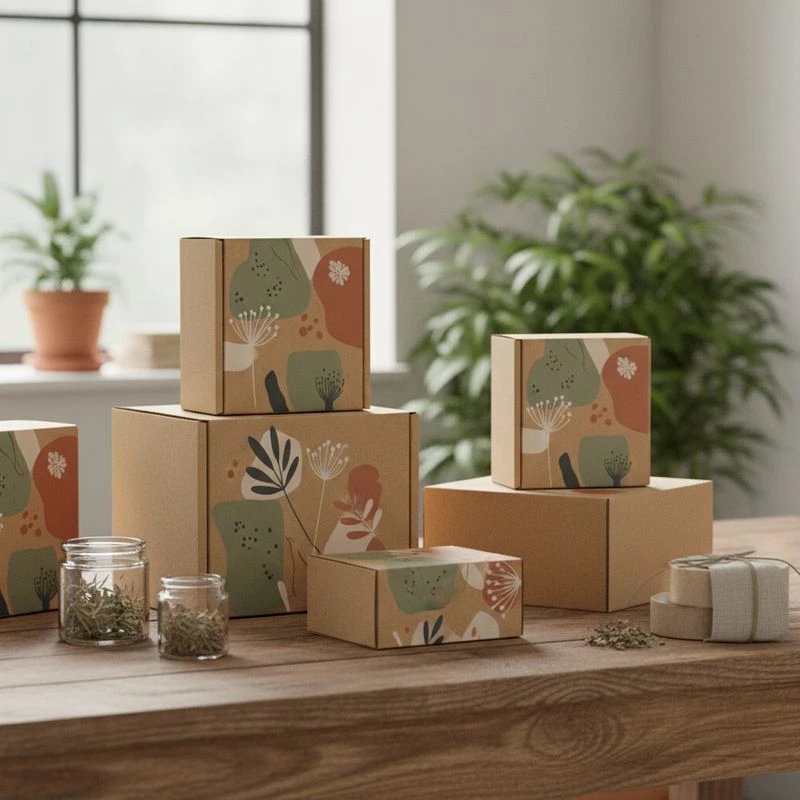
Custom kraft boxes for natural product lines can give a product range a simple, ingredient-led appearance while providing a practical format for retail shelves, gifting and online orders. They are particularly suitable when the packaging needs to feel considered rather than overly glossy or heavily decorated.
The best choice is not simply “brown box versus white box”. Specify the board, box structure, print method, closure, insert and end-of-life information around the product itself. A natural-looking pack that does not protect a glass jar, leaks ink onto the surface, or leaves customers unsure how to dispose of it will work against the brand.
Kraft Packaging
Kraft packaging is made from paper-based board with a recognisable natural brown appearance. It is often selected for soaps, candles, botanical goods, dry foods, skincare, wellness products and handmade gift ranges because its visible fibres and muted colour suit an understated brand identity.
However, “kraft” describes an appearance or board family more than one fixed packaging specification. Board weight, surface smoothness, recycled content, coating, strength and print response can all differ. Ask for the actual material details rather than approving a sample solely because it looks like kraft.
Choose the box construction before the artwork
Start with how the product will be handled, displayed and packed. Common options include:
| Box type | Best suited to | Points to check |
|---|---|---|
| Tuck-end carton | Lightweight jars, bottles, bars and retail products | Product fit, opening direction and closure security |
| Sleeve and tray | Gift sets, soaps, candles and presentation-led products | Tray rigidity, friction fit and ease of sliding |
| Mailer box | E-commerce orders, sample packs and multi-product sets | Internal protection, postal handling and outer labelling area |
| Two-piece rigid-style box | Premium gifting and reusable presentation | Board thickness, insert design and storage footprint |
| Window carton | Products where visibility supports the sale | Window material, recyclability considerations and product protection |
A carton should allow enough clearance for easy packing without leaving excessive movement. This is particularly important for bottles, pumps, glass containers and delicate handmade products. If the item needs cushioning, build that requirement into the design with an insert, divider or protective wrap rather than relying on an oversized box.
Match the board to the product environment
Natural products are not automatically low-risk products. Oils, balms, moisture, fragrance and powder can affect packaging differently. Before selecting kraft board, consider:
- Oil and grease exposure: Products containing oils or waxes may need an inner barrier, a protective liner or a different pack format.
- Moisture exposure: Boxes used in bathrooms, refrigerated settings or humid storage conditions need careful material selection.
- Product weight: A heavy jar can distort a light carton or strain a tuck closure.
- Abrasion: A rough natural surface can scuff when cartons are tightly packed or transported.
- Light sensitivity: Some ingredients or products need protection from light. A kraft carton may assist as an outer pack, but the required barrier depends on the product and its primary container.
- Food contact: If packaging will touch food directly, confirm that the substrate, inks, adhesives and finishes are appropriate for the intended use and applicable requirements.
Do not assume that a standard kraft carton is suitable as primary packaging. In many natural product ranges, the kraft box is an outer presentation and information layer around a sealed primary container.
Kraft brown, white kraft or printed colour?
Unbleached brown kraft has the strongest “natural” visual signal, but it changes how ink appears. Pale colours, fine type and bright brand shades can look muted against the brown substrate. White kraft or a light-coloured print area may offer a better compromise where brand colour accuracy matters.
Use brown kraft when the brand benefits from:
- A calm, minimal and handmade appearance
- Dark single-colour artwork or simple line illustrations
- A restrained colour palette
- Visible material texture as part of the design
Choose a lighter or white-facing stock where the pack requires:
- Small, highly legible information panels
- Fine photographic detail
- Bright colours or close brand-colour matching
- A cleaner contrast for ingredients, directions and warnings
Always approve a physical production sample or proof where colour, readability and texture are important. Screen colour is not a reliable guide to ink on natural board.
Recyclable
Kraft boxes can be a useful choice for packaging intended to be easier to recycle, but recyclability depends on the entire pack, not the paperboard alone. Laminates, plastic windows, foil, strong coatings, magnets, mixed-material inserts and residue from the product may all change how the package should be handled after use.
A well-designed recycling message should be specific and honest. Avoid broad claims such as “eco-friendly” or “100% recyclable” unless the exact finished packaging and local collection conditions have been verified.
Design for simpler material separation
Where a recyclable packaging outcome is a priority, simplify the pack where practical. A mostly paper-based carton with limited additional materials is generally easier for customers to understand than a decorative box made from several permanently bonded layers.
Consider the following design choices:
- Use paper-based inserts instead of foam where they meet protection needs.
- Avoid unnecessary plastic windows; if a window is essential, assess whether it can be easily separated.
- Keep labels, seals and tamper features proportionate to the pack’s purpose.
- Review whether metallic films or laminate finishes are necessary for the intended look.
- Choose minimal adhesive coverage where the box design allows it.
- Place disposal guidance where it is visible but does not crowd mandatory product information.
The right solution is product-specific. A fragile gift set may need more components than a bar soap carton, and a product requiring a barrier may not suit a simple uncoated board.
Recycled content and recyclability are different questions
A carton may contain recycled fibre, be recyclable after use, both, or neither in the way a buyer assumes. Treat these as separate specifications:
- What fibre is used in the board?
- Can the completed box be collected and processed in the customer’s likely disposal stream?
- Can any separate components be removed without difficulty?
- Does the product leave contamination that affects disposal?
For South African product lines, verify disposal claims against the packaging materials, collection context and current requirements relevant to the category. This is especially important when labelling packs with environmental statements.
Avoid sustainability claims that overreach
Natural styling does not prove a lower environmental impact. Similarly, a brown box is not automatically compostable, recycled or recyclable in every situation. Keep wording factual and tied to what has been verified.
Better packaging copy tends to describe a practical action, for example instructing customers to separate a component before disposal if that is needed. It should not imply environmental credentials that the pack design cannot substantiate.
B2B Printing
For business buyers, kraft box printing requires more planning than applying a logo to a standard carton. The print specification affects lead times, visual consistency, unit cost, minimum order considerations and whether the pack remains legible across a full product range.
The most effective approach is to define the product family first: which elements must stay consistent, and which must change between variants?
Build a repeatable packaging system
A natural product range often grows from one item into several scents, flavours, sizes or seasonal sets. Create a system that enables expansion without redesigning every carton from scratch.
A practical system may include:
- A fixed logo position and brand mark
- A consistent information panel
- Colour or icon variations for each product type
- Shared box dimensions where products allow
- Reserved space for batch, date or variable product information
- A defined hierarchy for product name, key benefit and usage directions
This makes it easier for retailers and customers to recognise related products while helping procurement teams manage multiple SKUs.
Select print coverage with the substrate in mind
Large areas of solid ink can make a brown kraft box look substantially different from an unprinted carton. This may be desirable for a stronger branded finish, but it reduces the visible natural-board effect and can reveal scuffing more readily in some handling situations.
For a more natural appearance, consider:
- One- or two-colour printing
- Dark ink on the kraft surface
- Line art, patterns or botanical illustrations
- Unprinted areas that let the board show through
- Simple, high-contrast typography
For more detailed branding, discuss print coverage, colour expectations and finish options with the packaging supplier. A production proof is valuable where the design includes small text, pale ink, fine gradients or critical brand colours.
Prepare artwork that works in production
Artwork should be supplied to the printer’s dieline and specification. The exact requirements vary, but packaging artwork commonly needs clear bleed, safe margins, cut lines, fold lines and designated non-print areas.
Before sign-off, check:
- Text does not sit too close to folds, cuts or glued seams.
- Barcodes have sufficient contrast and quiet space for scanning.
- Product claims and instructions remain readable at the final carton size.
- Variant names are easy to distinguish at shelf distance.
- Ingredients, warnings and other mandatory information have been reviewed for the relevant product category.
- Variable details have an appropriate application method, such as a label or designated print area.
- The artwork has been checked on the correct box orientation.
A small error on a flat artwork file can become very noticeable after folding. Request a dieline review and, where appropriate, an assembled sample before committing to a full production run.
Procurement questions for a print supplier
When comparing suppliers, ask questions that lead to an equivalent quotation and more reliable evaluation:
- What board options are available for the proposed box size and product weight?
- Is the board suitable for the product environment and intended use?
- What are the minimum order quantities for the selected construction and print treatment?
- Will there be tooling, artwork preparation or sampling requirements?
- What tolerances apply to colour, cutting and folding?
- Can the supplier provide a physical sample or proof for approval?
- What packaging format will be used for delivery to prevent cartons from being crushed or scuffed?
- Which material and finish information can be confirmed for environmental claims?
XGolden Print provides custom packaging boxes and printing solutions. For buyers evaluating a broader range of structures, its custom box packaging options can be a useful starting point for discussing size, format and print requirements.
Natural Style
A natural style works best when it reflects the product rather than relying on generic earthy visuals. Customers should still be able to identify what the product is, how it differs from other variants and how to use it.
The most successful natural packaging is usually clear before it is decorative.
Use visual restraint without sacrificing clarity
Brown board, black ink and botanical illustrations can create a distinctive pack, but this combination can also become difficult to scan if every element has the same visual weight. Give the product name and essential information priority.
A useful front-panel hierarchy is:
- Brand name or logo
- Product type
- Variant, scent or key differentiator
- Net contents where required or useful
- A concise supporting message, if substantiated
Put longer descriptions, directions and detailed information on side or back panels. This protects the clean front-of-pack appearance while allowing the packaging to remain functional.
Choose typography for legibility, not just mood
Script fonts and delicate serif type may suit a botanical or artisanal identity, but they should not be used for small instructions, ingredients or warning text. Natural board can reduce contrast, especially under indoor retail lighting.
Use a clear typeface for functional copy and test it at the actual printed size. If information is dense, reconsider the carton dimensions, content hierarchy or use of a secondary label rather than reducing text until it becomes difficult to read.
Keep colour purposeful
Colour can help customers navigate a range of natural products. For example, one accent colour can distinguish a calming blend from an energising blend without covering the entire kraft surface.
Limit the palette so it remains consistent across batches and box sizes. If colour is a key product identifier, establish an approved physical reference rather than relying only on digital files.
Custom Design
Custom design is worthwhile when a standard carton cannot provide the required fit, shelf presence, protection or unboxing experience. It does not always mean choosing the most complex structure. In many cases, the most effective custom kraft box is a straightforward design that fits the product accurately and communicates clearly.
Follow a product-first design process
Use this sequence to reduce avoidable changes:
- Measure the packed product. Include caps, pumps, labels, seals and any protective wrap.
- Define the sales channel. A shelf carton, gift box and e-commerce mailer face different handling demands.
- List functional needs. Consider protection, tamper evidence, display orientation, opening experience and storage.
- Select a structure. Choose the simplest format that meets the needs.
- Specify materials and finish. Match board and printing to weight, environment and brand style.
- Create the artwork layout. Allocate space for all required product information before adding decorative elements.
- Review a sample. Check fit, folding, opening, print clarity and overall appearance with the real product.
- Approve the production specification. Record dimensions, board, print colours, finishes, packing method and approved artwork version.
This process is useful for both emerging brands and established procurement teams because it turns subjective packaging preferences into a documented specification.
Add protection only where it earns its place
A custom insert can prevent movement and create a polished presentation, but it adds material, assembly and cost. Use inserts when the product genuinely needs positioning or separation, such as a multi-item gift set or fragile container.
For a single robust product, a correctly sized carton may be enough. For delivery orders, test the complete packing system: product, carton, internal protection, shipping box and any void fill. The retail carton alone should not be expected to absorb every handling risk.
Common mistakes with custom kraft boxes
Avoid these frequent issues:
- Choosing kraft for the appearance without testing whether it suits oils, moisture or product weight
- Assuming brown board will reproduce bright colours accurately
- Using too little contrast for essential copy
- Designing before finalising the product container dimensions
- Adding a window or decorative finish without considering material separation
- Leaving no room for batch, date, barcode or legally required information
- Ordering a complex box structure for a product that needs a simple, efficient carton
- Approving artwork only on screen rather than checking a physical proof or sample
FAQ
Are custom kraft boxes suitable for skincare products?
They can be suitable as outer cartons for skincare products, particularly where a bottle, jar or tube is already sealed. Check compatibility with oils, moisture, product weight and any required product information. Do not assume uncoated kraft board can safely contact the product itself.
Can kraft packaging be printed in full colour?
Yes, but the final appearance depends on the board surface and colour. Printing on brown kraft can alter lighter shades and reduce colour vibrancy. If colour matching is important, request a proof and consider a lighter-facing stock or a design with controlled print areas.
What information should appear on a natural product box?
Include the information required for your product category and target market, then prioritise what customers need to identify and use the product correctly. Common content may include the product name, variant, contents, directions, ingredient information, warnings and traceability details where applicable. Verify the exact requirements before printing.
Should a natural product brand use a matte finish?
A matte or uncoated appearance can support a natural style, but it is not automatically the right choice. Consider scuff resistance, handling conditions, print coverage and the desired level of protection. Request samples of relevant finish options before deciding.
A well-specified kraft box should support the product, the brand system and the customer’s disposal understanding. Begin with the product dimensions and handling needs, then compare material samples and box structures before finalising artwork.
