
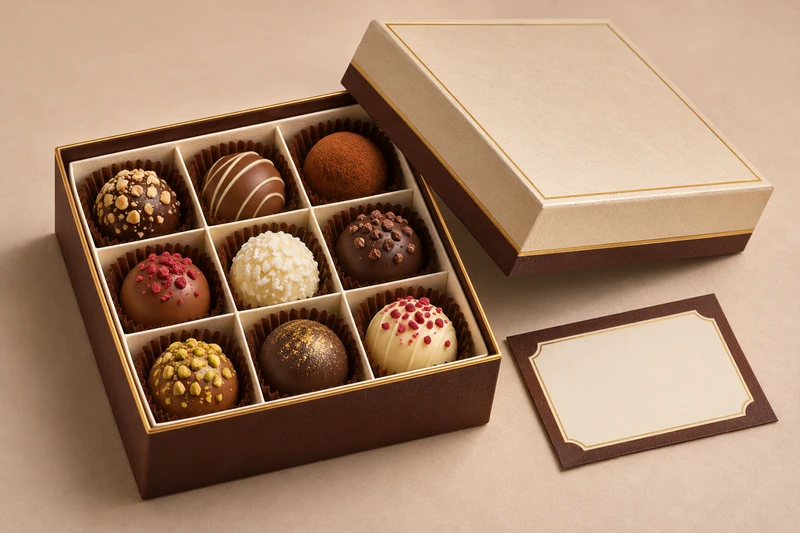
Chocolate truffle boxes need to do more than hold a set number of chocolates. For a mixed-flavour assortment, the box must give every truffle an appropriate position, make the selection easy to understand and present the gift neatly when opened. Piece count, truffle shape, cups, dividers and the contact layer should all be planned together.
For chocolatiers, retailers and gifting teams in South Africa, a well-specified truffle box can support counter presentation, seasonal gifts, online-order packing and event favours. XGolden Print designs and produces custom paper packaging boxes, including gift packaging, rigid boxes and lid-and-base boxes, with structural design, material selection, artwork support, printing, finishing, fitted inserts and sample approval available for the individual project.
The assortment determines the truffle box
Start with the chocolates, not the outer box. A mixed assortment may include round truffles, domes, squares, pralines or pieces with different toppings. Even when the chocolates appear similar in size, their height, coating, decoration and fragility can affect how they should be spaced and supported.
Chocolate truffle boxes are commonly used for:
- Mixed-flavour collections for specialist retail
- Small thank-you gifts and corporate gifting
- Seasonal or celebratory confectionery sets
- Wedding and special-event favours
- E-commerce gift orders, where the presentation box forms part of the unboxing experience
- Larger gift sets containing truffles alongside a card, tea, candle or another customer product
The assortment also influences how the recipient chooses a chocolate. A box of one flavour can use a simple repeated layout. A mixed selection may need rows, colour groupings or numbered positions so that flavours can be identified before someone opens a cup or bites into a piece.
Before selecting a structure, define whether the box is intended to be:
- A retail-facing assortment with flavour information on the outside or inside lid.
- A gift box where the opening experience, printed message and reveal of the chocolates matter.
- A component in a larger gift set that needs to coordinate with other products.
- An outer presentation box for online orders, placed inside separate transport packaging.
The paper box is a presentation and organisation layer. It is not automatically a complete transport-protection system, temperature-control solution or primary food container. The individual truffles, cups, trays, wraps and any food-contact layer must be considered separately for the actual packing and distribution arrangement.
Piece count and space around each chocolate
The number of pieces is the starting point for the cavity layout, but it should not be treated as the box capacity until the actual truffles are measured. A 9-piece layout may suit one range of chocolates and be unsuitable for another with a wider base, taller decoration or more delicate coating.
Provide dimensions for each truffle style, including the widest point and height. If the assortment has several shapes, identify the largest and tallest piece, as well as any truffle that should not touch neighbouring pieces. This helps prevent a visually neat grid from becoming too tight once the chocolates are packed.
A useful box brief records:
- Number of chocolates per box
- Dimensions and approximate weight of each chocolate type
- Number of flavours and whether each has a fixed position
- Whether all pieces use the same cup or require different cavity sizes
- Required clear space between pieces
- Whether a flavour card, tissue, ribbon or message insert sits inside the box
- Whether the box will be packed by hand or as part of a more structured packing workflow
The available internal depth matters as much as the footprint. A shallow truffle box may look refined but can press against a high garnish or transfer marks if there is insufficient clearance above the chocolates. Conversely, excessive open space can allow products to shift and make a small assortment look under-filled.
| Truffle box use | Key layout requirement | Helpful packaging option | Information to confirm |
|---|---|---|---|
| Mixed retail assortment | Clear piece positions and flavour recognition | Repeated cavities, numbered rows or an insert card | Truffle dimensions, flavour order and shelf-facing information |
| Corporate gift | Balanced presentation and brand coordination | Lid-and-base box with branded artwork and a fitted layout | Piece count, gift message and recipient handling |
| Event favour | Compact format and simple access | Small box with a defined truffle arrangement | Quantity, event artwork and packing sequence |
| E-commerce gift order | Product stability within the presentation box | Dividers or fitted inserts, plus separate transport packaging as needed | Boxed weight, outer shipping pack and delivery destination |
| Multi-product gift set | Space for truffles and companion items | Custom compartment layout or fitted insert | Dimensions and weight of every included product |
For a first production run or a new recipe range, sample approval provides an opportunity to check the physical arrangement with representative products. The final number of pieces and the cavity fit should be confirmed for the specific project rather than assumed from an image, sample style or previous box.
Cups, dividers and contact-layer requirements
Paper cups and dividers can keep truffles separate, but they do not solve every packaging requirement. Their purpose may be to position the product, reduce direct contact between pieces, support neat hand packing or create a more considered presentation. The right arrangement depends on the chocolate surface, filling, decoration and packing method.
A simple paper cup layout can work where chocolates are consistently shaped and placed carefully. Dividers may be more appropriate when rows need clear separation or when pieces could move into one another. A fitted insert can create defined spaces for a more structured gift-box layout, especially when different shapes must sit in assigned positions.
However, buyers should distinguish between:
- The outer paper box: the branded presentation structure seen by the shopper or recipient.
- The insert, divider or tray: the internal component that controls spacing and product placement.
- The primary wrap or contact layer: the part that may directly touch the chocolate or contain it.
All food-contact components, including cups, liners, inserts or other layers that may touch the chocolates, need to be specified and confirmed for the actual project. Do not assume that a paper appearance, a previous packaging format or a box style confirms food-contact suitability. Requirements can vary according to the selected materials, how the chocolates are packed and whether a separate contact layer is used.
It is also important to clarify the packing sequence. For example:
- Are chocolates placed directly into cups after production?
- Are they already wrapped or contained before going into the outer box?
- Does the packer need the cups pre-positioned and numbered?
- Will a flavour leaflet be inserted before or after the chocolates?
- Does the box need to remain open on a packing line, then close quickly for finishing?
These details affect structural design as well as the practical handling of the truffle box. They should be included in the brief before materials and internal components are finalised.
Two-piece truffle boxes and rigid chocolate presentations
A two-piece lid-and-base format gives a chocolate gift set a familiar reveal: the lid is lifted away to expose the full assortment at once. This can suit mixed truffle boxes where the layout, flavour card and presentation are all part of the gifting experience.
The LB-306 truffle lid-and-base box is a relevant style reference for a two-piece truffle presentation. A lid-and-base structure may suit an assortment that benefits from an uninterrupted view of the chocolates once opened. Actual dimensions, materials, internal layout and product fit still need confirmation against the intended truffle range.
For a more substantial presentation, a rigid format can be considered. The RB-306 fine-chocolate rigid box is a fine-chocolate rigid style reference. Rigid chocolate presentations can be useful for premium gifts, corporate selections and sets intended to be retained after opening, but the structure should be selected around the product weight, insert arrangement and intended use rather than appearance alone.
When choosing between a lid-and-base box and a rigid chocolate box, consider the following:
Opening and product access
A lift-off lid can reveal the full arrangement in one movement. This helps when flavour identification is printed inside the lid or when the assortment is designed to look like a complete collection. The lid must also be easy to remove without disturbing the chocolates or a loose insert.
Weight and internal support
The outer box should be planned around the combined product weight, not only the number of truffles. Heavier, larger or layered sets may need more considered support from the internal layout. Any proposed material and construction should be reviewed for the exact contents.
Retail display and gifting
For retail, the exterior often needs a clear product name, flavour indication, quantity statement or variant marker. For gifting, the outer surface may focus more on occasion artwork, recipient messaging or coordinated brand presentation. Both uses can be accommodated, but the information hierarchy should be agreed before artwork is prepared.
XGolden Print can support custom gift packaging planned around multiple products, coordinated branding and the intended opening experience. This is particularly useful where truffles form one part of a festive, corporate or event gift rather than the entire box contents.
Identifying mixed flavours in a gift set
A mixed truffle gift set should make flavour identification simple without taking attention away from the chocolates. The approach depends on whether the recipient needs to identify flavours before selecting a piece, after tasting it or when purchasing from a retail display.
Possible identification methods include:
- A printed flavour guide placed inside the lid
- A separate card matching each truffle position
- Numbered cavities with a corresponding flavour key
- Small printed markers on a divider or insert
- A flavour list on the base or outer sleeve
- Variant labels or stickers for seasonal and limited-edition assortments
The best method is usually the one that fits the packing process. If truffles may be arranged in different orders, a numbered layout can create confusion unless the packer follows a fixed sequence. If flavours change regularly, a replaceable insert card or label may be easier to update than printing every flavour directly onto the box.
For South African retail buyers, artwork planning may also involve deciding what needs to appear shelf-facing and what can sit inside the pack. Product name, flavour range, quantity and brand information often need a clear place in the design, while a more detailed tasting guide can remain inside for the recipient. Where local-language artwork is required for a particular sales channel or customer group, supply the approved wording and hierarchy early so it can be incorporated into the packaging artwork.
Labels and stickers can also help distinguish box variants, identify a seasonal assortment or apply a batch-specific message where appropriate. XGolden Print produces custom labels and stickers in agreed dimensions, shapes and roll or sheet formats. Confirm the intended surface, placement position, application method and box finish so the label specification suits the project.
Checking fit, packing and storage arrangements
A good-looking sample should be checked as a working truffle packaging system, not only as a visual mock-up. Test the actual product arrangement, opening sequence and packing steps with representative chocolates whenever possible.
Key checks include:
- Do all truffles sit level within their cups, divider spaces or insert cavities?
- Is there adequate clearance above decorated pieces when the lid closes?
- Can packers place each chocolate consistently without damaging its surface?
- Does the flavour guide correspond exactly to the final layout?
- Do cups, dividers and inserts remain in position during ordinary handling?
- Is the box comfortable to open without dislodging the contents?
- Does the completed gift box fit the planned outer transport packaging?
- Are storage conditions and any product-specific handling needs managed by the confectionery brand’s own process?
Avoid treating a presentation box as the sole protection for an online order. The truffle box may need a separate outer shipping carton and suitable protective packing around it, selected according to the full packed item and delivery route. This keeps the branded gift presentation distinct from the transport-protection arrangement.
Material choices, finishes, inserts, quantities, sample terms, pricing and production schedules all need to be confirmed for the individual project. XGolden Print has 27 years of experience in custom paper packaging and can support the process from structural design and artwork through to sample approval and production.
To discuss custom chocolate truffle boxes, share your truffle dimensions and piece count, product weight, preferred layout, artwork, quantity, required delivery date and destination. Explore custom box options with XGolden Print for a packaging brief built around your actual assortment.
