
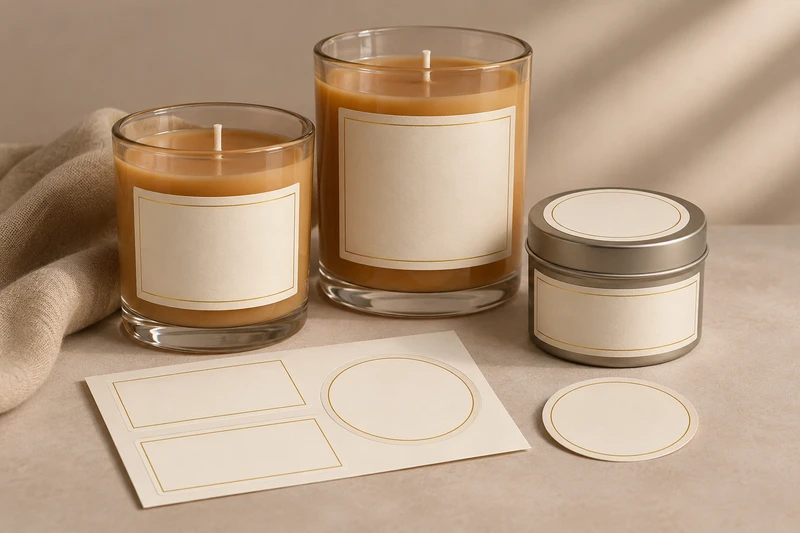
Candle label sizes should be chosen from the usable surface of the actual jar or tin, not from a standard template. Measure the container where the label will sit, allow for curves, seams and raised details, then reserve space for your approved product information.
For candle brands and packaging buyers in South Africa, a clear label plan helps keep retail shelves, gift sets, online orders and event favours consistent across fragrance variants. XGolden Print designs and produces custom labels and stickers for jars, bottles, boxes and bags, with dimensions, shapes and roll or sheet formats agreed for each project.
Start with the usable area on the candle container
The usable label area is the smooth, accessible part of the candle container where a label can sit without crossing a curve that distorts the artwork, a mould line, a handle, a raised logo or the base edge. It is usually smaller than the container’s overall width or height.
Start by identifying the label positions you need:
- Front label: usually carries the brand, candle name and scent.
- Back label: can hold approved product details, care copy or a barcode.
- Lid label: gives a top-down view when candles are stacked or displayed in a gift box.
- Base label: keeps supporting information out of the main display area.
- Wrap label: may cover much of the container circumference, but needs careful seam planning.
For a straight-sided candle jar, measure the height of the smooth sidewall available for the label. Then measure the circumference at the same height. A front label normally uses only part of this circumference, leaving the rest of the jar visually open. A full-wrap label needs a defined start and finish point so that important copy does not disappear into the join.
For curved or shouldered jars, measure at the exact height where the label will be applied. The diameter can change significantly from the middle of the jar to the shoulder or lower edge. A label that looks balanced on a flat digital layout may wrinkle, lift or appear uneven if it crosses a sharply changing curve.
For tapered candle jars, take measurements at both the top and bottom edges of the planned label position. If those measurements differ, a rectangular label may not follow the surface neatly. The artwork, label shape and application position should be reviewed on a physical sample rather than assumed from a product photograph.
What to measure before specifying candle label sizes
Provide the following information in your packaging brief:
- Container height and widest diameter.
- Diameter or circumference at the intended label height.
- Height of the smooth side panel.
- Position of seams, embossed details, handles, feet or moulded marks.
- Lid diameter and any recessed or raised lid area.
- Base diameter and the available flat area underneath.
- Whether the jar is straight, curved, tapered, faceted or irregular.
- Whether the candle is sold individually, in a box, as part of a set or as an event favour.
Photographs with a ruler or dimensioned technical drawing can help show the container shape, but an actual container sample is the most reliable reference for confirming placement.
Front-label size on straight and curved jars
A front label should be large enough to identify the candle from a normal shopping distance, while leaving the jar shape visible and avoiding crowded copy. For many candle ranges, the front label is the main shelf-facing panel, especially when jars are placed side by side in retail displays or photographed for an online listing.
On a straight jar, a rectangular front label is often straightforward to position because the sidewall remains consistent. The final width should reflect the visible front panel, not simply the full circumference. A label that extends too far towards the sides can make a rounded container look visually busy and may place text outside the most readable viewing angle.
On a curved jar, reduce the risk of distorted presentation by keeping critical artwork—such as the logo, scent name and variant colour—within the most forward-facing area. Fine text, borders and small icons need more care near the left and right edges because they may curve away from view.
For a tapered container, consider whether the label should follow the taper as a custom shape or whether a smaller centred front label is more appropriate. This is a design and sample decision, not something to settle from generic candle label dimensions.
Choosing a readable front-label hierarchy
The front of a candle label usually works best when it answers the shopper’s first questions quickly:
- Who made it? Brand name or logo.
- What is it? Candle type or collection.
- Which variant is it? Scent, fragrance name or edition.
- What makes it distinct? A restrained supporting line, where appropriate.
Avoid treating every available surface as a place for copy. When a candle comes in several scents, a clear scent name and consistent label structure can make variants easier to distinguish in a shop, gift set or e-commerce fulfilment workflow.
If your range uses local-language artwork, decide early whether one label design will carry multiple languages or whether separate label versions are required. This affects the available space, artwork management and the way variants are packed for application.
Lid and base labels have different jobs
Lid and base labels serve different purposes from front labels. Their size and layout should follow how the candle is handled, stacked, photographed and presented.
A lid label is useful where customers view candles from above—for example, on retail tables, in open gift boxes, in a drawer box or when several candle jars are arranged together. It can repeat the scent name, show a collection identifier or provide a simplified brand mark. The lid design should be planned around the available flat or recessed circle rather than the lid’s outside edge alone.
A base label is generally better suited to supporting information that does not need to dominate the front presentation. This might include approved product identifiers, variant details, barcodes, care information, batch references or other information supplied by the brand. Keep the layout clear enough for staff and customers to read when the jar is lifted.
| Candle application | Most useful label position | Main packaging requirement | Point to confirm |
|---|---|---|---|
| Single retail candle jar | Front and base | Clear shelf-facing brand and scent identification | Usable sidewall and base area |
| Candle gift set | Front and lid | Easy recognition when jars are arranged in a box | Lid visibility and coordinated variant artwork |
| Online candle order | Front and base | Product identification that remains clear in listing photography and fulfilment | Barcode location and packing workflow |
| Wedding or event candle favour | Front or lid | Compact branding, names, dates or event artwork | Final guest-facing design and application quantity |
| Candle tin | Lid and/or side | Layout suited to the tin’s profile and closure | Tin surface, label position and sample confirmation |
A lid label should not be assumed to replace a front label. When jars are displayed on a shelf at eye level, the front is usually more visible. When they are arranged flat in a hamper or gift box, the lid may become the first point of recognition.
Likewise, base labels should not carry information that must be immediately visible to a customer before purchase. Decide what needs to be seen first, what should remain accessible after purchase, and what is primarily for internal stock identification.
Arranging scent names and approved product details
A candle label layout needs a deliberate division between branding and approved product information. The brand should supply the final wording, languages, symbols, ingredient-related statements, warnings, identifiers and other content required for its product. XGolden Print can support artwork preparation, but does not determine what product information is legally required for a candle.
For the front label, place the scent name where it can be found quickly. Long fragrance names may need a different typographic treatment from short names, particularly if the range includes several variants. Test the longest scent name first so the collection does not become inconsistent when a future fragrance has more words.
For the back or base label, organise supplied content in clear groups rather than a dense block of small text. Typical groups may include:
- Product or collection name
- Scent or variant name
- Brand-approved candle details
- Brand-approved care or use information
- Barcode and internal stock reference
- Batch or production fields where the brand requires them
- Website, social or contact information supplied by the brand
Leave practical clearance around barcodes, small type and the outer label edge. Do not place essential copy across a container seam, deep curve, lid rim or textured area. If labels will be applied by hand, a simple alignment reference in the application workflow can also help staff keep the front label centred across a production run.
Avoid these common candle label layout mistakes
- Designing to the jar’s overall dimensions instead of the smooth label panel.
- Using a full-wrap layout without deciding where the seam will fall.
- Placing fine borders too close to a curved edge.
- Treating a lid diameter as a guaranteed printable circle without checking the actual lid surface.
- Adding required copy late, after the front label has already been approved.
- Assuming one label size will suit every jar, tin and candle vessel in a range.
- Ordering labels before confirming how the team will apply, pack and inspect them.
For candle tins, sample confirmation is particularly important. Tin profiles, edges, lids and surface finishes can differ, so label shape, position and suitability should be confirmed against the individual tin application.
The LS-322 candle-jar label style
For a focused candle-jar label reference, see the LS-322 candle-jar label style. It is a useful starting point when considering a label application for candle jars, but it should not be treated as a preset size or universal solution.
The final label dimensions still depend on the selected jar, the available flat or curved panel, artwork density and where the label must sit. A front label for a short, wide jar may need a very different proportion from one for a tall vessel, even when both candles belong to the same brand range.
XGolden Print can support the practical development of the label brief through:
- Structural and label-format planning around the container.
- Material selection for the intended application, subject to project confirmation.
- Artwork support for the agreed label size and shape.
- Custom dimensions and shapes.
- Roll or sheet formats agreed for your application method.
- Sample approval before production.
If the candle will also be sold in a rigid gift box, magnetic closure box, drawer box or lid-and-base box, plan the label and outer packaging together. The label identifies the primary container—the jar or tin—while the box supports retail presentation, gifting and product arrangement. A presentation box is not automatically a complete transport-protection system; outer shipping protection should be considered separately for courier or fulfilment use.
Checking placement, adhesion and legibility on a sample
A sample check is where a candle label layout becomes a practical packaging specification. It lets the brand assess the real container, not only the artwork file.
Review the sample in the same way the candle will be sold and handled:
- Place the jar or tin upright on a shelf and view the front label.
- Turn it through a full rotation to see whether copy becomes hard to read around the sides.
- Check the lid label with the container closed and when grouped with other candles.
- Inspect the base label while holding the jar normally.
- Confirm that the intended label position does not conflict with seams, curves, ridges or closure edges.
- Check that scent names, product variants and supplied information remain legible.
- Review label alignment against the intended application method.
- Test the sample within any gift box, insert or outer packaging planned for the candle.
Adhesion and material suitability need to be assessed against the actual container surface and use conditions. Glass, coated jars, textured vessels and tins can each require different decisions. Heat exposure, oils, moisture, handling conditions and storage environments should be described in the brief rather than assumed. XGolden Print can confirm the appropriate material and project requirements with you, but no general label construction should be treated as suitable for every candle application without review.
A sample also helps identify whether the label application should be supplied on rolls or sheets. The right format depends on the label size, the number of variants, the application workflow and whether labels are applied individually by hand or through an agreed process.
Prepare a clearer candle label brief
Before requesting pricing or production guidance, prepare one brief for each container type. Include:
- Jar or tin sample, or complete measurements and photographs.
- Candle label sizes being considered for front, lid, base and back positions.
- Quantity by scent, size and artwork version.
- Label shape and preferred roll or sheet format.
- Final or draft artwork, including all approved text.
- Intended use conditions and expected handling.
- Whether the candle is sold alone, in a gift set, online or for an event.
- Any related box, insert or presentation packaging requirements.
- Required delivery date and destination.
For broader options across jars, boxes, bags and other packaging surfaces, explore XGolden Print’s custom stickers and labels. Share your candle container dimensions, quantity, artwork, required delivery date and destination with XGolden Print to discuss a label format suited to your specific project.
