
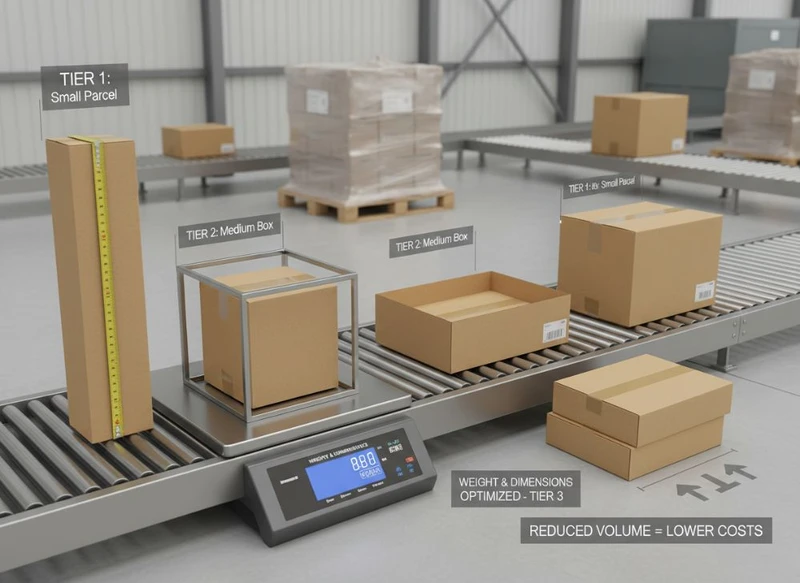
Custom paper box packaging can lower shipping costs by reducing parcel size, limiting unnecessary weight, protecting products more effectively and improving handling in the fulfilment process. The biggest savings usually come from matching the box closely to the product rather than simply choosing the cheapest board or the smallest possible carton.
For South African businesses, where delivery costs can be sensitive to both mass and parcel dimensions, packaging should be assessed as part of the total landed cost. That means considering box material, packing time, void fill, damage risk, storage space and return requirements—not only the unit price of the box.
Optimising Dimensions to Meet Carrier Tiers
A right-sized box is often the most direct way to reduce shipping expenditure. Many shipping services use dimensional weight or size bands alongside actual mass. A lightweight parcel can therefore cost more than expected if it occupies too much space.
Custom packaging allows you to specify internal dimensions around the actual packed product, including any necessary protective layer. Reducing excess length, width or height may lower the parcel’s dimensional rating and can also allow more parcels to fit into a delivery vehicle or fulfilment cage.
Before finalising a dieline, measure the product in its complete shipping configuration:
- Product length, width and height at its widest points
- Protective wrap, tissue, sleeves or inserts
- Product movement tolerance inside the box
- Sealing method and the space taken up by closure flaps
- Any bundled items, instructions or promotional inserts
- The external dimensions after the box is assembled
Avoid designing only around product dimensions
A common mistake is to create a box with internal measurements exactly equal to the product size. This can make packing slow, place pressure on corners and create inconsistent closure. Instead, allow a controlled clearance that suits the product and its protective needs.
For example, a robust folded garment may need very little extra room, while a glass jar, electronic item or framed product needs carefully planned protection. The goal is not the tightest fit at all costs; it is the smallest reliable shipping format.
Check the packaged parcel, not the flat layout
A packaging supplier may work from a flat dieline, but transport charges are based on the assembled parcel. Ask for a physical sample or prototype where possible, then measure and weigh the finished pack. Confirm the current size and mass rules with the delivery services you use, as these commercial terms can change.
Choosing Lightweight Yet Durable Paper Stock
Lower box weight can help reduce shipping costs, particularly for products close to a weight threshold. However, using the lightest available paper stock is not automatically economical. If the board crushes, splits or deforms in transit, any saving on material or postage can quickly be outweighed by replacement, refund and customer-service costs.
The practical choice is the lightest stock that reliably supports the product and its transport journey.
Paper packaging options vary in construction and suitability. Folding carton board can work well for many lightweight retail, beauty, food-adjacent and gift products. Corrugated board provides greater stiffness and cushioning for heavier, fragile or larger items. The required grade, flute profile, coating and finish should be selected according to the product’s mass, shape, stacking conditions and exposure to handling.
| Packaging need | Suitable design approach | Shipping-cost consideration |
|---|---|---|
| Lightweight, non-fragile goods | Compact folding carton with simple closure | Minimises material mass and bulk |
| Premium gift items | Folding carton with a fitted insert | Controls movement without excessive loose fill |
| Heavier products | Appropriately specified corrugated box | May prevent costly damage despite a higher box mass |
| Fragile products | Corrugated outer box with purpose-designed internal support | Reduces movement and repeat shipments |
| Products affected by moisture or scuffing | Protective finish or suitable outer wrap where needed | Confirm whether the added layer is necessary and compatible |
Balance board weight against structural design
Strength does not come from paper weight alone. A well-designed box with appropriate folds, locking tabs, double-wall areas or internal supports can perform better than a heavier but poorly structured carton.
When comparing quotations, ask suppliers to distinguish between:
- Board or corrugated material type
- Box style and closure method
- Internal fitments or inserts
- Printed finish and protective coatings
- Flat-packed versus assembled supply
- Minimum order quantity and lead-time assumptions
This makes it easier to compare total packaging value rather than selecting on a single material description.
The Role of Fit in Minimising Void Fill
Void fill protects products by limiting movement, but it adds material, packing time and often parcel volume. A box with excessive empty space may require paper, cushioning, air pillows or other fillers that make the shipment bulkier and less efficient.
A custom-fitted paper box can reduce or remove the need for loose void fill by holding the product in a predictable position. Depending on the item, this can be achieved with:
- Folded paper inserts
- Die-cut card dividers
- Product sleeves
- Locking tabs
- Pulp or paper-based protective components
- Multi-compartment layouts for sets or bundles
For a gift set, for instance, a single fitted insert can keep each item in place while creating a more considered unboxing experience. This may be more efficient than placing several loose products in an oversized box with large volumes of filler.
Do not eliminate protection blindly
Less void fill is beneficial only when the product remains adequately protected. Fragile products still need enough shock absorption and separation from box walls. Test the final pack through your normal handling process before rolling it out widely.
Also consider variability. If a box will hold several product versions, a universal design may create too much unused space for smaller SKUs. In that situation, separate box sizes, adjustable inserts or a modular pack system may be more economical.
Reducing Damage Rates with Stronger Boxes
Shipping costs include more than the amount paid to send a parcel. Damaged deliveries can create additional costs through replacement stock, extra packaging, reshipping, refunds, returns processing and lost customer confidence.
A stronger box can lower these indirect shipping costs when it is correctly matched to the item and transport conditions. Strength should be considered at the points where packages are most likely to fail:
- Corners and edges
- Closure flaps and adhesive areas
- Areas carrying product weight
- Points where products can strike each other
- Box walls exposed to compression during stacking
- Areas weakened by handles, windows or cut-outs
Build protection into the box design
Instead of increasing all material specifications, reinforce the parts of the pack that need it. A product may benefit from a locking base, reinforced corners, an internal cradle or a divider more than it would from a generally heavier board.
This is especially relevant for products with concentrated weight, such as bottles, jars, tools, hardware or items with sharp edges. A box that appears strong when empty may not perform well once that weight shifts during handling.
Consider the full distribution journey
Assess how the package will move from your premises to the customer. A retail-ready carton placed inside an outer shipping box has different requirements from a single box shipped directly to a consumer.
Consider likely exposure to:
- Repeated handling and transfer between vehicles
- Stacking and compression
- Vibration during road transport
- Warm, humid or wet conditions
- Manual picking and packing
- Returns from customers
Where your product is sensitive to moisture, compression or abrasion, confirm that the selected material and any finish are appropriate for those conditions. Packaging requirements and applicable standards vary by product category, so verify relevant local requirements before production.
Flat-Packed Paper Boxes for Storage Savings
Flat-packed paper boxes can reduce the storage footprint of empty packaging before use. This matters for businesses that hold multiple packaging sizes, seasonal gift boxes or high volumes of e-commerce cartons.
Because boxes are supplied unassembled, more units can generally be stored in the same area than pre-erected cartons. This can reduce warehouse congestion and make it easier to keep a practical buffer of packaging on hand.
Flat-packed supply can also offer handling advantages:
- Less space used in stock rooms and packing areas
- Easier separation of different box sizes and designs
- Lower risk of empty boxes being crushed before use
- More efficient replenishment to packing benches
The trade-off is assembly time. A complex box that is difficult to fold or close can slow fulfilment and offset storage savings. For high-volume operations, choose box styles that are quick to erect consistently, or evaluate whether pre-glued or auto-locking formats are justified.
Negotiating Bulk Rates with Packaging Suppliers
Ordering in larger volumes can reduce the unit cost of custom packaging, but bulk purchasing should be based on realistic demand. Ordering too many cartons simply transfers cost into storage, handling and potential obsolescence.
A sensible approach is to balance unit pricing against the practical cost of carrying stock. Consider how often artwork changes, whether product dimensions are stable and whether the packaging will be used across more than one SKU.
When requesting packaging quotations, provide a clear brief that includes:
- Finished internal and external dimensions
- Product mass and fragility
- Required box style and closure
- Printing requirements and artwork status
- Whether inserts, dividers or labels are needed
- Estimated order quantities and call-off needs
- Flat-packed or assembled preference
- Any intended packing method or automation
Ask for tiered pricing at several realistic order quantities. This helps procurement teams identify the point where a lower unit rate is outweighed by additional inventory holding.
For businesses developing branded mailers, product cartons or retail packs, reviewing custom box packaging options alongside the shipping specification can prevent a visually attractive design from becoming an inefficient parcel format.
Look beyond the box price
A lower-cost box may require extra tape, void fill, labour or outer protection. Compare the full packed cost per order:
- Box and insert cost
- Printing and finishing cost
- Void fill and sealing materials
- Packing time
- Storage and handling
- Shipping impact from packed dimensions and mass
- Expected cost of damage, returns or rework
This comparison gives a more useful basis for supplier discussions than unit price alone.
Designing Boxes for Automated Fulfilment
Packaging design can affect how efficiently orders move through a fulfilment operation. Even where packing is mainly manual, a box that opens, fills and closes easily can reduce labour time and inconsistency.
For operations using conveyors, label applicators, scanners, automated taping or other equipment, dimensions and surfaces should be compatible with the process. A box that is too flexible, irregularly shaped or difficult to orient may cause delays or require extra manual handling.
Features that support efficient packing
Consider design features such as:
- Self-locking bases that reduce taping
- Consistent panel surfaces for shipping labels
- Clear orientation marks for packers
- Easy-open but secure closures
- Standardised box footprints across related products
- Inserts that can be placed in one motion
- Minimal loose components
A dedicated label area can prevent barcodes or address labels from being applied across seams, folds or textured finishes. If you use branded seals or item-identification labels, custom printed stickers can be specified to suit the available panel space and packing workflow.
Validate with the people packing orders
Packaging teams often identify practical problems that are not obvious in a design proof. Before committing to a large run, ask packers to assemble, fill, seal and label sample boxes using the normal process. Watch for slow folds, unclear orientation, loose inserts and label-placement issues.
Reusable and Returnable Packaging Solutions
Reusable or returnable paper packaging may reduce costs for some business models, but it is not suitable for every product or delivery route. It is most relevant where goods move repeatedly between known locations, customers return containers as part of an established process, or packaging is designed to have a second use.
A stronger reusable box may cost more initially. The commercial case depends on whether it can be returned, inspected and used again without creating excessive transport, cleaning or administration costs.
Before adopting a returnable approach, assess:
- Whether customers have a convenient way to return the packaging
- The likelihood of boxes coming back in reusable condition
- Reverse-logistics costs and handling requirements
- Hygiene or product-category requirements
- Whether customer data can be removed or covered securely
- How many reuse cycles are realistically achievable
- Whether a recyclable single-use option is more practical
For premium presentation, a reusable format may work well for selected products, especially when the box is designed as part of the gift itself. Explore gift packaging formats where presentation, product protection and practical parcel dimensions need to work together.
A Practical Checklist Before Ordering Custom Boxes
Use this checklist to assess whether a custom paper box is likely to reduce your shipping cost:
- Measure the finished packed parcel, not just the product.
- Compare actual mass and dimensional rating with your current shipping terms.
- Remove unnecessary air space without compromising protection.
- Select board and structure for the product’s real handling conditions.
- Calculate the cost of void fill, tape and packing labour.
- Check whether the box can be assembled quickly and consistently.
- Confirm label placement, barcode readability and closure security.
- Test samples with representative products before placing a full order.
- Order quantities that balance unit cost with storage and product-change risk.
- Review damage, return and reshipment patterns after implementation.
Custom packaging is most effective when it is treated as an operational tool, not just a branding surface. A box that is slightly better fitted, easier to pack and more protective can reduce several small costs across each order.
When you are ready to develop a specification, start with the product dimensions, packed weight, handling risks and target parcel size. XGolden Print can then be considered as one option for custom packaging and printing, with box structure and quantities assessed against your practical requirements.
